
Due to the rainy weather over the past two weeks, we are still planting full-season soybean in some areas. In addition, it appears that wheat harvest is not far off (some wheat at the Tidewater AREC was at 23% moisture today!). So, should we be increasing our seeding rates?
In general, yes. But, big increases probably will not be needed until late-June. Below are some seeding rate data that we collected from soybean 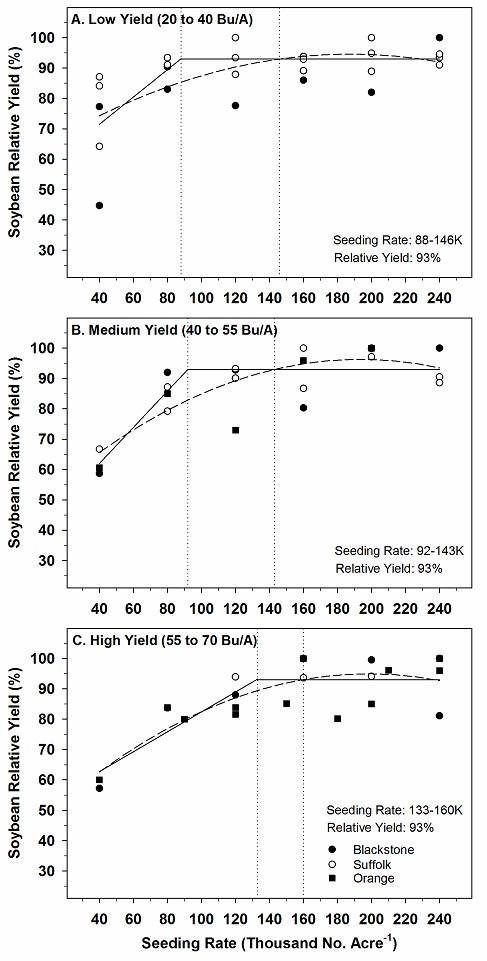 planted in early-June after barley. First, we don’t have a lot of data of soybean grown after barley, so I don’t have as much confidence in the exact seeding rate needed. Note that there is a wide range in the optimal seeding rates, illustrated by the area between the dotted lines in the graph. Although, these data may not directly apply to full-season soybean (no small grain), it should be close.
I think that we should now be using 120,000 to 160,000 seed/acre. The range will depend on the planting date. In general, I’d suggest bumping up your seeding by 20-30,000 seed/acre per week through June.
If you remember the seeding rate data that I shared in this blog last month for May-planted soybean (see Soybean Seeding Rates – How Low Can We Go?), I stated that maximum yields could be obtained with only 95,000 to 110,000 seed/acre when the yield potential is greater than 40 bushels/acre. That’s pretty low, but was adequate for maximum yield under good growth conditions. For less than 40 bushel potential, seeding rates needed to be a little higher. In the above graph, it appears that more seed is needed to obtain 55 to 70 bushels/acre after barley, I cannot fully explain why; therefore, I would assume that this response is primarily due to the location that we obtained the data (again, we don’t have a lot of data).
Once we get into mid- to late-June, I’d rather see a seeding rate of 180,000 to 220,000 seed/acre, depending on planting date. This is based on the data to the right. You’ll notice that, like full-season soybean, the optimal seeding rate falls with greater yields. This is most likely due to greater leaf area with those high-yielding locations. As I’ve stated often, the seeding rate response can usually be traced back to whether or not the crop developed enough leaf area to capture 90-95% of the light by early pod development. Unfortunately, I don’t have any double-crop data planted following wheat with yields greater than 55 bushels/acre. I hope to solve that problem this year with new experiments.


 Small grains are maturing rapidly and soybean planting will soon follow. While there is little benefit to having more than 70 to 80 thousand uniformly-spaced soybean plants per acre when planted in May, more plants will be needed to maximize yield potential as planting date is delayed later into June. My general seeding rate recommendations (seed per foot, depending on row spacing) are listed in the table below.

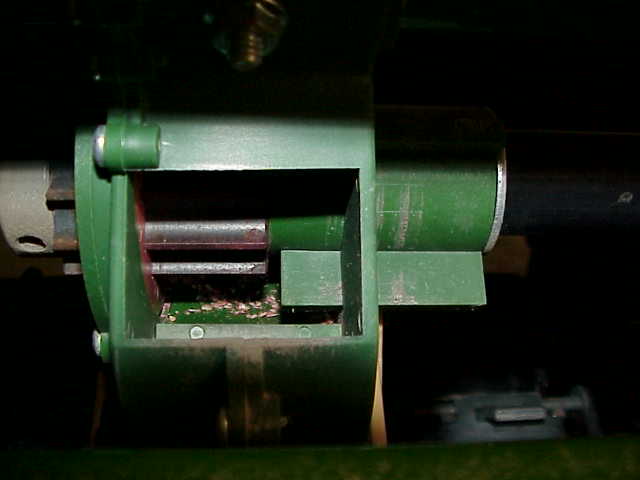 and this seed then bounces to and fro within a long tube (this is sometimes referred to as a “controlled spill”). Without a metering system near the disk opener, this will result in a stand that is far from being uniform – it’s over-planted in some areas, it’s under-planted in others). Therefore, I lean towards the higher seeding rates with planted with a drill that does not meter the seed.