Author Archives: doughiggins

Managing Fusarium Head Blight Risk as Drought Accelerates Wheat Development in Virginia

Update: 4/20/2026. Drought conditions remain moderate to severe across much of Virginia. Although a weather system moved through the state on April 19, most major small grain production areas received little rainfall (<0.1 inch). Combined with the warm temperatures observed last week, these dry conditions are accelerating winter wheat development. Much of the wheat in the Northern Neck, Middle Peninsula, and Eastern Shore has headed or is approaching heading, and some fields have started flowering.

As of April 20, 2026, the risk of Fusarium Head Blight is low across most production regions, although pockets of moderate risk remain. Fields planted no-till into corn residue are at greater risk, especially when susceptible varieties were used. Growers with susceptible wheat planted into no-till corn stubble may still benefit from a timely fungicide application.

Because heat and drought can move wheat through growth stages more quickly than expected, scout fields frequently so fungicides can still be applied at the correct stage, Feekes 10.5.1 (beginning flowering).

–Douglas S. Higgins, Plant Pathologist, Virginia Tech Eastern Shore Agriculture Research and Extension Center
Wheat Growth Stages and Scab Management Update – April 25, 2025

Douglas S. Higgins, Assistant Professor and Extension Specialist, Virginia Tech Eastern Shore Agriculture Research and Extension Center

In Virginia, wheat is currently at varying growth stages across the state. Many fields are at the boot stage (Feekes 9) or beginning to head (Feekes 10.1 to 10.3), while in some areas and in early-maturing varieties heads are fully emerged (Feekes 10.5).

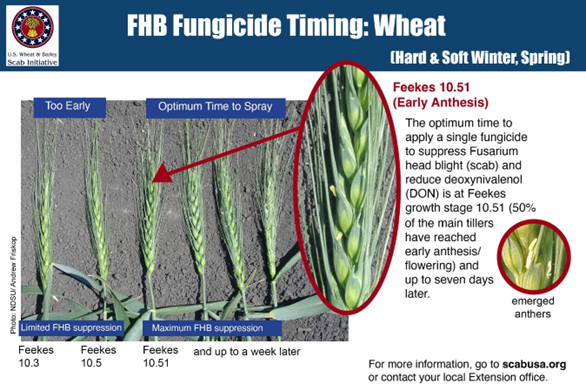
For those choosing to make a fungicide application, the optimal timing for managing scab is at early flowering (Feekes 10.5.1) and up to seven days afterward (see figure below). Reminder: Do not use products that contain strobilurins (FRAC 11) to manage scab.  

Warm, humid, and wet conditions leading up to and during flowering favor infection by the scab-pathogen. As of April 25, 2025, conditions in Virginia are not favorable for disease development in flowering wheat. However, for fields expected to flower in the coming days or weeks, monitor your local weather closely and consult the Fusarium Risk Tool (https://www.wheatscab.psu.edu/) for updates on disease-conducive conditions.