As many are aware, a new pest of cotton rapidly spread throughout the southeast in 2025. The cotton jassid (Two-spot Cotton Leafhopper) was first identified in Florida in late 2024, and by the end of the 2025 season was confirmed as far north as Northhampton county, North Carolina. It was not identified in Virginia in 2025, but we do not know what the population will do in 2026. Aggressive monitoring for this pest is a critical first step in managing this pest when (or hopefully if) it does arrive in Virginia cotton. This is a tiny insect (~2 mm in length), light green, and has two very distinctive black spots on the tips of its wings. There are native insects that are very similar in appearance, but do not have these two spots. Look on the underside of potential host plants to scout.
The cotton jassid (two-spot cotton leafhopper)
This pest has a wide host range including cotton, specialty crops like okra and eggplant, and ornamental hibiscus (to name a few preferred/common hosts). If you have any of these plants in your yard, home garden, or you grow cotton and notice any hopperburn symptoms, please contact me as soon as possible so we can scout. Hopper burn appears as yellowing around the leaf margins, and can progress to dark red/brown and senescence on margins of affected leaves. You will likely notice injury before you notice the insect, so this is a good way to scout as well.
Cotton jassid injury in cotton
At winter meetings we distributed packages of okra seed to our stakeholders to use as sentinel monitoring plots in home gardens. If you would like a packet of seed to contribute to this effort, we still have some. This article has additional details about what the pest looks like, scouting, damage, and how you can contribute to the monitoring effort.
With a good rain today (Thursday May 7), now is a good time to consider your plan for thrips management in cotton and peanuts for 2026.
The first step is to consider how your planting date affects your thrips management, using the thrips risk predictor tool from NC State. This tool forecasts the risk of heavy thrips injury to cotton, specific to a given location and target plant date. An example output from the tool at the Tidewater AREC in Suffolk can be seen below. Because the model uses local weather data, the closer to planting you are when you check, the more accurate the model will be. In this example, the model looks very different than when it was checked prior to today’s weather. It will also change significantly for different locations, so it is worth your time to enter your own information. As of May 7, for the Tidewater AREC, cotton planted between 5/9 and 5/12 will be at elevated risk for thrips injury.
Cotton planted into the high risk windows may benefit from the addition of an in-furrow insecticide targeting thrips. You can also recheck the model after planting to target your scouting efforts and determine the need for foliar insecticides. In the above example, if we had planted cotton on 4/29, we would be monitoring it carefully for thrips injury as it emerges and grows. The most consistent economic return on a foliar thrips spray will come from an application just as the first true leaf is visible. The thrips risk model also generates an optimal spray date, as indicated by the red dot on the figure below. This is an underutilized feature of the tool, and we are testing the value of this model output in the 2026 season.
This tool is specifically designed for cotton, but planting date also has an impact on thrips in peanut. In 2025, we found significantly higher thrips pressure and tomato spotted wilt virus incidence in early planted (late April) peanuts relative to mid or late may. Imidacloprid (Admire Pro) in furrow at planting can provide some thrips suppression, but efficacy has decreased over time, and it is likely insufficient for high-risk scenarios. There are other at-plant options including AgLogic and Thimet, but they are more expensive. We are generating more extensive efficacy data for all at-plant options in 2026. For earlier planted peanuts, scout carefully to determine the need for a foliar application in addition to at-plant insecticides.
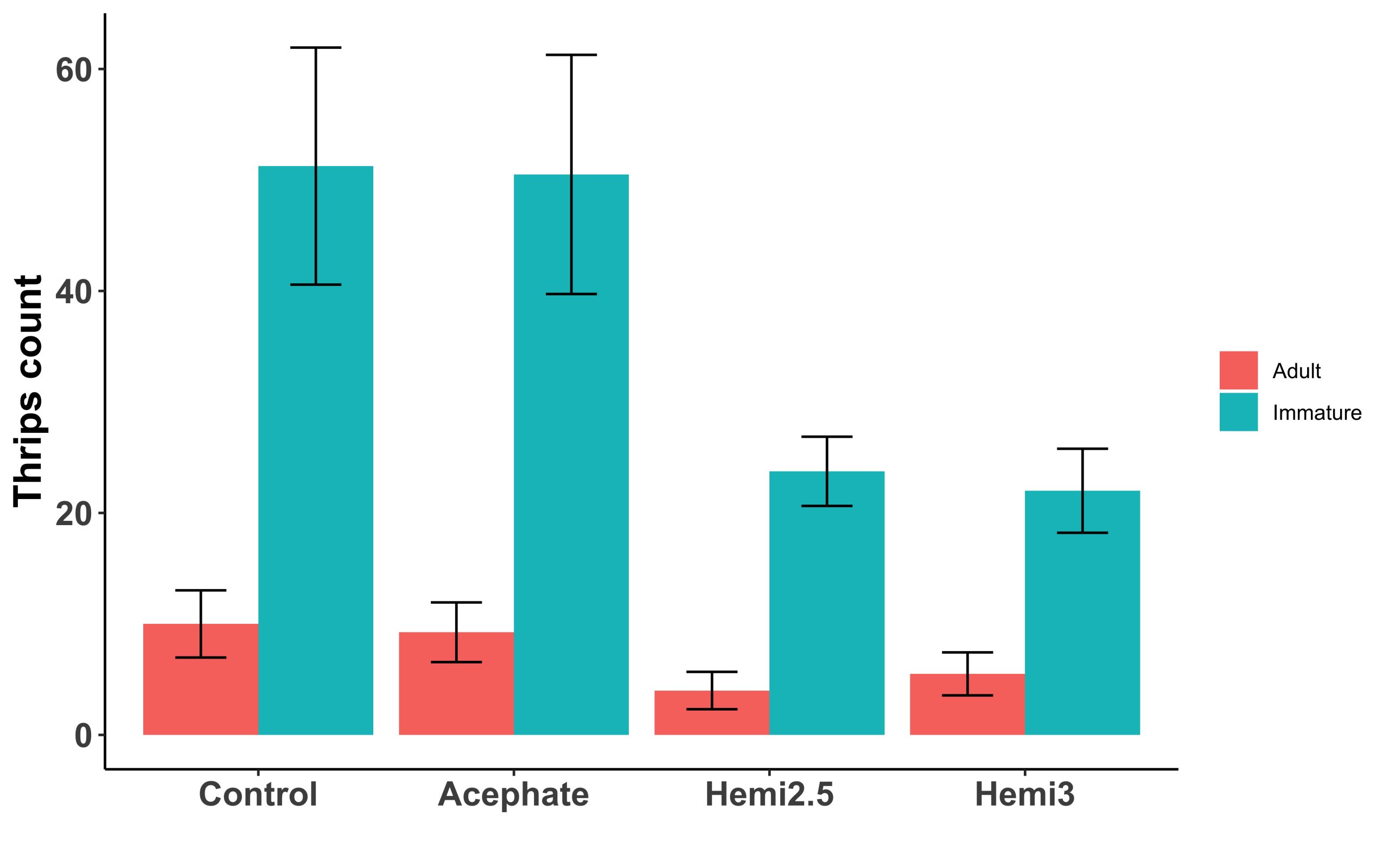
The next thing to consider is what insecticide to use, if a foliar application is made. In 2025, we identified tobacco thrips populations with reduced susceptibility to Acephate in Virginia (~ 75-79% mortality on average). We are continuing to monitor this situation in 2026. Hemi SC provides excellent control for both tobacco thrips and western flower thrips and is a viable alternative. This product must be applied either in combination with an herbicide or with a non-ionic surfactant to achieve good control. For peanut, Exirel (cyantraniliprole) can provide good control as a foliar application.
One additional consideration for foliar management are differences in species composition. Western flower thrips have histroically been more difficult to manage with acephate. In 2025, we had a higher proportion of western flower thrips in cotton than usual. Look out for future updates on species composition for 2026.
Update: 4/20/2026. Drought conditions remain moderate to severe across much of Virginia. Although a weather system moved through the state on April 19, most major small grain production areas received little rainfall (<0.1 inch). Combined with the warm temperatures observed last week, these dry conditions are accelerating winter wheat development. Much of the wheat in the Northern Neck, Middle Peninsula, and Eastern Shore has headed or is approaching heading, and some fields have started flowering.
As of April 20, 2026, the risk of Fusarium Head Blight is low across most production regions, although pockets of moderate risk remain. Fields planted no-till into corn residue are at greater risk, especially when susceptible varieties were used. Growers with susceptible wheat planted into no-till corn stubble may still benefit from a timely fungicide application.
Because heat and drought can move wheat through growth stages more quickly than expected, scout fields frequently so fungicides can still be applied at the correct stage, Feekes 10.5.1 (beginning flowering).
–Douglas S. Higgins, Plant Pathologist, Virginia Tech Eastern Shore Agriculture Research and Extension Center
Recently, soybean aphids have been confirmed at higher populations than typically expected in August. While many folks are scouting for worms and stinkbugs, we also recommend looking for aphids in your soybean fields as well. The key variables to consider regarding managing soybean aphids are the number of aphids per plant and the soybean growth stage. Information from our Pest Management Guide on Soybean Aphids in summary including info on thresholds and sampling are as follows (VCE Field Crops PMG, Publication 456-016):
Number of aphids per soybean plant
The current economic threshold for aphids is an average of 250 aphids per plant, on two consecutive field visits spaced about 5-7 days apart. This is because aphid populations can “crash” quickly due to heavy pressure by natural enemies like lady beetles, parasitic wasps, and fungal diseases. When scouting, choose a “Z” or “W” shaped pattern to cover the entire field and sample at least 20 to 30 plants per field by examining the entire plant, including stems and upper and lower leaf surfaces. Use the aphid/plant average for determining the need for treatment.
The soybean growth stage
The threshold of 250 aphids per plant applies to soybeans through the R5 growth stage (3 mm long seed in the pod at one of the four uppermost nodes on the main stem), after which time plants can tolerate 1,000+ aphids with no threat to yield. If an insecticide is applied for aphids, pyrethroids (e.g. bifenthrin, Warrior II, Mustang Max, etc.) can be effective for management, but choosing a more selective insecticide can preserve natural enemy populations and limit future flare ups of aphids or other pests.
Carrie Ortel, Extension Soybean Agronomist, Virginia Tech Tidewater AREC
Mark Reiter, Soils and Nutrient Management Extension Specialist, Virginia Tech Eastern Shore AREC
Joseph Haymaker, Postdoctoral Associate, Virginia Tech Eastern Shore AREC
Many of the full-season soybean fields in Virginia are beginning to flower, which is a great time to start tissue testing if there is a concern for crop nutrition. Tissue testing is an effective way to monitor crop nutrition when done correctly. To get reliable results, choose the correct, uppermost fully expanded soybean leaf during optimal conditions and carefully interpret the results. Tissue testing may begin as early as V4 but is most reliable during flowering and can continue through pod filling.
Step 1: Plan Your Sampling During Good Field Conditions
Time It Right – Field Conditions Matter
Field conditions at sampling time greatly affect the accuracy of tissue tests. Aim to collect samples when plants are actively transpiring, which usually means:
Adequate soil moisture (not drought or waterlogged).
Moderate temperatures and healthy plant function.
Avoid sampling during:
Drought, which can limit nutrient uptake even when nutrients are present in the soil.
Saturated soils, which can temporarily inhibit root function.
Shortly after foliar nutrient applications—wait at least a week and ensure a rain event has occurred to allow nutrients to be absorbed and leaf surfaces to clear.
Address In-Field Variability
Soybean nutrient levels can vary within a field due to differences in soil texture, drainage, or previous management practices. For meaningful results:
Divide fields into management zones based on known variability.
Take one composite sample per zone, collecting at least 18 trifoliolate leaves randomly throughout that area (Ortel et al., 2023).
This helps identify localized deficiencies and supports more precise nutrient management.
Step 2: Collect Your Leaf Sample
Choose the Right Plant Part
To get consistent and accurate results, it’s critical to sample the correct, uppermost fully expanded trifoliate leaf, as nutrient concentrations differ between leaves. The uppermost fully expanded trifoliate leaf is typically located on the second, third, or fourth node from the top of the plant (Figure 1, shown below).
Figure 1. Soybean plant at the full flower (R2) growth stage. The uppermost fully developed leaf is shown as the leaf on the third node from the top of this plant.
Look for the highest leaf that is dark green, full-sized, and has a coarse texture.
Avoid leaves with a velvety feel or are lighter in color than others—these are still developing and can falsely indicate nutrient levels.
Check with your testing lab for specific guidelines. Some labs also recommend sampling the whole plant during vegetative stages or including/excluding the petiole (the stalk attaching the leaf to the stem). Be sure your sampling method agrees with the lab’s interpretation standards.
Collect the Sample Properly
Once you identify the correct leaf, follow these best practices:
Collect 18–25 leaves per sample for a good composite.
Take samples across a consistent management zone (based on yield history, soil type, or other field characteristics).
Place leaves in a paper bag (not plastic) to allow drying and prevent mold.
If your lab uses critical nutrient thresholds without the petiole (e.g., Virginia Tech), remove the petiole before bagging.
Step 3: Interpret Results with Context
Getting accurate lab results is only half the process—understanding them correctly is essential.
Use growth-stage-specific critical concentrations when available, such as potassium in soybean (Slaton et al., 2021). These values indicate the threshold below which yield may be affected.
If no critical values are available, use sufficiency ranges cautiously—they are less precise and based on broader surveys instead of replicated research.
Also, consider nutrient mobility:
Mobile nutrients like nitrogen (N), phosphorus (P), potassium (K), and magnesium (Mg) can move within the plant and are often relocated from leaves to developing seeds and pods (Bender et al., 2015). Lower concentrations in leaves during reproductive stages may not signal a deficiency.
Immobile nutrients like calcium (Ca), sulfur (S), and most micronutrients remain in their original locations and offer more stable indicators.
Although some nutrient deficiencies may not be visually apparent (hidden hunger), only take action with a corrective application of fertilizer if a deficiency occurs. Prophylactic foliar fertilizer applications have not been shown to increase yields (Matcham et al., 2021). When a nutrient deficiency does occur, a corrective application of granular fertilizer should be used to correct macronutrients, while a foliar fertilizer may be used to correct micronutrients.
Take Home Points
Collect a composite sample of at least 18 of the uppermost fully expanded soybean trifoliate leaves from each management zone.
Only collect tissue samples during favorable field conditions and adequate soil moisture.
Consider the plant part collected (petiole included or excluded), growth stage, and nutrient mobility with interpreting results.
Bender, R. R., Haegele, J. W., & Below, F. E. (2015). Nutrient uptake, partitioning, and remobilization in modern soybean varieties. Agronomy Journal, 107(2), 563–573. https://doi.org/10.2134/agronj14.0435
Matcham, E. G., Vann, R. A., Lindsey, L. E., Gaska, J. M., Lilley, D. T., Ross, W. J., Wright, D. L., Knott, C., Lee, C. D., Moseley, D., Singh, M., Naeve, S., Irby, J. T., Wiebold, W., Kandel, H., Lofton, J., Inman, M., Kleinjan, J., Holshouser, D. L., & Conley, S. P. (2021). Foliar fertilizers rarely increase yield in United States soybean. Agronomy Journal, 113(6), 5246–5253. https://doi.org/10.1002/agj2.20889
Ortel, C. C., Roberts, T. L., Hoegenauer, K. A., Poncet, A. M., Slaton, N. A., & Ross, W. J. (2023). Mapping variability of soybean leaf potassium concentrations to develop a sampling protocol. Agrosystems, Geosciences and Environment, 6(4). https://doi.org/10.1002/agg2.20439
Slaton, N. A., Drescher, G. L., Parvej, R., & Roberts, T. L. (2021). Dynamic critical potassium concentrations in soybean leaves and petioles for monitoring potassium nutrition. Agronomy Journal, 113(6), 5472–5482. https://doi.org/10.1002/agj2.20819
On Monday, May 26 the Tidewater AREC entomology team collected tobacco thrips from cotton throughout southeastern Virginia. These populations were sent to the University of Tennessee where they were tested in the lab for susceptibility to acephate, spinetoram (Hemi SC or Radiant), and dicrotophos (Bidrin). Across all the sites, the results were very consistent with;
75-79% mortality with acephate 100% mortality with spinetoram 47-50% mortality with dicrotophos
We would classify this as tobacco thrips having reduced susceptibility to acephate in southeastern Virginia. Acephate resistance was also previously confirmed in northeastern North Carolina, just across the state line. This year we have found a high proportion of flower thrips, which are harder to kill with acephate, and now have confirmed that acephate has reduced efficacy for tobacco thrips. If you still plan to make a foliar thrips application, or are making a second application after a previous acephate application, Hemi SC (spinetoram) should be considered for more effective control. See this previous blog post for more details on the importance of timing your foliar application for maximum economic return.
We’d like to thank Sebe Brown at the University of Tennesee and his team for running the lab tests and the Virginia Cotton Board for sponsoring this research.
It has been a cool and wet start to the cotton season in southeast Virginia, and growth is slow. With a slow start to the season some folks are considering a second foliar application for thrips management. There are a couple key things to consider…
The first thing to consider for effective thrips management is timing
The most consistent return on investment comes from a foliar application early in the first true leaf stage. An application at the second leaf stage sometimes pays off, which is more likely to be the case with our current growing conditions. If cotton reaches the three or four-leaf stage, foliar applications made for thrips rarely pay off.
The next consideration is what insecticide to chose.
One of the most commonly used products to control thrips with a foliar spray is acephate. There are two thing to consider when using acephate; 1) western flower thrips are not as susceptible to acephate as tobacco thrips, and 2) acephate resistance has been documented in tobacco thrips in northeastern North Carolina, just across the state line from us in southeastern Virginia.
Populations of western flower thrips have been high so far in southeastern Virginia.
In several trials at the Tidewater AREC in Suffolk, we found around 80% western flower thrips in a foliar insecticide trial. Additionally, collections made from grower fields throughout Suffolk and Southampton counties on May 23 averaged 73% western flower thrips. While most fields did have a majority of western flower thrips, it is important to note that it varies between fields even across a relatively small area, and some sampled fields had a larger proportion of tobacco thrips. A table of thrips collections from May 23 can be found below. Each row represents a sample of five cotton plants in a field in Suffolk or Southhampton county.
Field
Tobacco thrips
Western flower thrips
% Western flower thrips
#1
2
6
75%
#2
2
13
86%
#3
1
4
80%
#4
4
23
85%
#5
11
3
21%
#6
1
9
90%
#7
1
8
88%
#8
4
4
50%
In the foliar insecticide test at the TAREC, acephate (at 3 oz/ac) did not provide better control than not treating with these high populations of flower thrips. Hemi SC (spinetoram), provided good thrips control at both the 2.5 and 3 oz rates. Hemi SC is the same active ingredient found in Radiant and is available for use in Virginia and the Carolinas this year for thrips suppression. It is important to mix Hemi SC with a non-ionic surfactant or with an herbicide which already contains a surfactant, to get good thrips control.
If you are using acephate, you should carefully monitor the performance of the application in your field. If you are not satisfied with the performance of an acephate application, the cotton growth stage and the growing conditions at that time should be assessed before considering a second application. If a second application is made, Hemi SC should be considered for more effective control and to rotate the insecticide mode of action. Bidrin should not be used for a second application after acephate, as these two insecticides are the same mode of action.
Both acephate and spinetoram can be washed away by rain up to 8 hours after application (or possibly longer), but acephate is slightly less susceptible to being washed away when comparing the two. However, some protection from a foliar application is better than none under current conditions, which are expected to extend through this weekend.
As a reminder, if you are planting Thryvon cotton, it provides excellent thrips control and does not need a foliar application. If you have any thrips questions contact Tim Bryant (757-621-8804, btim2@vt.edu), field crop entomologist at the TAREC in Suffolk, VA.
Douglas S. Higgins, Assistant Professor and Extension Specialist, Virginia Tech Eastern Shore Agriculture Research and Extension Center
In Virginia, wheat is currently at varying growth stages across the state. Many fields are at the boot stage (Feekes 9) or beginning to head (Feekes 10.1 to 10.3), while in some areas and in early-maturing varieties heads are fully emerged (Feekes 10.5).
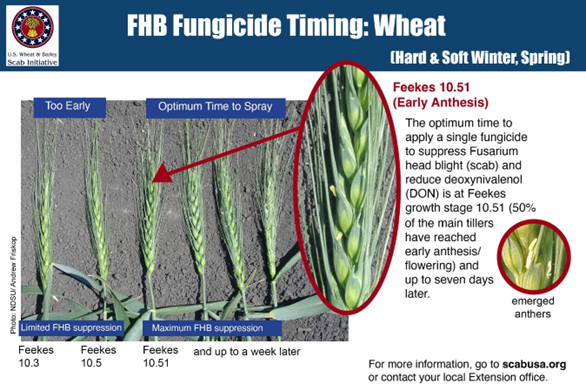
For those choosing to make a fungicide application, the optimal timing for managing scab is at early flowering (Feekes 10.5.1) and up to seven days afterward (see figure below). Reminder: Do not use products that contain strobilurins (FRAC 11) to manage scab.
Warm, humid, and wet conditions leading up to and during flowering favor infection by the scab-pathogen. As of April 25, 2025, conditions in Virginia are not favorable for disease development in flowering wheat. However, for fields expected to flower in the coming days or weeks, monitor your local weather closely and consult the Fusarium Risk Tool (https://www.wheatscab.psu.edu/) for updates on disease-conducive conditions.
First, I would like to introduce myself. I am Tim Bryant, the new assistant professor of entomology and extension specialist at the Tidewater AREC, in Suffolk, VA. I did my master’s degree here at the TAREC under Dr. Sally Taylor, and I am excited and grateful for the opportunity to come back and work with the farming community in Virginia. I am also looking forward to continuing to provide updates on this platform as regularly as we have updates to provide. Now, on to a quick update from my first few weeks on the job…
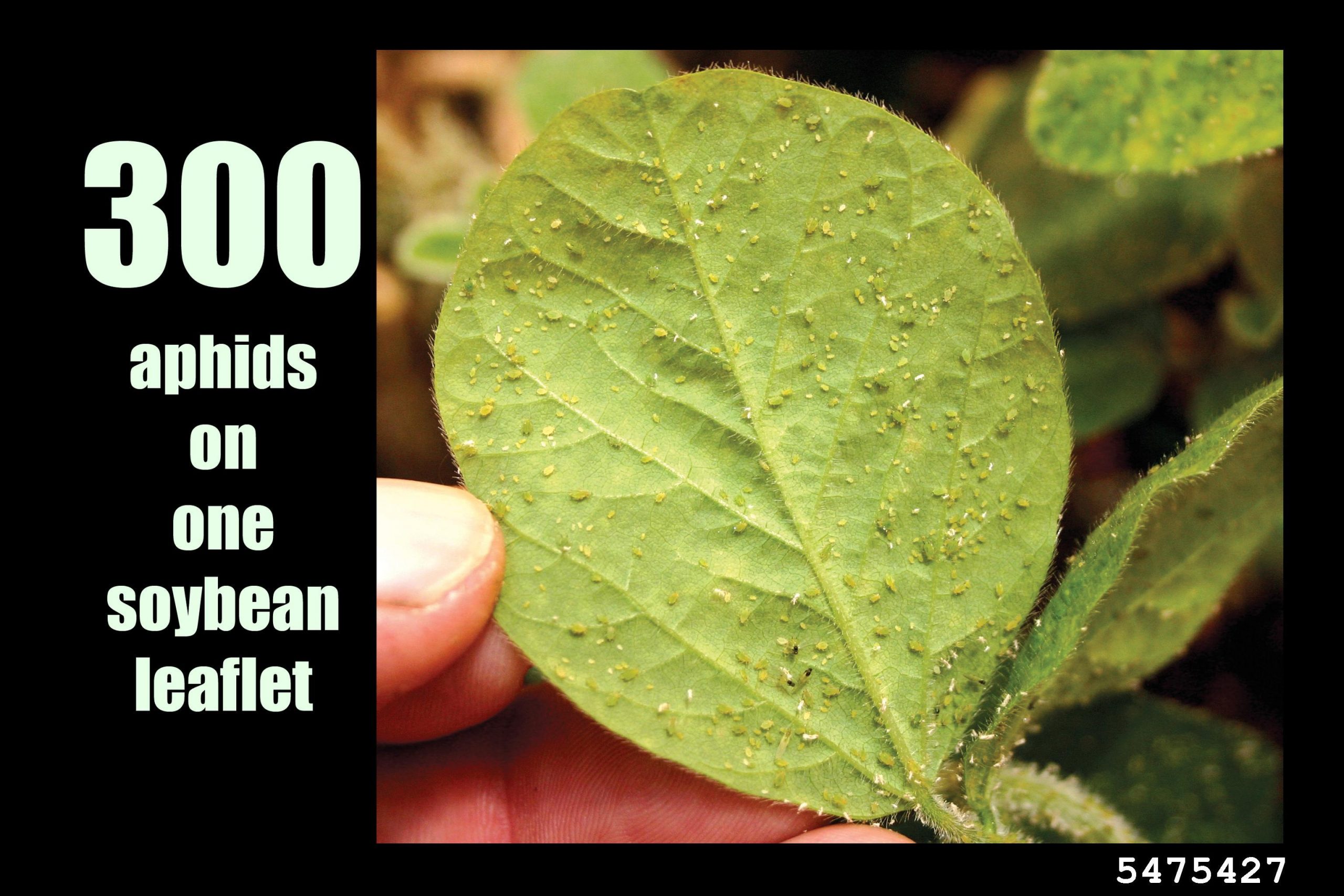
Soybean aphids have been reported in Mecklenburg and Prince George counties (First reports 8/28). Aphids can reproduce asexually, and are capable of rapid population growth under the right conditions, so close monitoring is important. Our threshold for managing soybean aphids is 250 per plant at R4 (full pod) or prior, and 1000+ at R5 (beginning seed) and beyond. The below image shows 300 aphids on a single leaflet as a point of reference (Photo credit: Roger Schmidt, University of Wisconsin-Madison, Bugwood.org). There is likely to be multiple developmental stages of aphids present at one time, and early stages are very small.
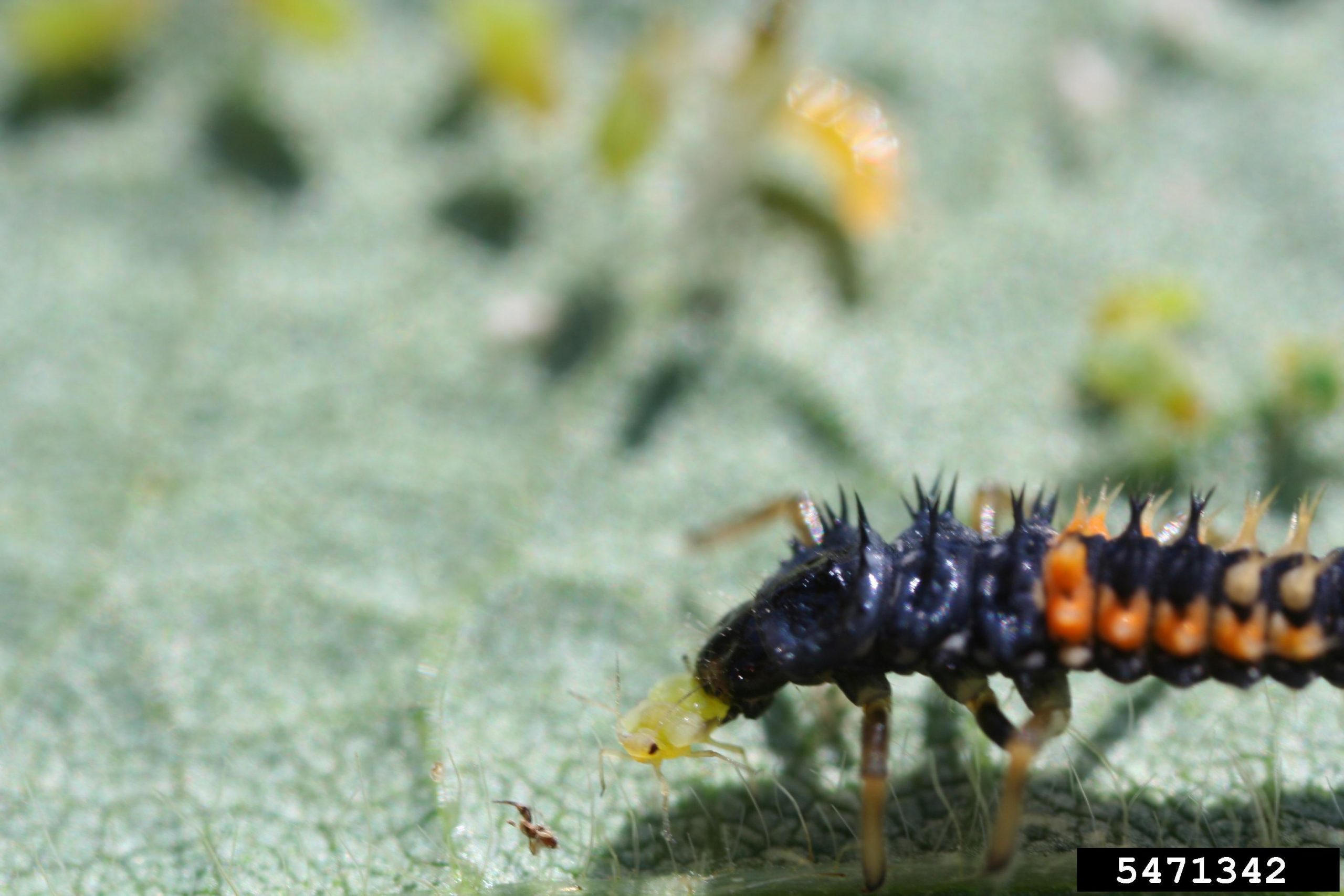
There are a couple key considerations for managing aphids; 1) they are highly susceptible to population crashes from natural enemies or weather events, and 2) broad-spectrum insecticide applications (i.e. pyrethroids) may kill aphids, but also the afore-mentioned beneficial insects. Eliminating beneficials can potentially flare up spider mites or other pests later on. If you think you may have an aphid problem, scout several areas of the field to estimate the number of aphids per plant and pay close attention to the number of beneficial insects present. Where we scouted for aphids, there were also large numbers of lady beetle adults and larvae, which are excellent aphid predators. If you reach the aphid threshold, sample again in 5-7 days to ensure the population has not crashed. Narrower spectrum insecticides (e.g. sivanto) may preserve some beneficial insects if an application for aphids is made. See our pest management guide (beginning on page “4-62”) for more details on labeled products, application rates, etc.
The below image shows a lady beetle larvae, which were found in abundance along with the aphids we are reporting on here, feeding on an aphid (Photo credit: Winston Beck, Iowa State University, Bugwood.org).
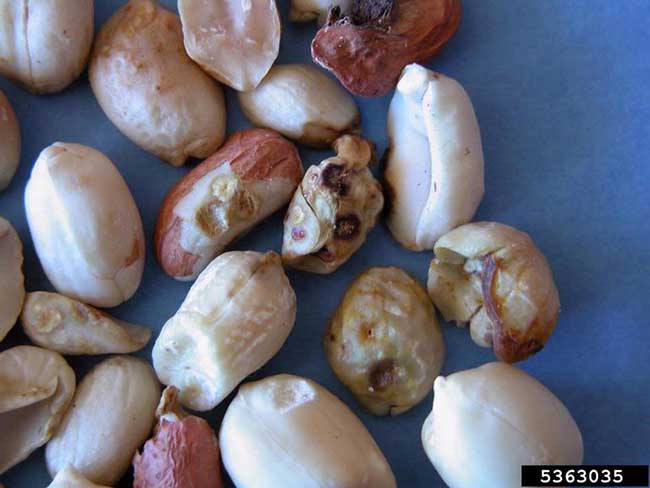
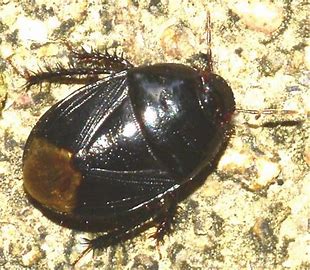
Peanut Burrower Bugs (Pangaeus bilineatus) have been collected and identified, by the Virginia Tech Insect Identification Laboratory, on the Tidewater AREC farm. Peanut burrower bugs are a subterranean pests that feed on pods and pegs of developing peanuts. Burrower bugs have most likely been around for a while but Lorsban (active ingredient is chlorpyrifos) was controlling their populations. Since the removal of Lorsban (chlorpyrifos) from market shelves, there are no effective chemical controls for producers. Damage caused by the peanut burrower bugs looks similar to stink bug damage. This damage is only seen when peanuts are shelled. The skin is removed at buying points by graders: The insect does not leave an indicator of damage on the shell of the peanut. Peanut burrower bug is more of an issue in hot dry years, and they are just as sporadic as southern corn rootworm.
In terms of prevention, there is no chemical control with the loss of lorsban. Some producers have gone back to using a moldboard plow and completely turning over the soil. Some producers have been planting earlier hoping for a thicker hull development earlier in the season. Damage is minimal in Suffolk, VA, but it is something to keep in mind.