Category Archives: Peanut

Have a thrips plan ready for cotton and peanut in 2026

With a good rain today (Thursday May 7), now is a good time to consider your plan for thrips management in cotton and peanuts for 2026.

The first step is to consider how your planting date affects your thrips management, using the thrips risk predictor tool from NC State. This tool forecasts the risk of heavy thrips injury to cotton, specific to a given location and target plant date. An example output from the tool at the Tidewater AREC in Suffolk can be seen below. Because the model uses local weather data, the closer to planting you are when you check, the more accurate the model will be. In this example, the model looks very different than when it was checked prior to today’s weather. It will also change significantly for different locations, so it is worth your time to enter your own information. As of May 7, for the Tidewater AREC, cotton planted between 5/9 and 5/12 will be at elevated risk for thrips injury.

Cotton planted into the high risk windows may benefit from the addition of an in-furrow insecticide targeting thrips. You can also recheck the model after planting to target your scouting efforts and determine the need for foliar insecticides. In the above example, if we had planted cotton on 4/29, we would be monitoring it carefully for thrips injury as it emerges and grows. The most consistent economic return on a foliar thrips spray will come from an application just as the first true leaf is visible. The thrips risk model also generates an optimal spray date, as indicated by the red dot on the figure below. This is an underutilized feature of the tool, and we are testing the value of this model output in the 2026 season.

This tool is specifically designed for cotton, but planting date also has an impact on thrips in peanut. In 2025, we found significantly higher thrips pressure and tomato spotted wilt virus incidence in early planted (late April) peanuts relative to mid or late may. Imidacloprid (Admire Pro) in furrow at planting can provide some thrips suppression, but efficacy has decreased over time, and it is likely insufficient for high-risk scenarios. There are other at-plant options including AgLogic and Thimet, but they are more expensive. We are generating more extensive efficacy data for all at-plant options in 2026. For earlier planted peanuts, scout carefully to determine the need for a foliar application in addition to at-plant insecticides.

The next thing to consider is what insecticide to use, if a foliar application is made. In 2025, we identified tobacco thrips populations with reduced susceptibility to Acephate in Virginia (~ 75-79% mortality on average). We are continuing to monitor this situation in 2026. Hemi SC provides excellent control for both tobacco thrips and western flower thrips and is a viable alternative. This product must be applied either in combination with an herbicide or with a non-ionic surfactant to achieve good control. For peanut, Exirel (cyantraniliprole) can provide good control as a foliar application.

One additional consideration for foliar management are differences in species composition. Western flower thrips have histroically been more difficult to manage with acephate. In 2025, we had a higher proportion of western flower thrips in cotton than usual. Look out for future updates on species composition for 2026.
Corn earworm/bollworm update for August 8, 2024

Corn earworm (= bollworm) moth catches were exceptionally high this week, continuing to climb in Dinwiddie, Prince George, and Suffolk, VA black light traps. The average number captured per night was 38 in Greensville, 79 in North Dinwiddie, 72 in Prince George/Disputanta, and 124 in Suffolk. Thanks to Sara Rutherford, Scott Reiter, and the Tidewater AREC entomology crew for their reports. Here is the Table.

Corn earworm/bollworm update for August 1, 2024

Corn earworm (= bollworm) moth catches increased greatly this week in southeastern Virginia black light traps. The average number captured per night was 50 in Greensville, 42 in North Dinwiddie, 39 in Prince George/Disputanta, and 67 in Suffolk. Thanks to Sara Rutherford, Scott Reiter, and the Tidewater AREC entomology crew for their reports. Here is the Table.

We have evaluated over 250 moths in our 2024 vial tests, with 57% surviving the 24-hour exposure to the pyrethroid insecticide, cypermethrin, at 5 micrograms per vial.

Corn earworm/bollworm moth update–July 25, 2024

Corn earworm (= bollworm) moth catches really started to increase this week in southeastern Virginia black light traps. The average number captured per night this week was 4 in Greensville, 11 in North Dinwiddie/Petersburg, 18 in Prince George/Disputanta, and 30 in Suffolk. Thanks to Sara Rutherford, Scott Reiter, and the Tidewater AREC entomology crew for their reports. Here is the Table

We have evaluated over 150 moths in our 2024 vial tests, with 61% surviving a 24-hour exposure to the pyrethroid insecticide, cypermethrin, at 5 micrograms per vial. Even though cypermethrin is no longer widely used, survival rates this high suggest we need to watch for some pyrethroid control failures, and to consider alternative chemistries when an insecticide is needed.

Peanut Burrower Bug in Virginia peanuts

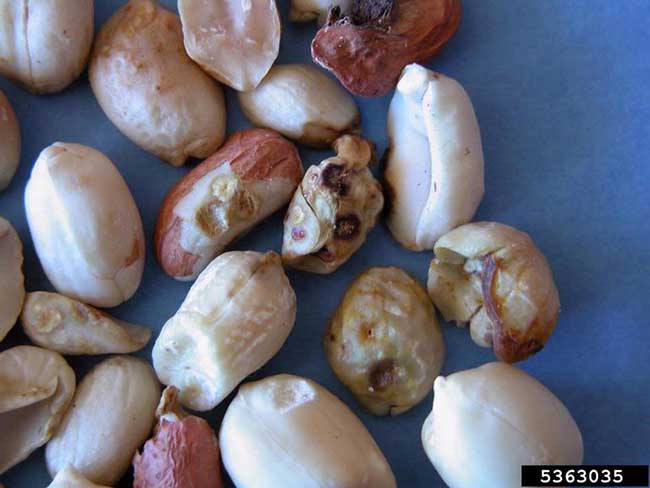
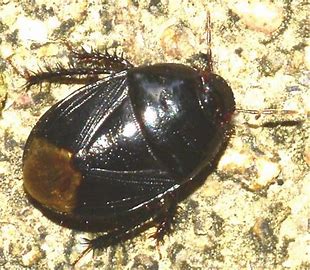
Peanut Burrower Bugs (Pangaeus bilineatus) have been collected and identified, by the Virginia Tech Insect Identification Laboratory, on the Tidewater AREC farm. Peanut burrower bugs are a subterranean pests that feed on pods and pegs of developing peanuts. Burrower bugs have most likely been around for a while but Lorsban (active ingredient is chlorpyrifos) was controlling their populations. Since the removal of Lorsban (chlorpyrifos) from market shelves, there are no effective chemical controls for producers. Damage caused by the peanut burrower bugs looks similar to stink bug damage. This damage is only seen when peanuts are shelled. The skin is removed at buying points by graders: The insect does not leave an indicator of damage on the shell of the peanut. Peanut burrower bug is more of an issue in hot dry years, and they are just as sporadic as southern corn rootworm.

In terms of prevention, there is no chemical control with the loss of lorsban. Some producers have gone back to using a moldboard plow and completely turning over the soil. Some producers have been planting earlier hoping for a thicker hull development earlier in the season. Damage is minimal in Suffolk, VA, but it is something to keep in mind.

Peanut burrower bugs can cause a wide range of damage, which is not visible until after the peanuts are harvested and shelled.
Peanut burrower bug poses a complex problem for producers | Colquitt County Ag Report (uga.edu)
Peanut Burrower Bug (tamu.edu)

We are not there yet, but getting close!

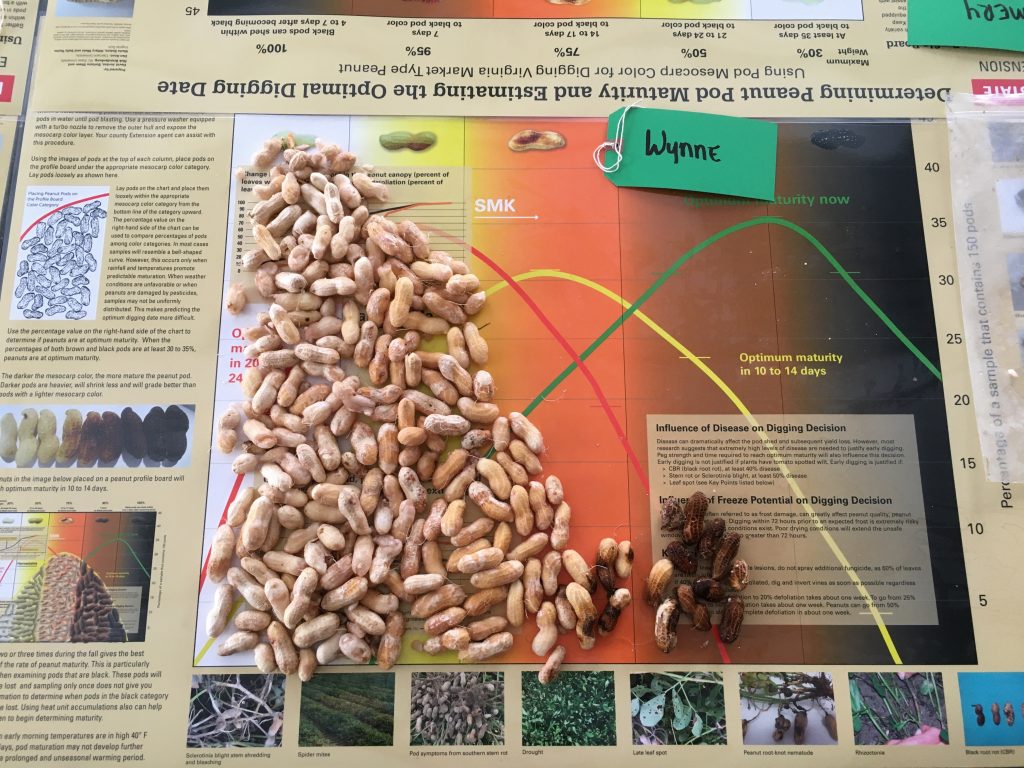
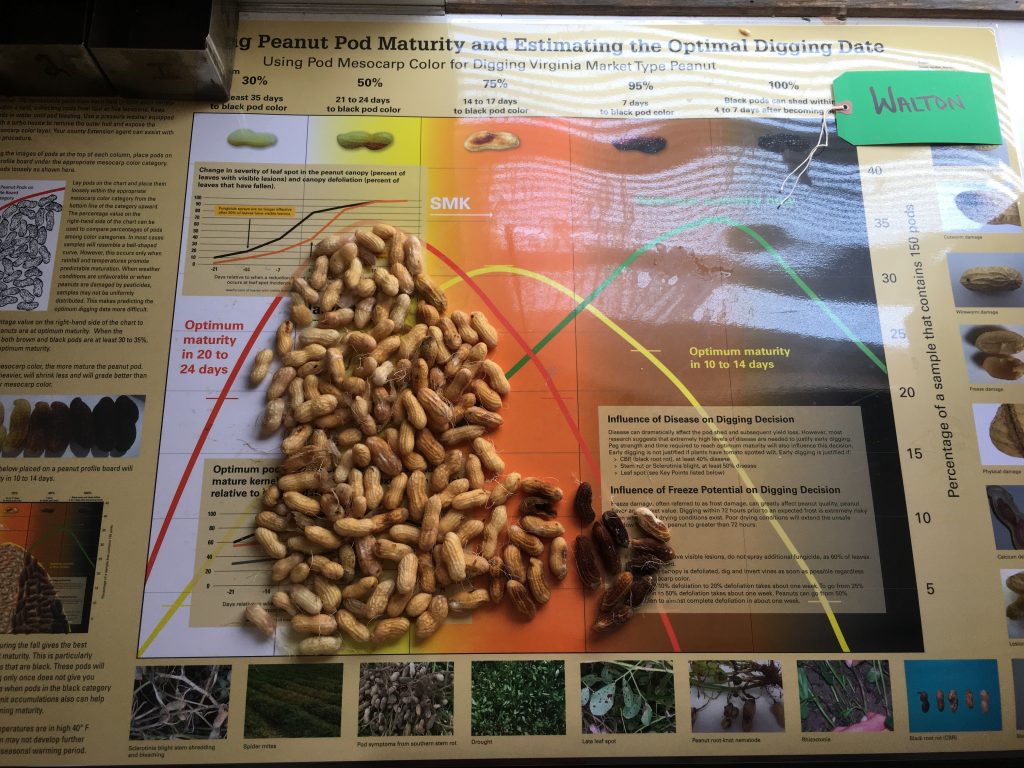
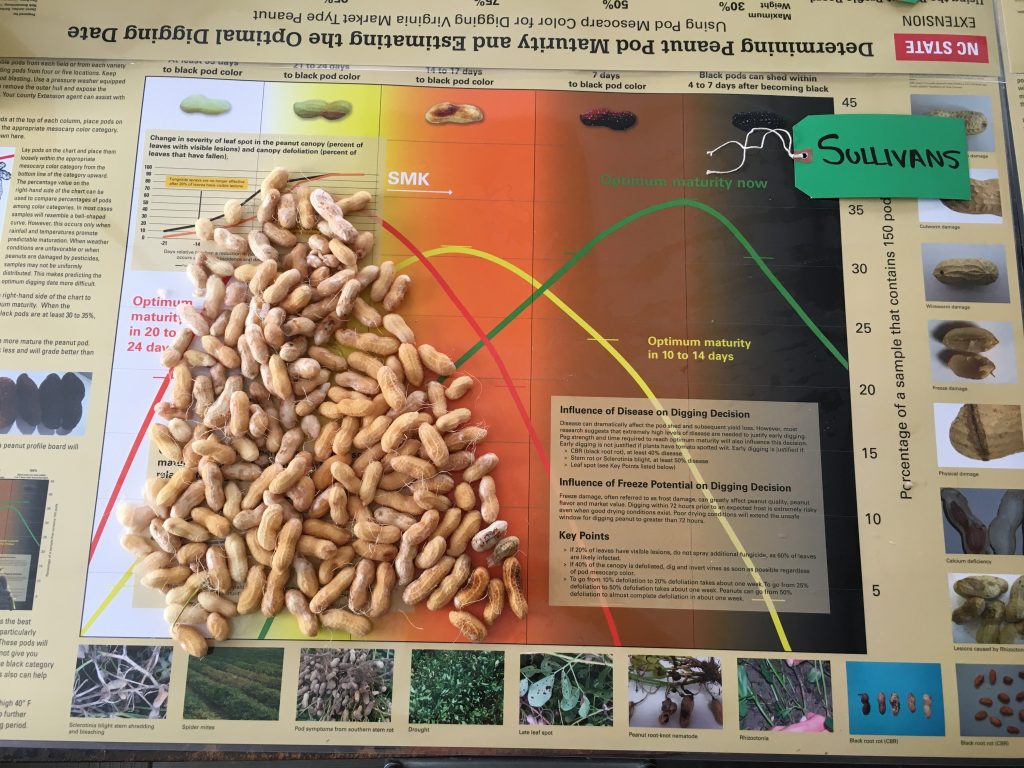
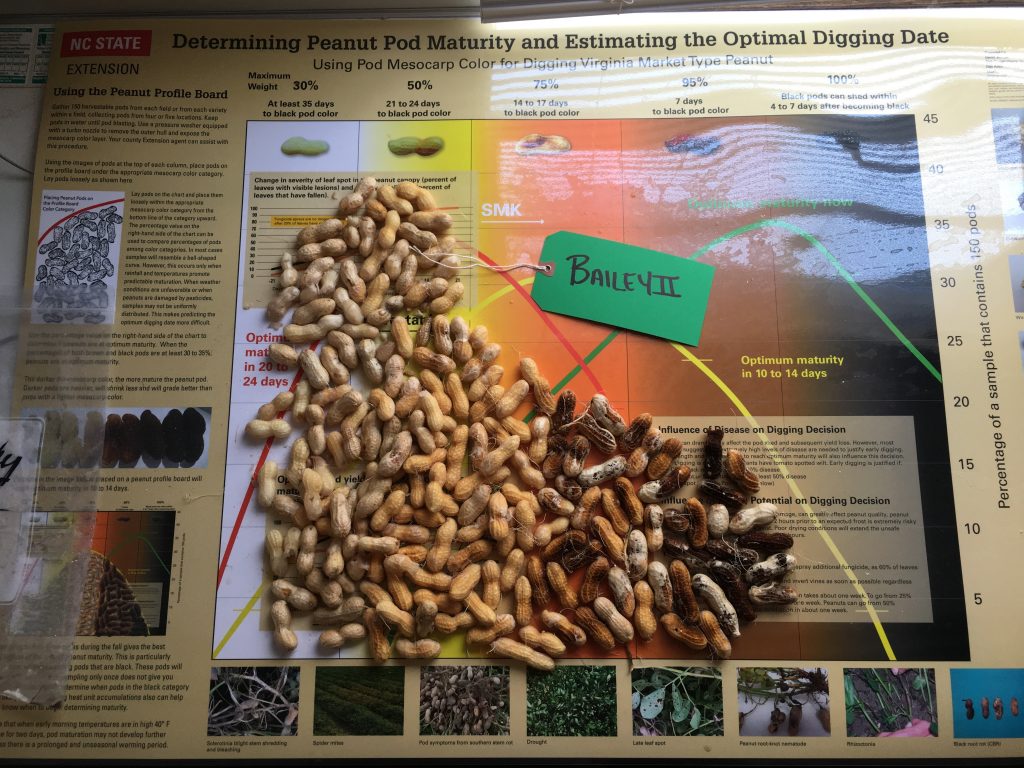
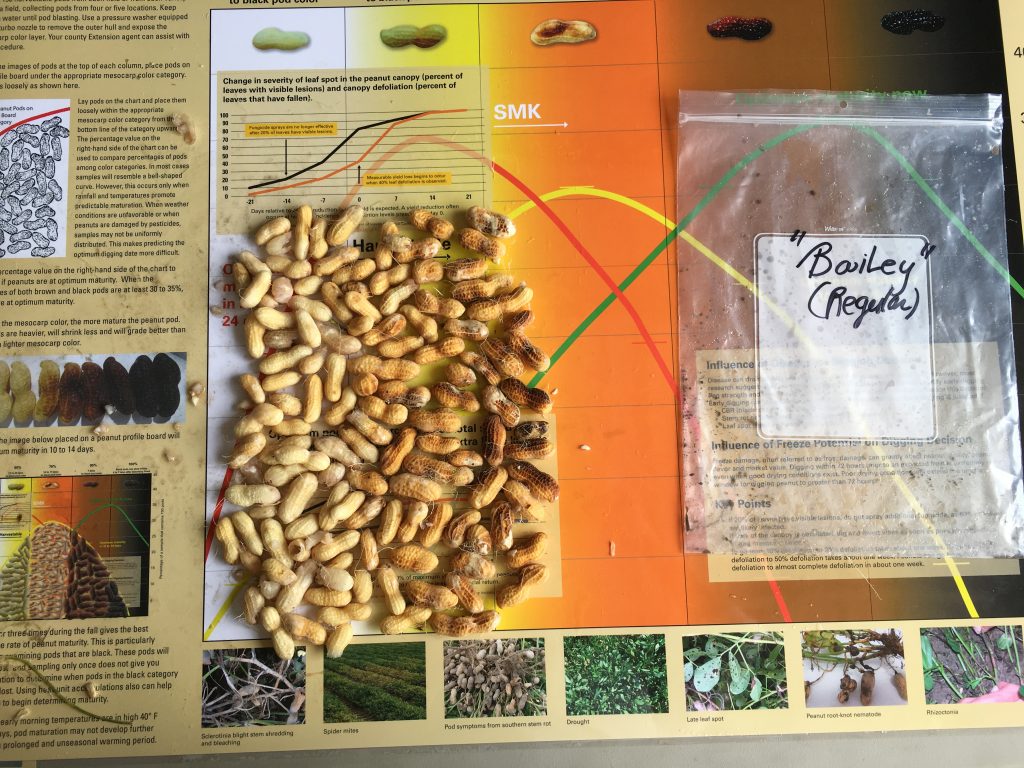
Today, Aug 26 2021, we pod blasted a few peanut cultivars grown at the Tidewater AREC in large plots to observe pod maturity at this time. While the peanuts planted in the first week of May might be ready in 20-25 days from now, those planted in late May are approximately 30 days from the optimum maturity. Keep in mind that weather is also a decisive factor; therefore, sampling for maturity again in 10-14 days from now will allow to pinpoint more accurately the day when peanuts are ready for digging.

Wynne planted on May 25.
Walton planted on May 3.
Sullivan planted on May 25.
Bailey II planted on May 5.
Bailey planted on May 25.

Peanut Maturity in SE Virginia on Sep 28, 2020

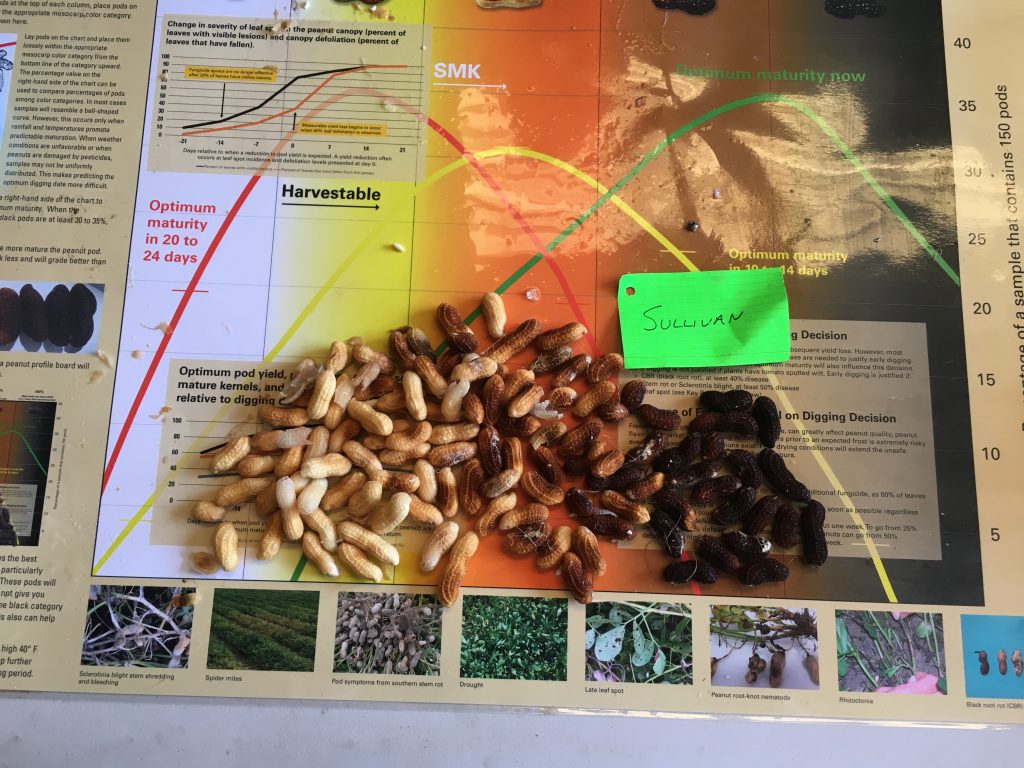
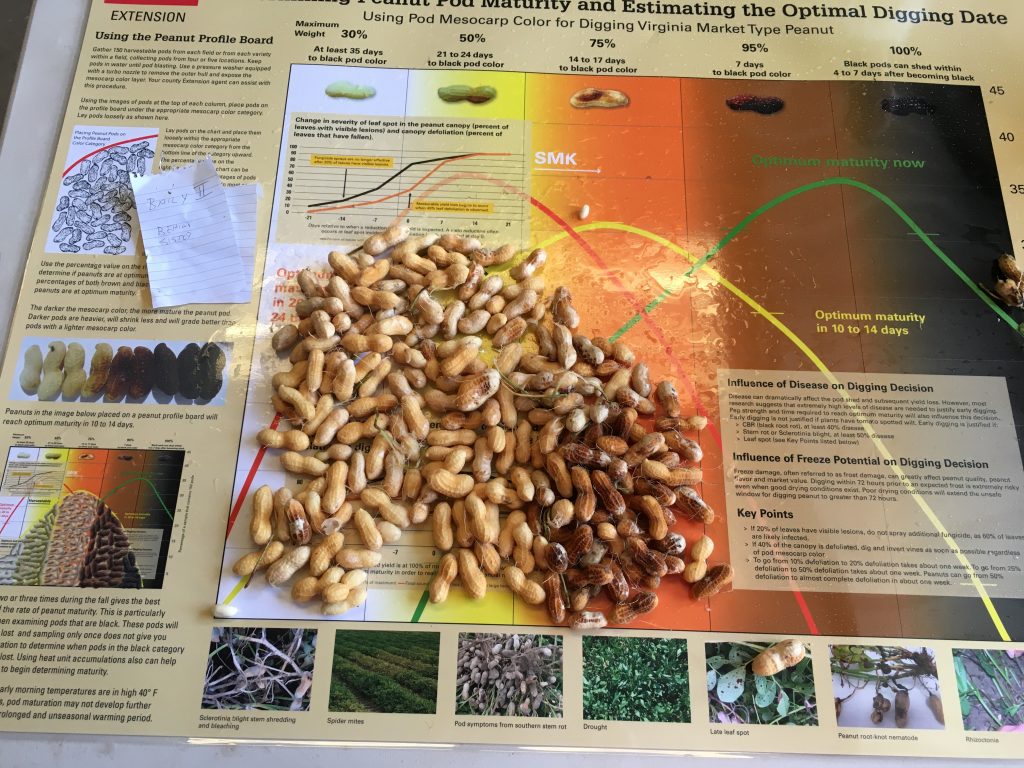
I know I missed a week of updates, but it was not much change in peanut maturity since recently. On Sep 28, however, some fields started looking close to digging. While some fields in theory still need three weeks to mature, others can be dug soon (see picture below showing samples of ‘Sullivan’ peanut planted at about the same time but in different fields with different conditions through the summer).

Maturity of peanut in Isle of Weight County, VA, on Sep 28, 2020. Samples are from different fields planted with Sullivan in mid-May.

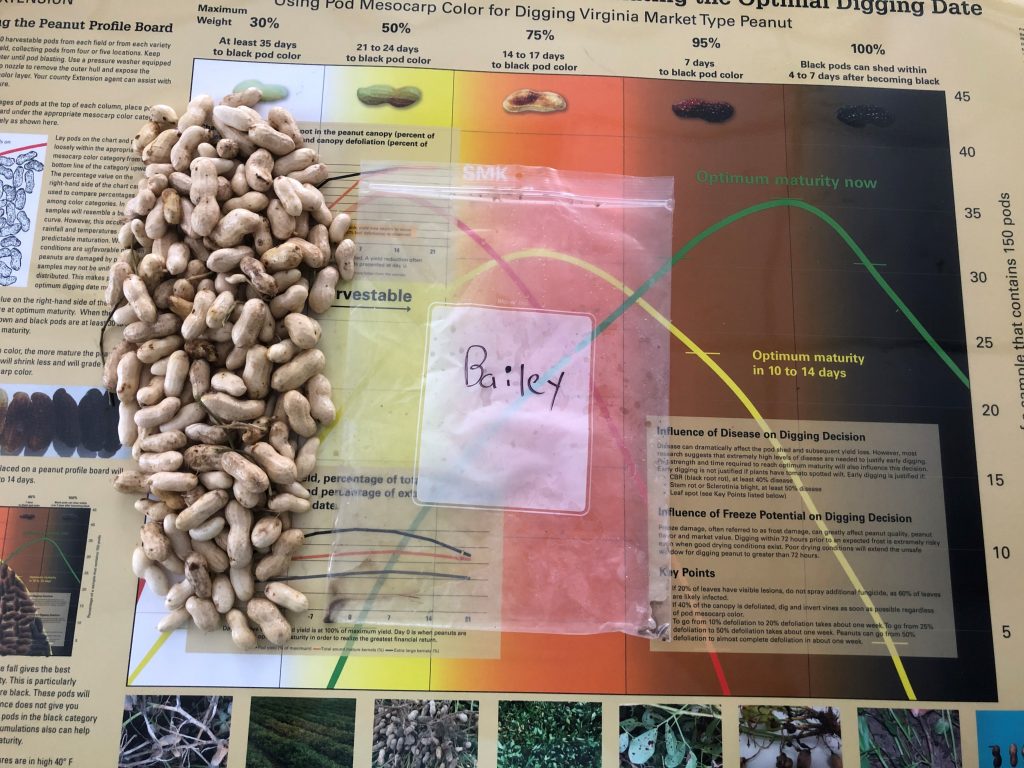
Similarly, cultivar ‘Bailey’ showed variable maturities depending on the soil type, growth conditions, and irrigation. But in majority of approximately 35 samples looked at on Sep 28, Bailey seemed ready to dig starting within the first week of October.

With the exception of Bailey, peanut cultivars currently grown in Virginia have the high oleic oil chemistry. Thus, it is important to realize that cooler temperatures at this time of completing maturity may affect the high oleic oil chemistry.  Research showed that temperatures in the range of 85 to 90 F during pod filling to harvest increased the oleic fatty acid content, which makes peanut a high oleic peanut; while lower temperatures promoted the linoleic fatty acid.  I hope not, but if research proves right for our late maturing peanut this fall, when temperatures dropped in high 60’s or at the most 70’s for the past 3-4 weeks, this determination should be made as soon as first peanuts are picked and measures taken. This is particularly important for Virginian growers that primarily grow peanut for certified seed production.

Sample of ‘Bailey’ peanut in Isle of Weight County, VA, on Sep 28, 2020.

Peanut Maturity in SE Virginia on Sep 15, 2020

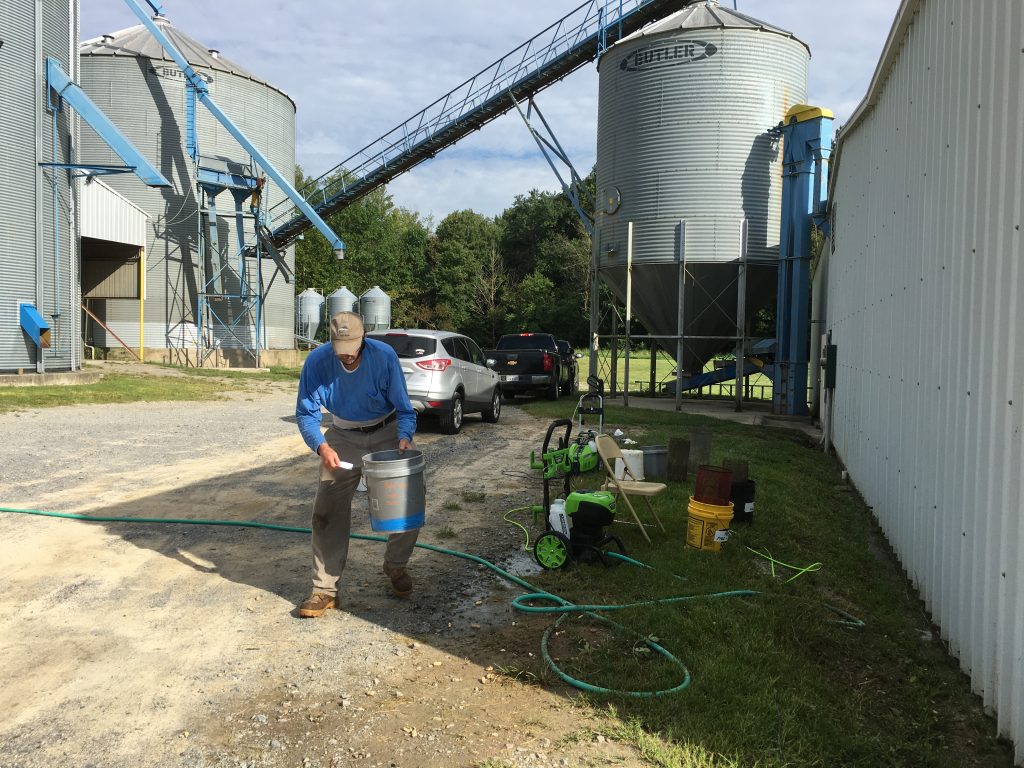
Frank Bryant pod blasting the peanut pods (left) and growers commenting on the pod samples (right).

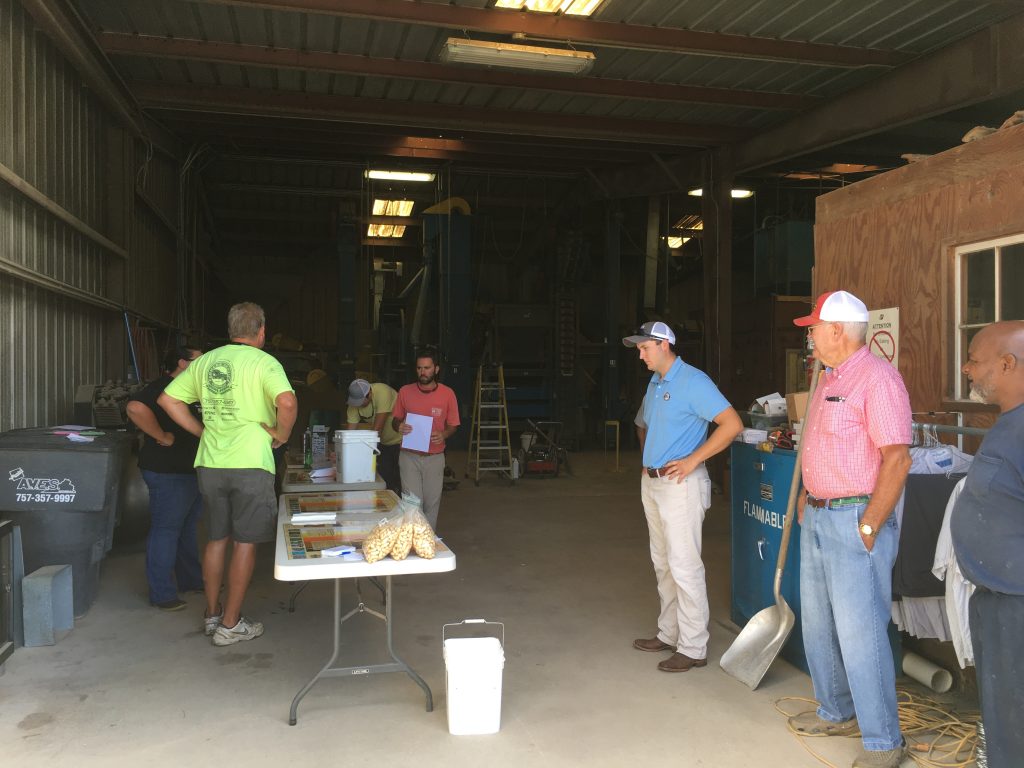
Monday, Sep 14 2020, Extension Agent Livvy Preisser organized a pod blasting clinic in Windsor, VA, at the Indika Farms Inc.

As every year my technician, Frank Bryant, assisted the Agent with this activity. Keeping the distance, several growers brought over 25 peanut samples from almost 2000 acres from the neighboring fields.

In average, peanut still needs 3 weeks or longer to complete physiological maturity, regardless if the fields were or not irrigated. From all, only one sample of non-irrigated Sullivan was 2 weeks closer to digging.  This agrees with what we have observed in the research plots this week.

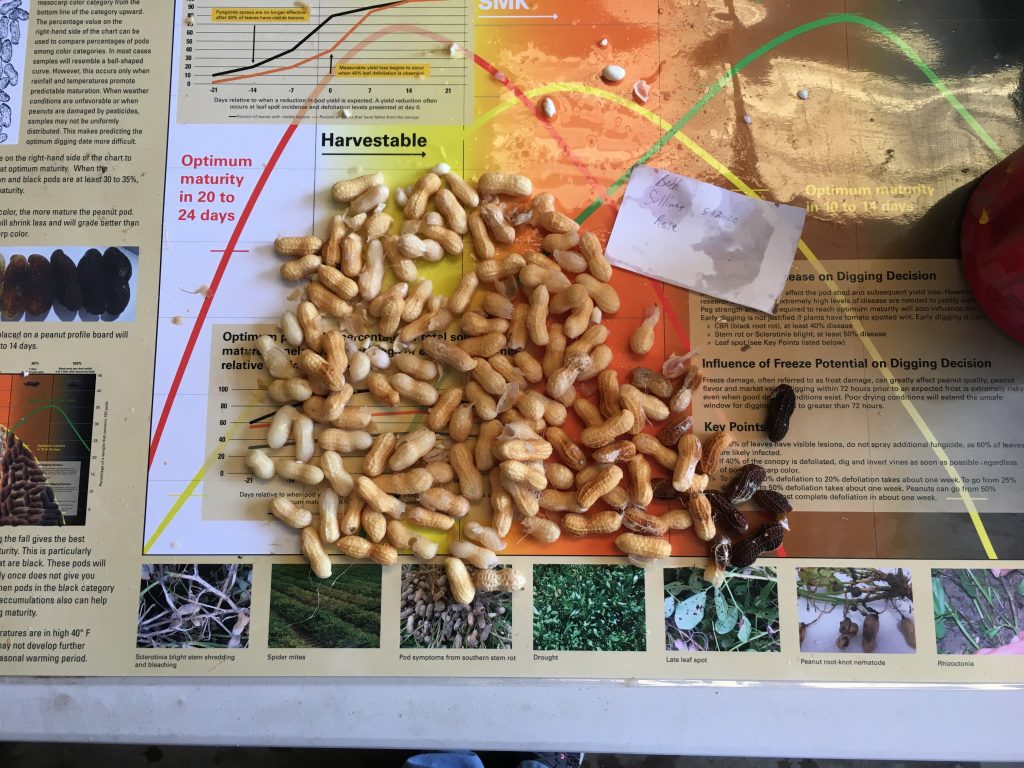
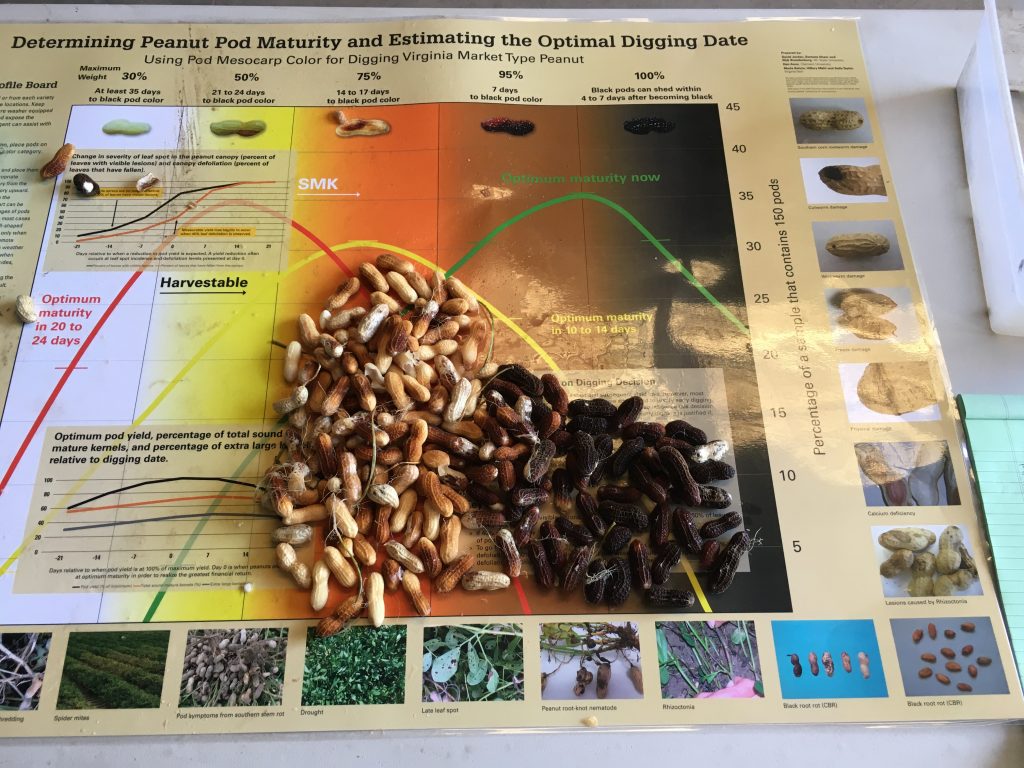
Maturity of peanut in Isle of Wight County, VA, on Sep 14, 2020. Samples are from different fields, Bailey (upper left and center), Bailey II (upper right), and Sullivan (below).

Additional pod blasting clinics will take place on Sep 16 at Carolina Easter, Courtland, VA; Sep 18 at Meherrin Ag. & Chemical, Capron, VA; Sep 22 at TAREC, Suffolk, VA; Sep 23 at Carolina Eastern, Courtland, VA; Sep 25 at Meherrin Ag. & Chemical, Newsoms, VA; and Sep 28, at Indika Farms Inc, Windsor, VA. They are organized by Extension Agents Livvy Preisser, Elisabeth Pittman, and Josh Holland.

Because temperatures of the past 3 weeks seem to decrease in the next 3 weeks and into the Fall by 15 to 20 F daily, from high 80s and on some days mid-90s to only mid-70s, the rate of pod development from immature (white mesocarp color) to mature (brown and black color) will decrease as well. Therefore, patience is needed with peanut crop this Fall for harvesting high yields and SMK in Virginia.  

Peanut Maturity in SE Virginia on Sep 8, 2020

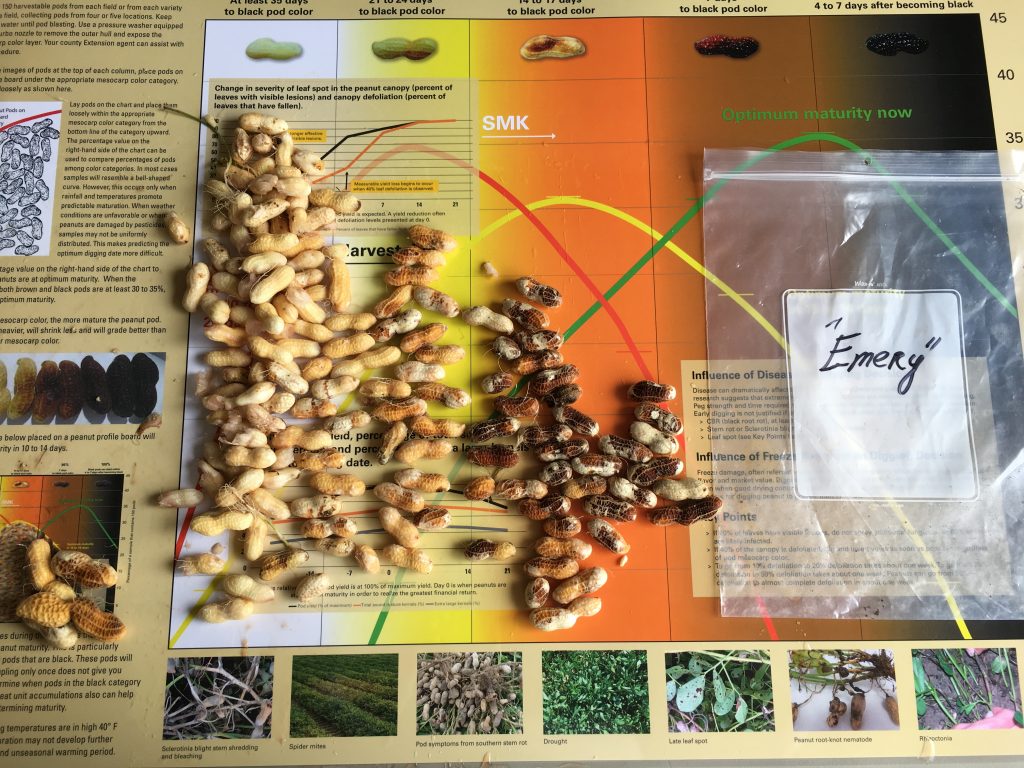
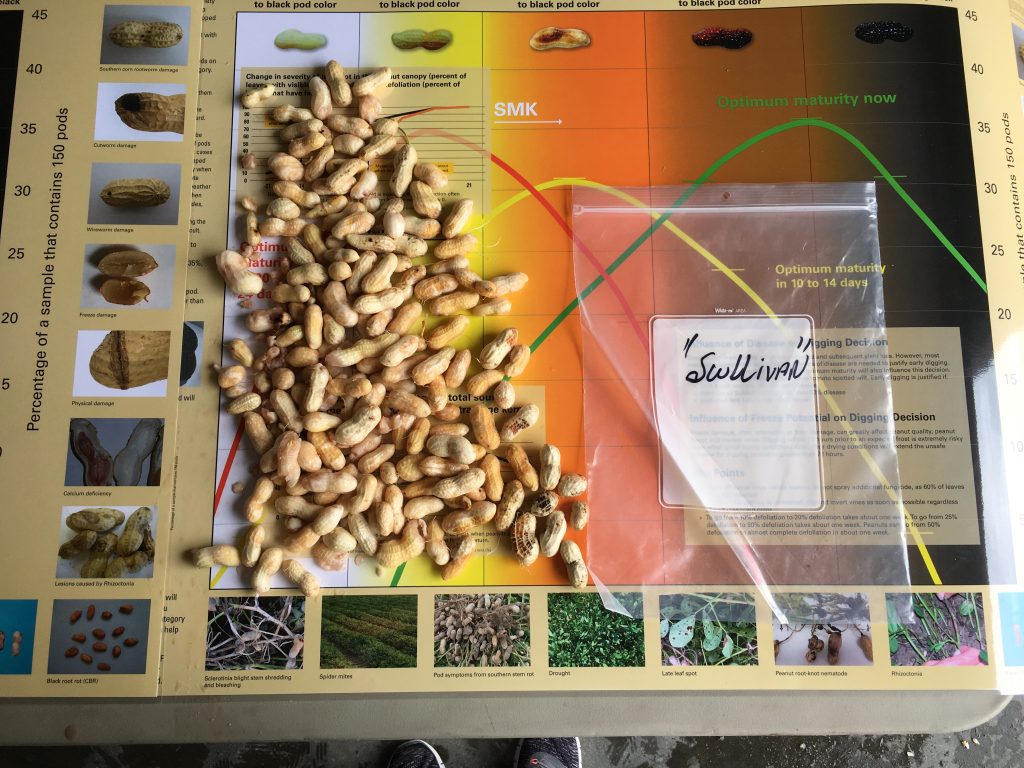
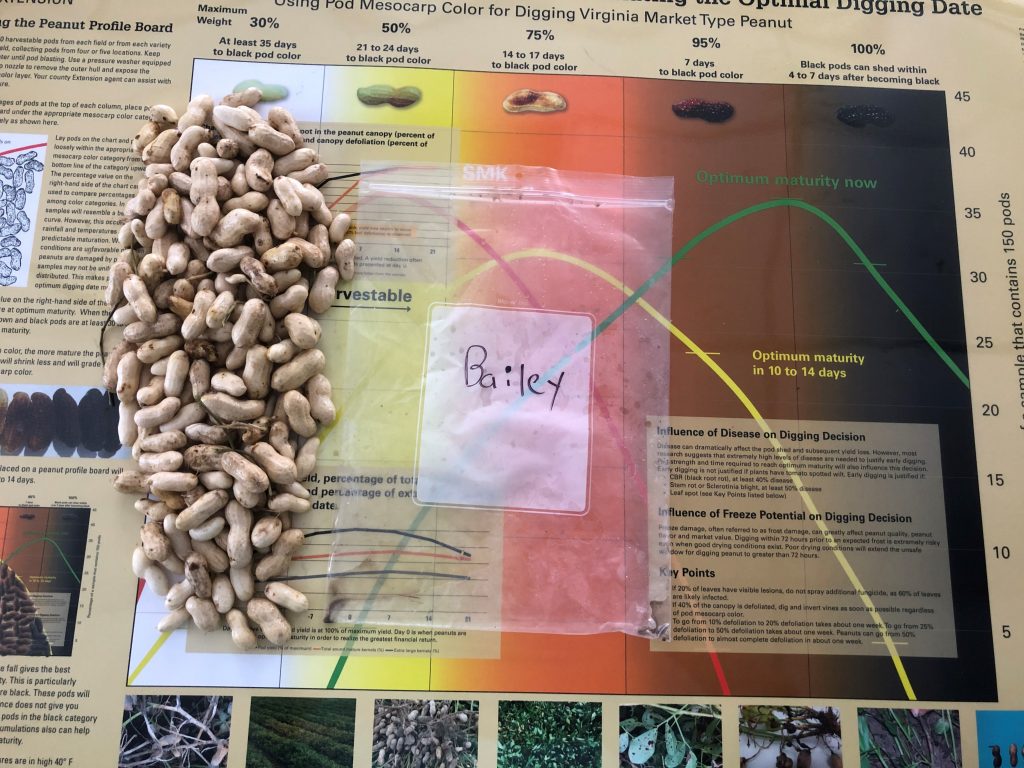
In the past two weeks, peanut progressed nicely towards harvest maturity. The pictures below show maturity of Bailey on Aug 25 and Sep 8, 2020; and maturity of Sullivan and Emery on Sep 8, in fields at the Tidewater AREC, Suffolk, VA. Recent good soil moisture and high temperatures, not many exceeding 95 F, seem to close the gap between last and this year’s harvest time.  It is, still, very improbable to have an early digging, like we have had in the past two years when peanut was complete dug by end of Sep in Virginia. Maybe by the end of Sep, 2020, we will start digging some early planted fields. I will provide weekly updates.

Bailey planted May 14, 2020 and pod blasted on Aug 25 (left) and Sep 8 (right), 2020.

Emery (left) and Sullivan (right) planted on May 14 and pod blasted on Sep 8, 2020.

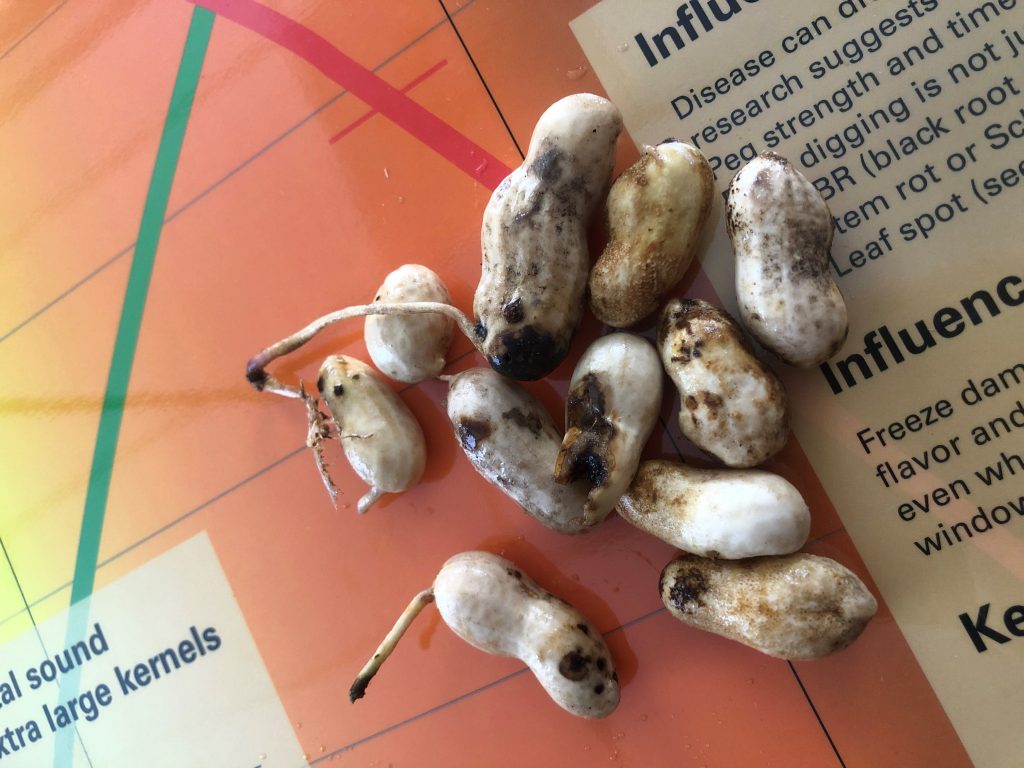
Damaged kernels probably from earlier noticed pods with Southern Corn Rootworm and other damage.

Peanut Maturity in SE Virginia on Aug 25, 2020

This year, peanut is nowhere near where it was last year, from the pod maturity point of view. The pictures below show 100% white (immature) pods from Bailey planted on May 14, 2020, and collected on Aug 25. Last year, on Aug 27, pods of Bailey planted on May 3, 2019, ranged from 10% white to 25% brown and black (fully mature), with the majority in yellow and orange mesocarp color denoting substantial progress towards physiological maturity. Indeed, in 2019, peanut was planted earlier than this year, but this only explains part of the reason why this year peanuts are maturing later than in 2019. The other part comes from the dry and hot July, when pollination, and growth of pegs and pods were slowed down.  Tropical storm and other rain events at the end of July benefitted pod development, but maturity is still delayed from the last season. I am showing pictures only from Bailey, as the main cultivar grown on 50% of the peanut acreage this year; but we looked at Sullivan, Emery and Wynne as well and they look similar with Bailey. This year, we also noticed on all these cultivars a fair amount of Southern corn rootworm and other pod damage, regardless the soil where pod samples were collected at the Tidewater AREC. I will continue updates on peanut maturity every other week.

Bailey planted May 14, 2020 and pod blasted on Aug 25, 2020
Bailey planted May 3, 2019 and pod blasted Aug 27, 2019
Bailey pegs and pods on July 20, 2020.
Bailey pods with Southern Corn Rootworm and other damage