Category Archives: Cotton

Monitoring for the cotton jassid in 2026

https://www.pubs.ext.vt.edu/articles/2026/two-spot-cotton-leaf-hopper-scouting.html

As many are aware, a new pest of cotton rapidly spread throughout the southeast in 2025. The cotton jassid (Two-spot Cotton Leafhopper) was first identified in Florida in late 2024, and by the end of the 2025 season was confirmed as far north as Northhampton county, North Carolina. It was not identified in Virginia in 2025, but we do not know what the population will do in 2026. Aggressive monitoring for this pest is a critical first step in managing this pest when (or hopefully if) it does arrive in Virginia cotton. This is a tiny insect (~2 mm in length), light green, and has two very distinctive black spots on the tips of its wings. There are native insects that are very similar in appearance, but do not have these two spots. Look on the underside of potential host plants to scout.

Green insect with two black spots on the wings

The cotton jassid (two-spot cotton leafhopper)

This pest has a wide host range including cotton, specialty crops like okra and eggplant, and ornamental hibiscus (to name a few preferred/common hosts). If you have any of these plants in your yard, home garden, or you grow cotton and notice any hopperburn symptoms, please contact me as soon as possible so we can scout. Hopper burn appears as yellowing around the leaf margins, and can progress to dark red/brown and senescence on margins of affected leaves. You will likely notice injury before you notice the insect, so this is a good way to scout as well.

A cotton field

Cotton jassid injury in cotton

At winter meetings we distributed packages of okra seed to our stakeholders to use as sentinel monitoring plots in home gardens. If you would like a packet of seed to contribute to this effort, we still have some. This article has additional details about what the pest looks like, scouting, damage, and how you can contribute to the monitoring effort.

Contact Tim Bryant any time with questions.

Have a thrips plan ready for cotton and peanut in 2026

With a good rain today (Thursday May 7), now is a good time to consider your plan for thrips management in cotton and peanuts for 2026.

The first step is to consider how your planting date affects your thrips management, using the thrips risk predictor tool from NC State. This tool forecasts the risk of heavy thrips injury to cotton, specific to a given location and target plant date. An example output from the tool at the Tidewater AREC in Suffolk can be seen below. Because the model uses local weather data, the closer to planting you are when you check, the more accurate the model will be. In this example, the model looks very different than when it was checked prior to today’s weather. It will also change significantly for different locations, so it is worth your time to enter your own information. As of May 7, for the Tidewater AREC, cotton planted between 5/9 and 5/12 will be at elevated risk for thrips injury.

Cotton planted into the high risk windows may benefit from the addition of an in-furrow insecticide targeting thrips. You can also recheck the model after planting to target your scouting efforts and determine the need for foliar insecticides. In the above example, if we had planted cotton on 4/29, we would be monitoring it carefully for thrips injury as it emerges and grows. The most consistent economic return on a foliar thrips spray will come from an application just as the first true leaf is visible. The thrips risk model also generates an optimal spray date, as indicated by the red dot on the figure below. This is an underutilized feature of the tool, and we are testing the value of this model output in the 2026 season.

This tool is specifically designed for cotton, but planting date also has an impact on thrips in peanut. In 2025, we found significantly higher thrips pressure and tomato spotted wilt virus incidence in early planted (late April) peanuts relative to mid or late may. Imidacloprid (Admire Pro) in furrow at planting can provide some thrips suppression, but efficacy has decreased over time, and it is likely insufficient for high-risk scenarios. There are other at-plant options including AgLogic and Thimet, but they are more expensive. We are generating more extensive efficacy data for all at-plant options in 2026. For earlier planted peanuts, scout carefully to determine the need for a foliar application in addition to at-plant insecticides.

The next thing to consider is what insecticide to use, if a foliar application is made. In 2025, we identified tobacco thrips populations with reduced susceptibility to Acephate in Virginia (~ 75-79% mortality on average). We are continuing to monitor this situation in 2026. Hemi SC provides excellent control for both tobacco thrips and western flower thrips and is a viable alternative. This product must be applied either in combination with an herbicide or with a non-ionic surfactant to achieve good control. For peanut, Exirel (cyantraniliprole) can provide good control as a foliar application.

One additional consideration for foliar management are differences in species composition. Western flower thrips have histroically been more difficult to manage with acephate. In 2025, we had a higher proportion of western flower thrips in cotton than usual. Look out for future updates on species composition for 2026.

Asiatic garden beetle update for June 18, 2025

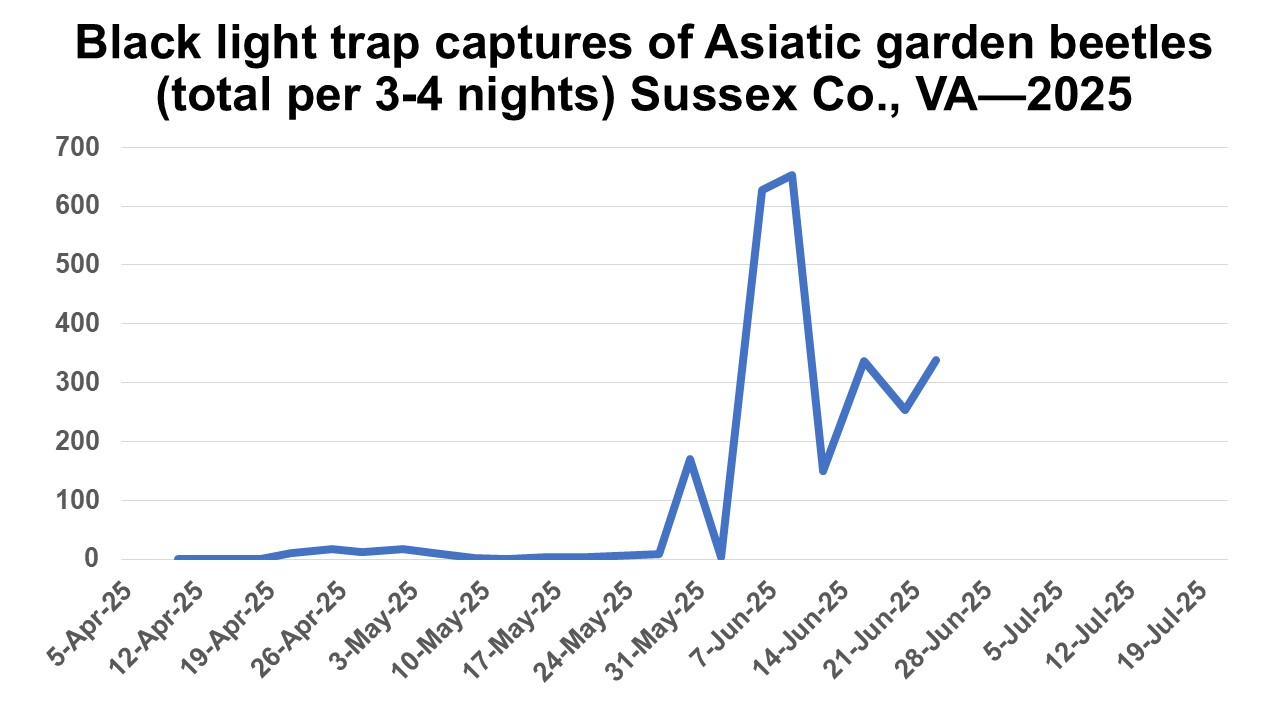
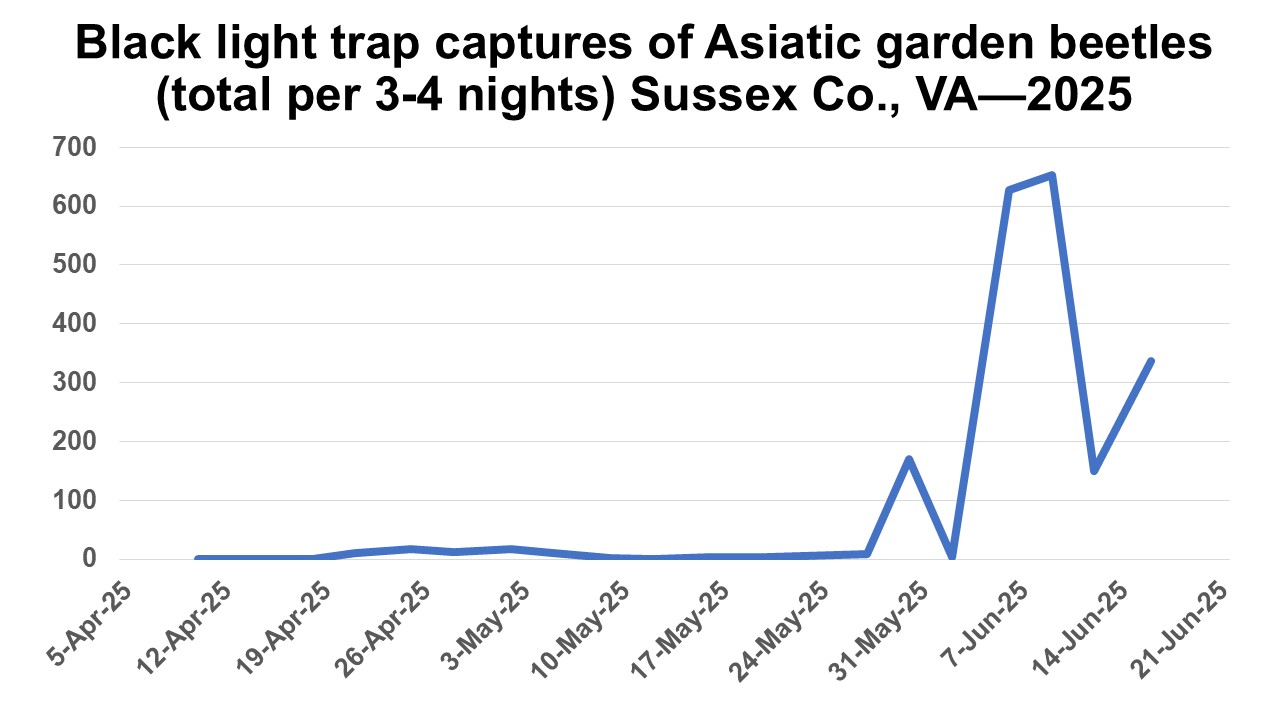
The entomology program at the Tidewater AREC has continued to monitor Asiatic garden beetle adults in our black light trap. The population peak in early June 2025 (see Figure) is very similar to what we saw in early June of 2024. Much of our cotton now has enough growth on it that some defoliation can be tolerated–but similar to thrips, I would recommend keeping an eye on anything that has not reached 4-5 true leaves.

Asiatic garden beetle in Virginia cotton–June 12, 2025 update

Asiatic garden beetle (AGB) captures in our Sussex, VA black light trap spiked the first week of June, totaling 1,281 adults over a 7-day span. Some severe AGB foliar injury to seedling cotton was reported near Wakefield (image below). We dug up cotton plants and marestail in AGB hotspots, finding adults under each, but we do not have evidence that they feed on cotton roots. For more information, please see our Virginia Cooperative Extension publication, “Asiatic Garden Beetle in Cotton”

Acephate resistance update in Virginia Cotton

On Monday, May 26 the Tidewater AREC entomology team collected tobacco thrips from cotton throughout southeastern Virginia. These populations were sent to the University of Tennessee where they were tested in the lab for susceptibility to acephate, spinetoram (Hemi SC or Radiant), and dicrotophos (Bidrin). Across all the sites, the results were very consistent with;

75-79% mortality with acephate
100% mortality with spinetoram
47-50% mortality with dicrotophos

We would classify this as tobacco thrips having reduced susceptibility to acephate in southeastern Virginia. Acephate resistance was also previously confirmed in northeastern North Carolina, just across the state line. This year we have found a high proportion of flower thrips, which are harder to kill with acephate, and now have confirmed that acephate has reduced efficacy for tobacco thrips. If you still plan to make a foliar thrips application, or are making a second application after a previous acephate application, Hemi SC (spinetoram) should be considered for more effective control. See this previous blog post for more details on the importance of timing your foliar application for maximum economic return.

We’d like to thank Sebe Brown at the University of Tennesee and his team for running the lab tests and the Virginia Cotton Board for sponsoring this research.

Cotton thrips management

It has been a cool and wet start to the cotton season in southeast Virginia, and growth is slow. With a slow start to the season some folks are considering a second foliar application for thrips management. There are a couple key things to consider…

The first thing to consider for effective thrips management is timing

The most consistent return on investment comes from a foliar application early in the first true leaf stage. An application at the second leaf stage sometimes pays off, which is more likely to be the case with our current growing conditions. If cotton reaches the three or four-leaf stage, foliar applications made for thrips rarely pay off.

The next consideration is what insecticide to chose.

One of the most commonly used products to control thrips with a foliar spray is acephate. There are two thing to consider when using acephate; 1) western flower thrips are not as susceptible to acephate as tobacco thrips, and 2) acephate resistance has been documented in tobacco thrips in northeastern North Carolina, just across the state line from us in southeastern Virginia.

Populations of western flower thrips have been high so far in southeastern Virginia.

In several trials at the Tidewater AREC in Suffolk, we found around 80% western flower thrips in a foliar insecticide trial. Additionally, collections made from grower fields throughout Suffolk and Southampton counties on May 23 averaged 73% western flower thrips. While most fields did have a majority of western flower thrips, it is important to note that it varies between fields even across a relatively small area, and some sampled fields had a larger proportion of tobacco thrips. A table of thrips collections from May 23 can be found below. Each row represents a sample of five cotton plants in a field in Suffolk or Southhampton county.

FieldTobacco thripsWestern flower thrips% Western flower thrips
#12675%
#221386%
#31480%
#442385%
#511321%
#61990%
#71888%
#84450%

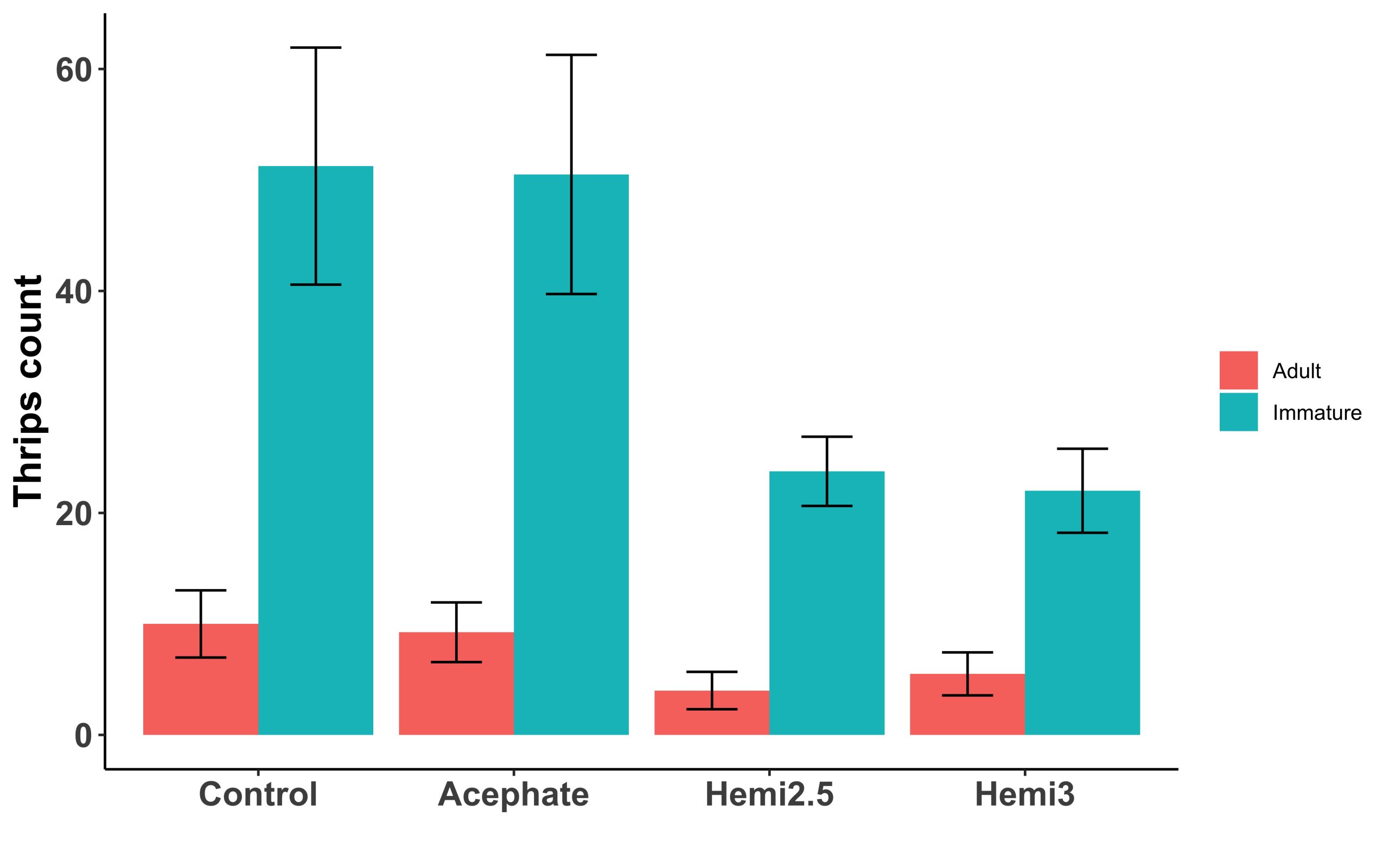
In the foliar insecticide test at the TAREC, acephate (at 3 oz/ac) did not provide better control than not treating with these high populations of flower thrips. Hemi SC (spinetoram), provided good thrips control at both the 2.5 and 3 oz rates. Hemi SC is the same active ingredient found in Radiant and is available for use in Virginia and the Carolinas this year for thrips suppression. It is important to mix Hemi SC with a non-ionic surfactant or with an herbicide which already contains a surfactant, to get good thrips control.

If you are using acephate, you should carefully monitor the performance of the application in your field. If you are not satisfied with the performance of an acephate application, the cotton growth stage and the growing conditions at that time should be assessed before considering a second application. If a second application is made, Hemi SC should be considered for more effective control and to rotate the insecticide mode of action. Bidrin should not be used for a second application after acephate, as these two insecticides are the same mode of action.

Both acephate and spinetoram can be washed away by rain up to 8 hours after application (or possibly longer), but acephate is slightly less susceptible to being washed away when comparing the two. However, some protection from a foliar application is better than none under current conditions, which are expected to extend through this weekend.

As a reminder, if you are planting Thryvon cotton, it provides excellent thrips control and does not need a foliar application. If you have any thrips questions contact Tim Bryant (757-621-8804, btim2@vt.edu), field crop entomologist at the TAREC in Suffolk, VA.

Corn earworm/bollworm update for August 8, 2024

Corn earworm (= bollworm) moth catches were exceptionally high this week, continuing to climb in Dinwiddie, Prince George, and Suffolk, VA black light traps. The average number captured per night was 38 in Greensville, 79 in North Dinwiddie, 72 in Prince George/Disputanta, and 124 in Suffolk. Thanks to Sara Rutherford, Scott Reiter, and the Tidewater AREC entomology crew for their reports. Here is the Table.