
Corn earworm (=bollworm) moth captures continued to increase this week in local black light traps. Sara Rutherford (Greensville ANR Agent) reported a nightly average of 21 moths; Scott Reiter (Prince George ANR Agent) had 11 per night at Templeton and 18 at Disputanta; and we averaged 48 in Suffolk. Here is the Table. In our pyrethroid resistance tests, 45% of moths are surviving the 24-hour pesticide exposure period (n=200 moths tested).
Corn, Peanut and Soybean Disease Update
Corn
Virginia growers are over the hump so far as corn disease management is concerned. Late season diseases such as tar spot and southern corn rust have not been observed in Virginia at this time and we are past the R3 (milk) stage which is the cutoff for making effective fungicide applications for each disease. Click the link for updated maps showing where each disease is currently in the U.S. https://corn.ipmpipe.org/diseases/
Peanuts
As of August 1st, peanut growth and development is a little behind in areas that have experienced periods of severe drought. Heat units for peanuts planted on May 1st so far are on par with 2021, which was a record-breaking year so far as yield is concerned. Growers in Virginia have made at least one fungicide application for leaf spot by August 1st, and many have made 2 applications. The risk of Sclerotinia blight has been variable based on the differences in vine growth due to drought in certain areas, however, recent rainfall events have been more numerous in the region and I expect disease pressure will continue to increase. Increased rainfall and relative humidity will shorten the LESD (last effective spray date) for leaf spot for most fungicide chemistries and growers using Miravis should consider spraying at 21 days after the first application if disease risk for leaf spot is continually high since the last spray of that product. Growers that have already made applications of Miravis tank-mixed with Elatus will have some protection against Sclerotinia blight and growers that are opting for Omega 500 should be scouting fields with histories of that disease, especially in those fields where peanut canopies are dense, to make applications at disease onset. If Miravis or the Miravis/Elatus combo was not applied as the first or second fungicide application I do not recommend using it in August or later due to concerns with fungicide resistance and the lack of curative or “kick back” activity associated with those chemistries. If peanut leaf spot severity becomes high due to weather and the inability to get equipment in fields to make timely fungicide applications, rescue treatments using Microthiol Disperss or chlorothalonil tank-mixed with Group 3 fungicides, such as Provost Silver, to reduce defoliation prior to digging.
Soybean
Fungicides have recently been going out for foliar diseases recently as most soybeans are in the R1 – R5 growth stages. Recent weather patterns have brought and continue to bring rain events and high relative humidity which favor the development of frogeye leaf spot and other foliar diseases. My main concern for fungicide applications is to avoid using Group 11 (strobilurin) fungicide chemistries alone as fungicide resistance to those has been previously documented in the frogeye leaf spot pathogen in Virginia. There are plenty of Group 3 (triazoles), Group 7 (SDHI) and Group 11 fungicide combinations available to manage foliar soybean diseases. Also, I’m thinking of naming August as “SDS (sudden death syndrome) month” as that is when SDS usually starts showing up. The first clinic sample with SDS came in Tuesday on soybeans planted April 15th. Typically, SDS symptoms occur in early planted and early maturing soybeans first and continue as soybeans mature. Soybeans planted early in cool (at or below 60°F), moist soils are more at risk of infection by the pathogen that causes SDS, Fusarium virguliforme. The most visible symptoms occur at the late R5 growth stage and into R6. Managing this disease is strictly preventive through the use of crop rotation, delayed planting, resistant varieties and the fungicide seed treatments ILeVO and Saltro. We are gathering data on SDS outbreaks in Virginia so please contact us if you suspect this disease in your fields.
As always, feel free to contact me if you have questions regarding disease and nematode issues in your fields. e-mail: dblangston@vt.edu, cell: 757-870-8498
Squash vine borer is bad this year
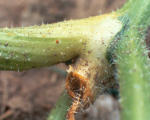
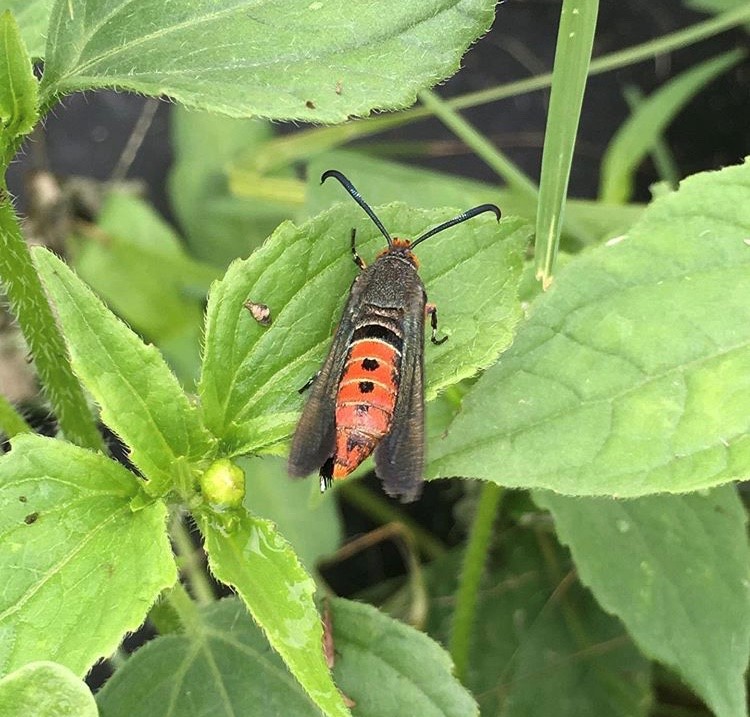
In southwest Virginia we’ve seen a lot of squash vine borer problems this summer. More than usual. This moth pest lays its eggs (singly) at the base of squash or pumpkins, where the larva quickly bores into the plant after egg hatch and ultimately kills the vine or entire plant (as we’ve seen in our squash research plots in Whitethorne, VA).


Control
Squash vine borer can be a major pest challenge for growers and home gardeners. If you only have a few plants to protect, then trying to cover the base of plants with aluminum foil or the cardboard can help as the moth prefers to deposit the egg at the base of plants. This acts as an oviposition deterrent. However, this is not practical for commercial growers and the best control option is an insecticide spray directed at the base of plants where the female moth may contact it and die before laying the egg, or, after egg hatch, the young neonate larvae may die from the insecticide residue before boring into the plant, where it will be protected. Pyrethroids such as Asana XL (esfenvalerate), Baythroid XL (beta-cyfluthrin), Brigade 2EC (bifenthrin), Danitol 2.4EC (fenpropathrin), Hero EW (zeta-cypermethrin + bifenthrin), Warrior II or Lambda-Cy 1EC (lambda-cyhalothrin), Mustang Maxx (zeta-cypermethrin), Permethrin 3.2EC, Tombstone (cyfluthrin), to name a few, are the most effective insecticides for quick contact control of the SVB. As always, please read the label before using any insecticide and be mindful that pyrethroids are toxic to pollinators and other beneficial arthropods. So avoiding spraying when flowers are open and in bloom, and directing sprays to the base of plants will help reduce nontarget impacts.
Corn earworm moth report for July 28, 2022
Corn earworm (=bollworm) moth captures have started to climb in local black light traps. Sara Rutherford (Greensville ANR Agent) reported a nightly average of 17.7 moths; Scott Reiter (Prince George ANR Agent) had 6.5 per night at Templeton and 10.3 at Disputanta; and we averaged 17.9 in Suffolk. Here is the Table. We have also started our corn earworm moth pyrethroid resistance monitoring program–this week we had 55% survival in vials containing 5 micrograms of the pyrethroid, cypermethrin (n=82 moths tested).

Virginia Ag Expo is Thursday, Aug 4
I want to remind everyone that the Virginia Ag Expo, Virginia’s largest field day, is next Thursday, Aug 4. The Expo is an educational, marketing, and social event that farmers and agribusiness look forward to each year. It moves from one location to another each year and strives to showcase the diversity of Virginia Agriculture. Our host this year is Mill Creek Farms and the event will be located at Camden Farm, which is located near Port Royal, right off of Highway 17 in Caroline County.
Precision for Profits is the theme for the 2022 Virginia Agricultural Expo. There will be a wide variety of agribusinesses present (currently over 85 exhibitors) showcasing the latest equipment, technology, goods, and services. Virginia Cooperative Extension will be working with NRCS to highlight the diversity of soils on this farm and the high potential for precision agriculture practices. Field plots are once again a walking, go-at-your-own-pace tour designed to fit your interest and schedule. Breakfast and Lunch will be catered by the vendors shown below.

The Virginia Ag Expo is jointly sponsored by the Virginia Grain Growers and Virginia Soybean Associations, in Cooperation with Virginia Cooperative Extension.
This event is FREE to the public. Click the link below to let us know you are coming!
When to start spraying peanuts for leaf spot and other diseases.
I have had a few questions about starting a peanut fungicide program on slow growing or late planted peanuts recently. The rule of thumb date I typically use is if you haven’t sprayed for leaf spot by July 10th, go ahead and start making applications by that date. I know many growers that may spray once or twice before July 10th or R3 (early pod), but this year may be a good year to start spraying later. My thought process here is that: 1) leaf spot fungicide applications made on young peanuts in the early, vegetative stages are less susceptible to leaf spot; 2) much of the fungicide applied ends up on the soil surface and can’t protect peanuts or be taken up by foliage; and 3) since it seems peanut growth is delayed digging may occur later than normal so fungicide applications may be needed later than normal. If you start spraying now you may increase the number of fungicide applications you end up making, driving up production costs. In fields on rotations of 3 years or less (higher risk of leaf spot), spraying earlier than July 10th may be warranted. The best way to reduce fungicide inputs is by using a spray advisory such as the Virginia Peanut Leaf Spot Advisory available on the Peanut-Cotton InfoNet (https://webipm.ento.vt.edu/cgi-bin/infonet1.cgi) or the Virginia Peanut Hotline at 1-800-795-0700.
Speaking of disease advisories, don’t forget the VSBA (Virginia Sclerotinia Blight Advisory). One thing to make note of with the VSBA is that much of the risk calculated for Sclerotinia blight is based on the vine growth and canopy development of peanuts. So if peanuts are behind in growth the risk of developing Sclerotinia blight is also delayed. Therefore fungicide applications made to prevent Sclerotinia blight should be made later depending on vine growth. I would at least wait until vines are less than 6-inches from meeting in row middles before making a fungicide application specifically for Sclerotinia blight. The Miravis + Elatus tank-mix targets both leaf spot and Sclerotinia blight, so the July 10th start date still applies to the first application of that combination. Keep in mind that if it looks like we may be digging peanuts late that an additional application of Omega 500 may be needed up to 30 days prior to harvest to manage Sclerotinia blight if the second Miravis + Elatus tank-mix is applied in early August. Also, I recommend a FRAC Group 3 or DMI fungicide (like Provost Silver) that’s effective against Sclerotinia blight to go out with the last application of Miravis in case some leaf spot is present at the time of application. FRAC Group 3 or DMI fungicides have some curative or “kick-back” activity which can arrest leaf spot that’s present at the time of application.
Be on the lookout for allium leafminer in your spring onions, garlic, or leeks
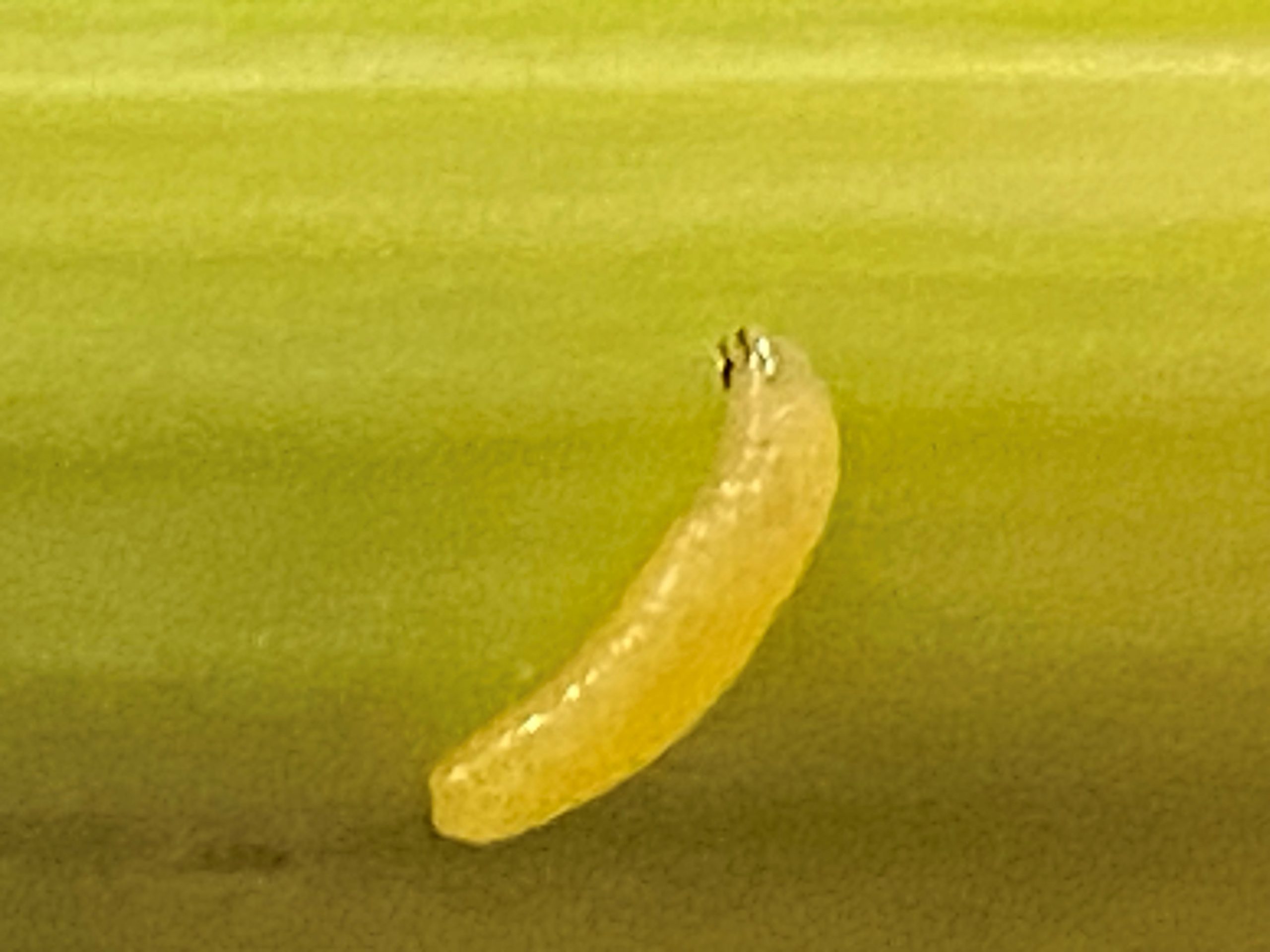
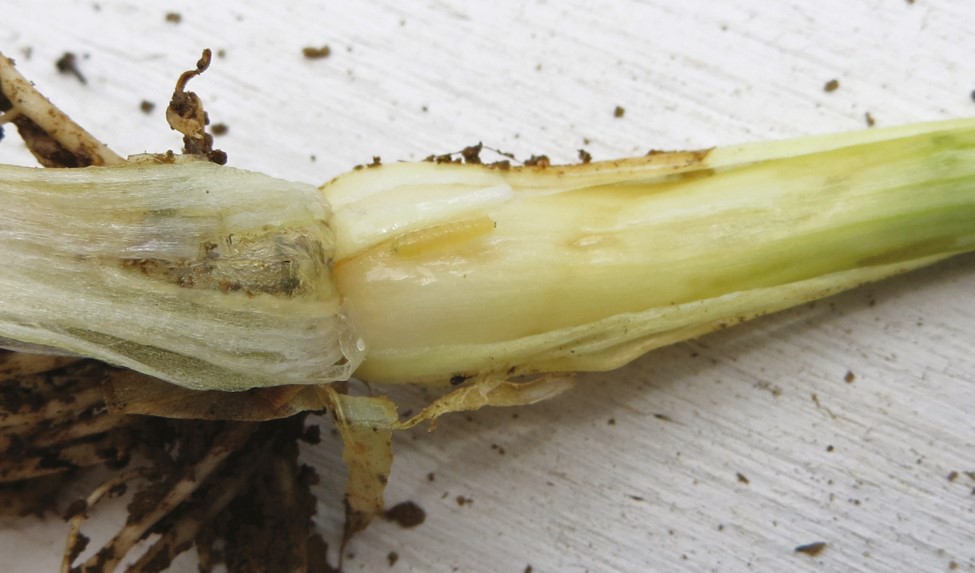
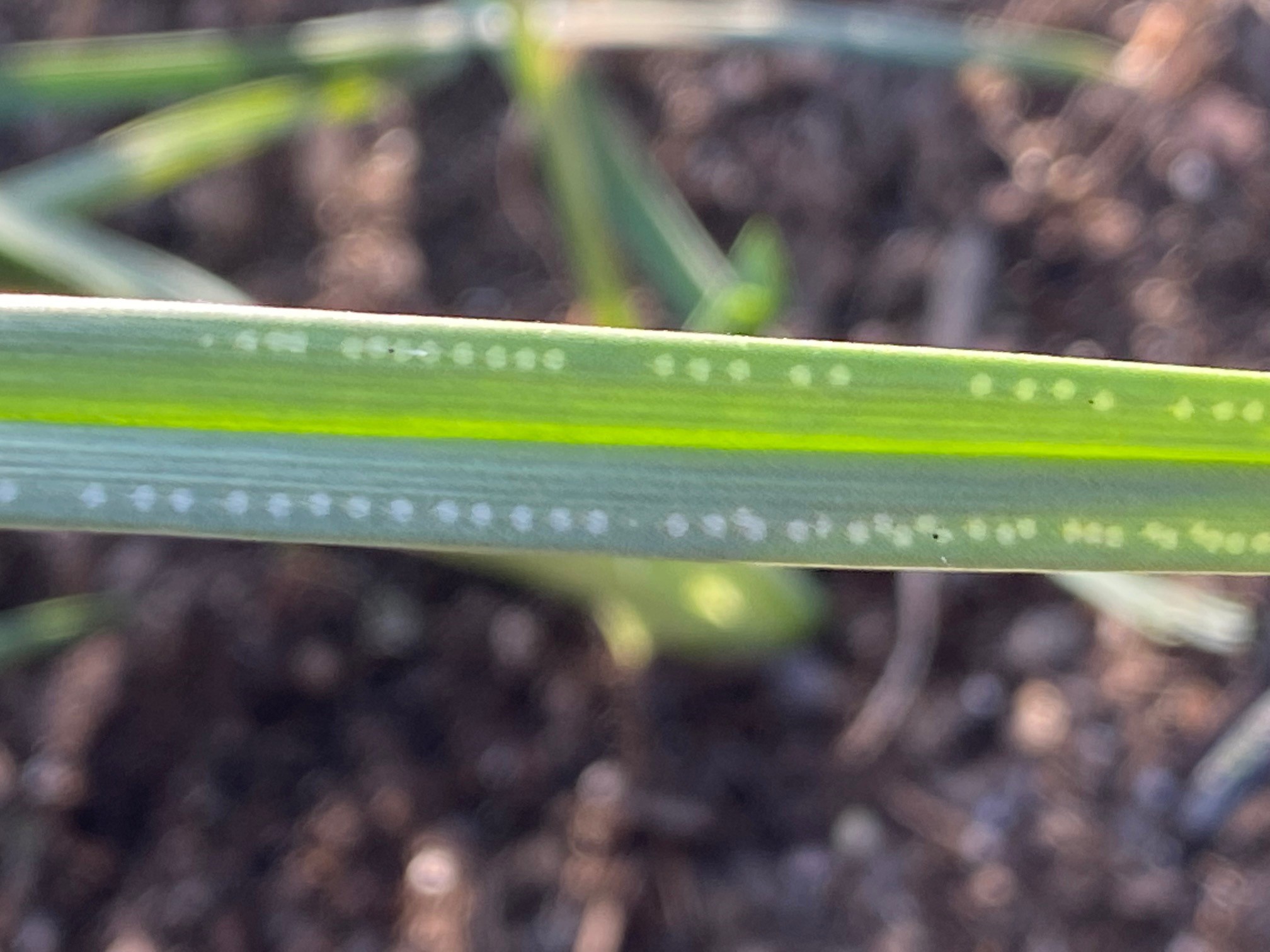
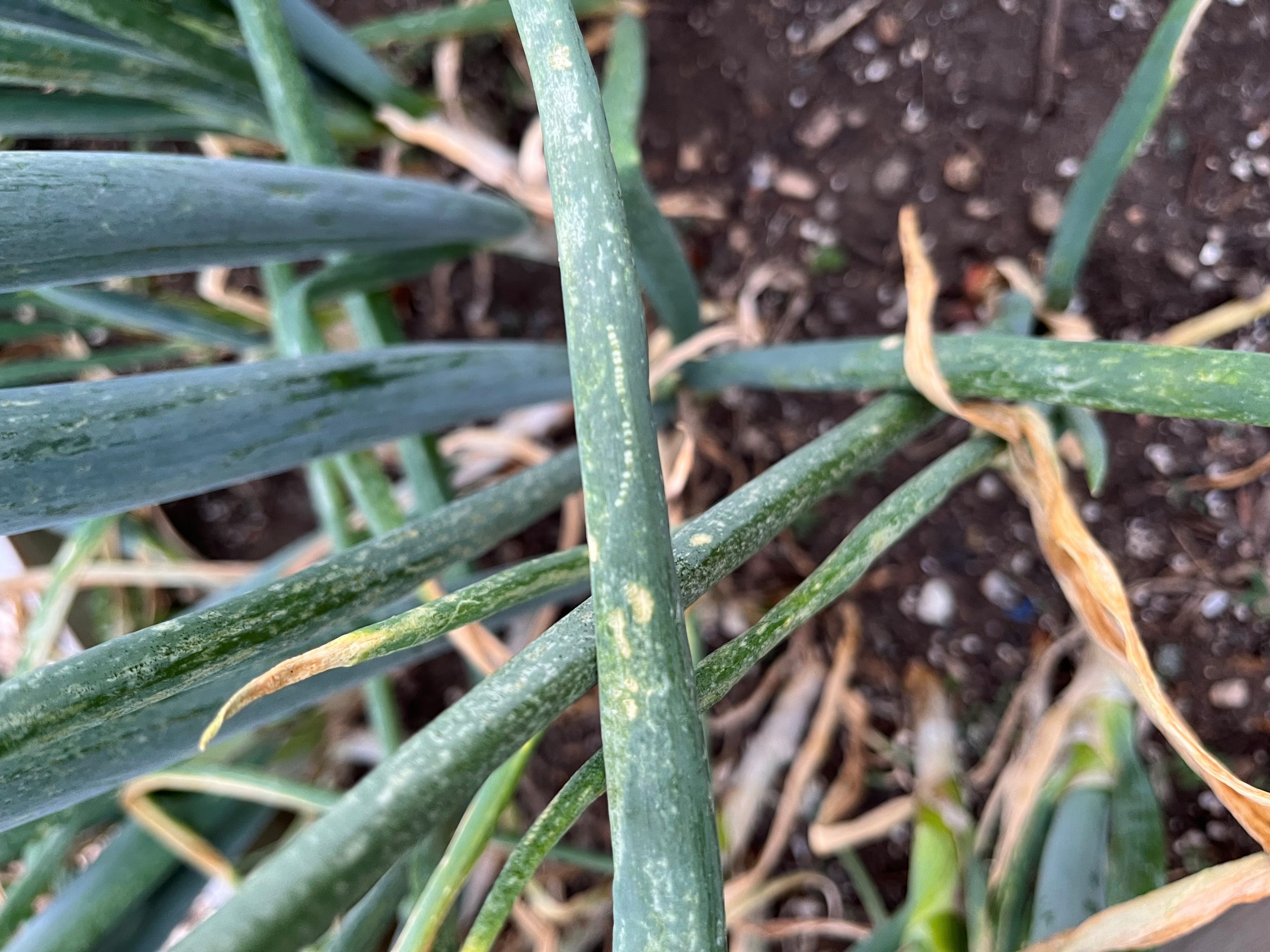
The allium leafminer (ALM), Phytomyza gymnostoma (Loew) (Diptera: Agromyzidae), is an invasive fly species that was first recorded in the U.S. in Pennsylvania in 2015. The pest attacks onions, garlic, and leeks where the larvae (maggots) feed on plant tissue by mining the plant causing wilting and possible death. This new pest to the mid-Atlantic area is a long grey-black fly with a distinctive yellow or orange patch on the top of its head, yellow sides and “knees” (femur-tibia junction), and white halteres (knobs as second pair of wings). The larvae are a typical whitish maggot. Adult females repeatedly puncture leaves with their ovipositor, resulting in a line of small white dots. Leaves can be wavy, curled and distorted. Larvae mine leaves and move into bulbs and leaf sheathes where they pupate. This invasive pest was recorded in southwest Virginia in 2021 and has been found in Montgomery, Carroll, Botetourt, and Bedford Counties in Virginia. Please pass this information on to VCE personnel and Master Gardeners so that we can track the spread of this invasive pest in The Commonwealth. The photos below show the life stages of this pest. The egg laying scars (perfect line of tiny circle marks on stems) are telltale sign.
Control: Covering plants in April-May, or September-October, during the adult flights, can exclude the pest. A number of systemic and contact insecticides can provide effective control including neonicotinoids, diamides, spinosyns, and pyrethroids. Products registered for allium leafminer control include:
Mustang Maxx 2.88 to 4.0 fl oz/A zeta-cypermethrin
Warrior 1.28 to 1.92 fl oz/A lambda-cyhalothrin
Scorpion 35SL 8.75 to 10.5 fl oz/A dinotefuran – soil
Scorpion 35SL 5.25 to 7.0 fl oz/A dinotefuran – foliar
Venom 70SG 5.0 to 6.0 fl oz/A dinotefuran – soil
Venom 70SG 3.0 to 4.0 fl oz/A dinotefuran – foliar
Entrust SC (OMRI) 3.0 to 6.0 fl oz/A spinosad
Radiant SC 6.0 to 10.0 fl oz/A spinetoram
Trigard 75WSP 2.66 oz/A cyromazine
Exirel 13.5 to 20.5 fl oz/A cyantraniliprole
Minecto Pro 7.0 to 10.0 fl oz/A cyantraniliprole + abamectin
2022 Weed Management Field Day
Corn, Soybean, and Small Grains
June 14th, 2022
8:30 to 11:00am
Location: Southern Piedmont AREC. We will not be at the main station, but park directly in the field. Look for signs between Blackstone and the main station on Hwy 40/Darvills Road.
Google Maps link to field entrance: https://goo.gl/maps/iKZmYnjx7wM2
Field entrance near: 1200 Darvills Road, Blackstone, VA 23824. GPS is not always accurate. Field entrance between Nottoway Lanes and Military Road.
Continuing Education Credits Approved:
- NRCS Conservation Planner: 2.0
- DCR Conservation Planner: 2.0
- DCR Nutrient Mgmt Planner: 1.0
- Certified Crop Advisor: 2.0 (Pest Mgmt)
Please register by texting 540-315-2954 or emailing flessner@vt.edu
Highlights:
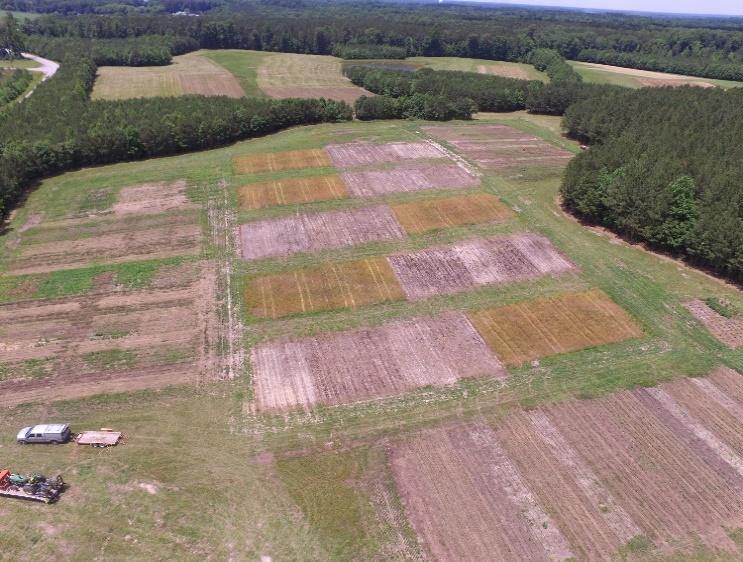
- View over 100 herbicide plots
- Learn about herbicide resistant Palmer amaranth and common ragweed control options
- Cover crops for weed control
- Harvest weed seed control:
- Chaff lining
- Redekop Seed Control Unit
- Pasture herbicide plots
If you are a person with a disability and desire any assistive devices, services or other accommodations to participate in this activity, please contact Michael Flessner at (540-315-2954) during business hours of 8:00 a.m. and 5:00 p.m. to discuss accommodations 5 days prior to the event. *TDD number is (800) 828-1120.
Virginia Cooperative Extension is a partnership of Virginia Tech, Virginia State University, the U.S. Department of Agriculture, and local governments. Its programs and employment are open to all, regardless of age, color, disability, gender, gender identity, gender expression, national origin, political affiliation, race, religion, sexual orientation, genetic information, military status, or any other basis protected by law.
Cooler Soil Temperatures = Delayed Soybean Emergence
The upcoming weekend rainfall (our meteorologists seem assured that it’ll be widespread) should greatly help parts of Virginia that are short on or getting short of topsoil moisture and position us perfectly for a good start to the soybean growing season.
However, with the rainfall comes cooler soil temperatures. Below are predictions for 4-inch soil moisture and soil temperature over the next 10 days from Orange (one of the coolest parts of Virginia) and Suffolk (one of the warmest parts). As you see, soil temperatures will plummet from relatively warm (>60o) to nearly 50o or less over the weekend. While soybean seed will germinate and emerge in a reasonable amount of time at 60O, germination and emergence will be very slow when temperatures dip below this.

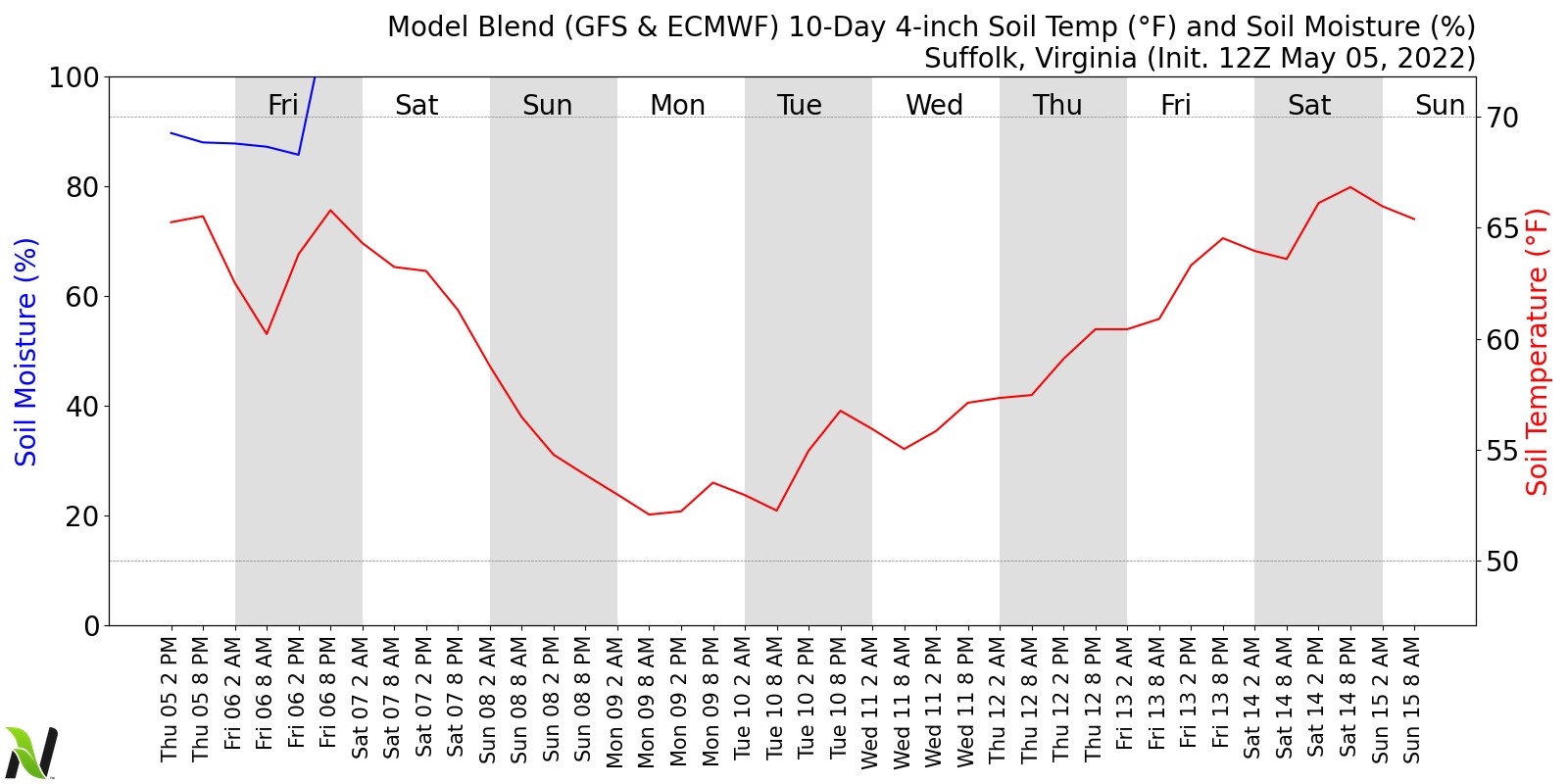
Therefore, heed my suggestion and make sure that you have a good fungicide seed treatment on anything that you are planting now or early next week.
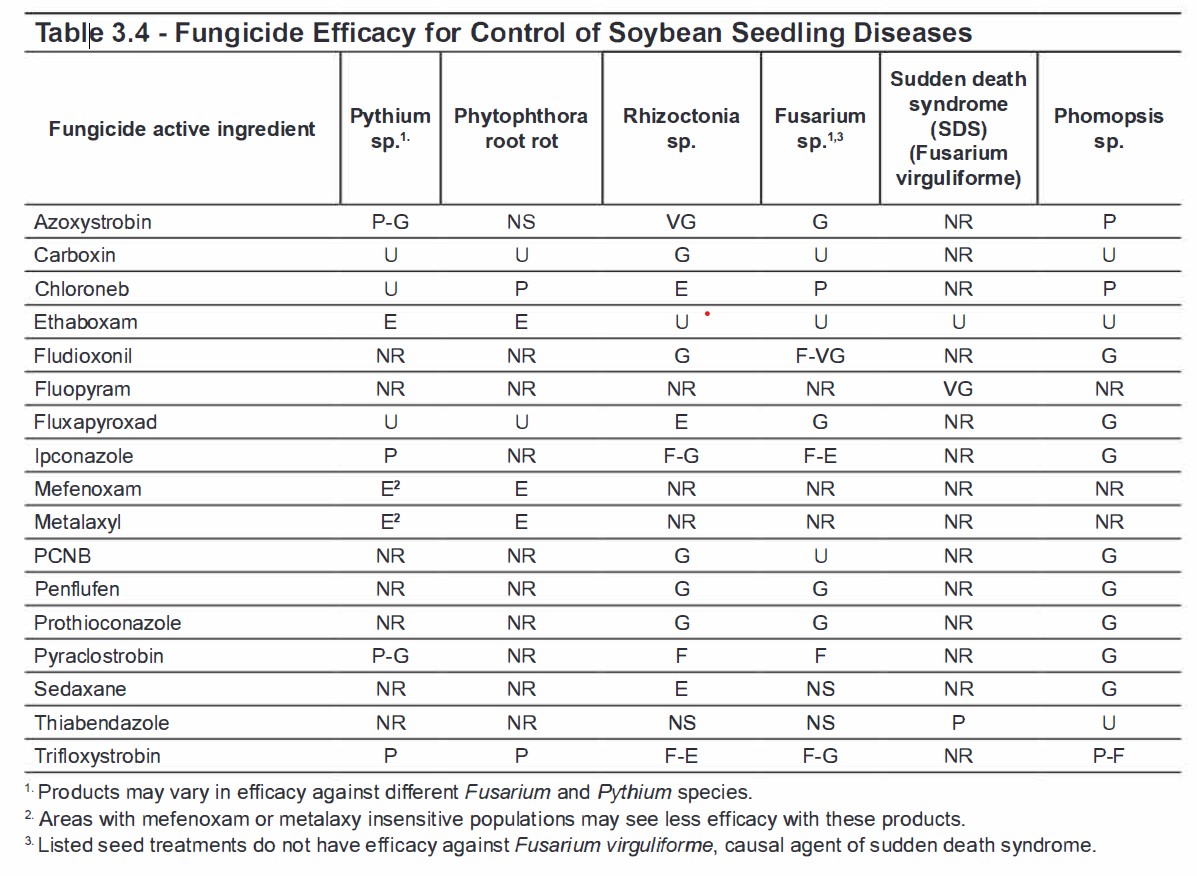
Below is the fungicide efficacy chart from our Pest Management Guide. The main diseases that we need to concern ourselves with are Rhizoctonia and Fusarium sp. If in wet soils, Pythium and Phytophtora sp. could also be a problem with slow-emerging soybean. Be sure to protect a slow-emerging crop with a fungicide containing the active ingredients that provide good to excellent control of the appropriate disease.

Soybean Planting Tips
Many may have already planted. Some have stopped planting other crops such and peanut and cotton due to cool soils and started planting soybean instead. Regardless, an advantage of soybean is that it tolerates a wide range of planting dates. I’ve found no advantage to planting soybean before May and have seen little yield penalty from planting as late as the first week of June, under most conditions. There are advantages to planting early and planting late, but that is not the subject of this post. Contact me for more detailed discussion on this matter-it will take more that a few comments.
With that said, I’ve always preferred May planting due to less risk of frost damage and slow emergence that is common with earlier planting. Still there are big differences in management when planting in early- versus late-May. Here I’ll review a few of these.
- Plant earliest maturing varieties first, then move to later maturing varieties. This will spread risk and harvest dates. We have however observed that early-planting and/or early-maturing varieties work better under productive soils/fields. If planting on poor soils/unproductive fields, later-maturing varieties will extend the growing season and push the critical pod- and seed-filling stages to less stressful times of the year.
- Always plant into moisture. But don’t plant more than 1 inch deep when soils are cool or emergence will be delayed substantially. One-half to 3/4 of an inch is adequate. For later planting dates when soils are warm, one can plant as deep as 1.5 inches and get rapid emergence.
- If planting into cool soils (usually before mid-May), use a good fungicide seed treatment. It could take 10 days or more for the soybean to emerge; plenty of time for soil-born seedling diseases to attack.
- A final plant population of 70 to 100 thousand plants per acre is usually adequate for full-season plantings. This means that 95 to 130 thousand seed per acre is enough, depending on expected emergence. Our research and in other states have observed that less seed is needed with low-yielding fields and greater seeding rates are needed with high-yielding fields. The problem is knowing how much the field will yield.
As always, contact me for more details regarding these tips or discuss other early-season soybean issues.