
The general FeXapan module is now available for online training for applicators in states that accept this method of training. Please see: http://www.dupont.com/products-and-services/crop-protection/soybean-protection/articles/fexapan-training.html
Another Online Dicamba Training Option
Earlier this week I posted links to BASF’s online dicamba training module. Here is another online training option from Monsanto. Again, Michael and myself encourage applicators to attend face-to-face trainings, but know that extenuating circumstance exist. You can access the training at the link below.
http://www.roundupreadyxtend.com/stewardship/education
As always, feel free to contact us with any questions or concerns.
Online Dicamba Training
BASF’s dicamba training module is now live! To access the training visit engeniastewardship.com and click on the training tab.
This online training module satisfies the US EPA requirement for mandatory dicamba training. It should be utilized as an alternative training opportunity for individuals who are unable to attend in-person trainings. BASF and Virginia Cooperative Extension strongly encourages in person training because it offers opportunities for dialogue and questions. Individuals can request in person trainings on engeniastewardship.com.
This online training module will NOT fulfill the Engenia® herbicide label requirement for training in the following states:
- Alabama, Arkansas, Georgia, Indiana, Mississippi, Missouri, and North Carolina: state university / extension training only
- Kentucky and Louisiana: in-person training only
- Florida, Illinois, Iowa, Minnesota, North Dakota, Oklahoma: Currently in-person training only
Time to start planning for horseweed/marestail
Charlie Cahoon and Michael Flessner, Extension Weed Specialists at Virginia Tech
Horseweed or Marestail
Horseweed is a winter or summer annual and a member of the asteraceae family. In the winter annual cycle, horseweed germinates in the fall and overwinters as a basal rosette. The following spring, the rosette bolts, reaching 1.5 to 6 feet in height. While most populations of horseweed in the region emerge in the fall, significant spring emergence can occur under certain conditions. Spring germinating horseweed does not form a rosette. Leaves are alternate, simple, linear to oblanceolate in shape, and lack petioles. Leaf margins are either entire or toothed. Flowers consist of numerous small heads arranged in a panicle with many white ray flowers and 20 to 40 yellow disk flowers. Seed are small and have a pappus of tan to white bristles (resemble dandelion seed). Seed are easily dispersed by the wind, allowing it to quickly spread to nearby fields and within fields.

Bolted horseweed. Virginia Tech Weed ID Guide.
Herbicide resistance: Regionally, glyphosate- and ALS-resistant horseweed are widespread. If you are unsure of the resistance status in your fields, assume resistance to glyphosate and ALS herbicides. Resistance to Gramoxone (PS I-inhibitor) has been reported in Delaware.
Management: Horseweed is more prevalent in no-till fields compared to fields prepared conventionally. Tillage can be useful in the long-term management of horseweed. Chemical control of horseweed is more consistent when the weed is in the seedling or rosette stage compared to bolting plants. Traditionally, glyphosate and ALS-inhibiting herbicides effectively controlled horseweed, however, biotypes resistant to these herbicides are wide-spread. Chemical control of glyphosate- and ALS-resistant horseweed requires a postemergence herbicide to control emerged horseweed and depending on application timing a residual herbicide for horseweed yet to emerge. Due to the prolonged germination period, horseweed seedlings can emerge 5 to 6 weeks after residual herbicide application, thus fall applications of residual herbicides often have limited effectiveness for spring emergence.
Herbicides used for emerged plants include 2,4-D (1 pt in the fall or 1 qt in the spring), dicamba, Liberty, Sharpen, or Gramoxone plus a triazine herbicide (atrazine or metribuzin). Preliminary research from Virginia and North Carolina suggest Elevore (a new auxin herbicide from Dow) also controls horseweed well. Fourteen days are required between Elevore application and corn or soybean planting and 30 days prior to cotton planting. Herbicides providing residual control include Valor SX, triazine herbicides (atrazine, simazine, and metribuzin), and ALS-inhibiting herbicides (if horseweed is not ALS-resistant).
Horseweed seedlings do not tolerate shade. Thus a well-established cover crop, or dense crop canopy can be very effective to manage horseweed infested fields.
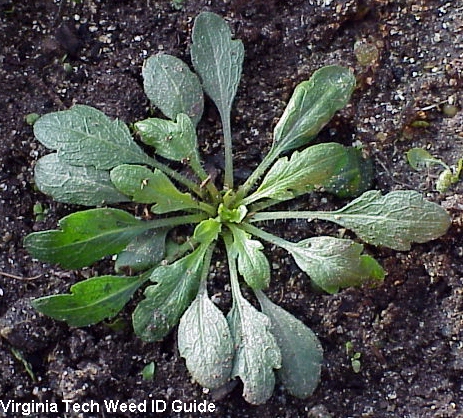
Horseweed rosette. Virginia Tech Weed ID Guide.
Soybeans: The key to managing horseweed in in soybeans is to control it prior to planting. Horseweed needs to be controlled prior to bolting (grow upright); this may require an application weeks prior to planting. Glyphosate plus 2,4-D (1 qt/A), glyphosate plus dicamba or glyphosate plus Sharpen will effectively control glyphosate- and ALS-resistant horseweed when they are small. Pay attention to rotational restrictions of preplant burndown herbicides when planning burndown applications and planting. If horseweed are susceptible to the ALS-inhibiting herbicides, Classic-containing herbicides (i.e. Canopy, Valor XLT, Envive, Surveil) are effective. If applications are made early pre-plant, herbicides containing Valor SX or metribuzin or the Authority products can be included to provide residual control, or a second application of a non-selective herbicide may be needed at planting. Liberty or Gramoxone also control small horseweed and can be used as a part of the burndown application. If horseweed is present at planting, Gramoxone plus a residual product (Valor SX, Authority products, metribuzin, or Sharpen) is suggested in regions with later emerging horseweed. Foliar applied PPO-inhibiting herbicides (Blazer, Reflex or Flextar, Resource, and Cobra) DO NOT control emerged horseweed. For Liberty Link varieties, Liberty applied postemergence controls small horseweed. Classic and FirstRate are postemergence options where horseweed are susceptible to the ALS-inhibiting herbicides and are small.
Cotton: Like soybean, horseweed needs to be controlled prior to cotton planting. Burndown combinations of glyphosate plus 2,4-D/dicamba plus Valor SX is normally in order. Again, pay attention to plant-back restrictions when timing burndown applications. Glyphosate plus Sharpen is also effective, but requires a long waiting period between application and cotton planting.
Corn: In no-till corn, Gramoxone plus triazine, glyphosate plus atrazine plus 2,4-D or dicamba, and Liberty plus atrazine applied burndown of emerged seedlings and residual control of glyphosate- and ALS-resistant horseweed. Consult labels for waiting interval prior to planting corn. Atrazine alone will provide good residual control of horseweed. Dicamba and 2,4-D are the most effective postemergence herbicides. For small emerged horseweed, foliar applied HPPD-inhibitors or Liberty plus atrazine are effective.
Sorghum: Glyphosate plus Sharpen or Gramoxone plus a triazine applied burndown. Atrazine alone or in combination with Gramoxone applied preemergence for residual control and control of small emerged horseweed. Atrazine can be used postemergence for control of small horseweed. However, similar to corn, 2,4-D and dicamba are the most effective postemergence options.
Small grains: 2,4-D, dicamba, Quelex, or Huskie will provide effective postemergence control of horseweed in small grains. Harmony Extra is also very effective on small horseweed that is susceptible to ALS-inhibiting herbicides.
Fall fallow application: In fields with a history of horseweed, fall applied herbicides can be helpful in managing the weed. However, a fall herbicide application will not substitute for a spring burndown application. Target applications for emerged horseweed plants in the late fall after one to two killing frosts. 2,4-D or dicamba should serve as the base for these applications. Glyphosate is often suggested in combination with 2,4-D and dicamba to control other winter annual weeds.
To see similar information on other problematic weeds consult the Virginia Pest Management Guide: Field Crops at http://pubs.ext.vt.edu/456/456-016/456-016.html or the Mid-Atlantic Field Crop Weed Management Guide at https://extension.psu.edu/mid-atlantic-field-crop-weed-management-guide.
As always, don’t hesitate to contact Michael or myself with any questions or concerns.
2018 Mid-Atlantic Commercial Vegetable Production Recommendations
Posted on behalf of Dr. Ramón Arancibia:
The ‘2018 Mid-Atlantic Commercial Vegetable Production Recommendations’ has been posted in the VCE publication website and is available for printing. https://pubs.ext.vt.edu/456/456-420/456-420.html

Virginia Soybean Yield Contest Results Announced
2017 was a great year to grow soybean. We set a new record for average soybean yields in Virginia and most were generally happy with their soybean crop.
Although we did not break Keith Brankley’s 2012 Virginia record of 109 bushels per acre (and this was not irrigated), we did induct 3 new members into the 100-bushel club with the help of irrigation. We also inducted 3 new members into the 90-bushel club and 4 new members into the 80-bushel club without the aid of irrigation.
I invite you to the Virginia Grain and Soybean Conference to share in their success and maybe get a few pointers on how to be the first inductee into the 110-bushel (or greater) club in 2018.
Below are a list of winners:
Double-Crop Contest
3rd place – Patti Craun with 66.8 bu/A using Pioneer P46T30X
2nd place – Kevin Craun with 67.2 bu/A using Pioneer P46T30X
1st place – Steve Smith with 72.3 bu/A using Channel 4916RX/SR
Full-Season Contest
3rd place – Michael Downing with 92.6 bu/A using Asgrow AG45X6
2nd place – Stephen Ellis with 93.8 bu/A using Axis 3916NR
1st place – Curtis Packett with 96.2 bu/A using Asgrow AG4135
Irrigated Contest
3rd place – Steve Hudson with 100.8 bu/A using Channel 4916R2X/SR
2nd place – Jonathan Hudson with 101.5 bu/A using Channel 4916R2X/SR
1st place – Frank Hula with 104.2 bu/A using Local Seed Co. TS3959R2S

The Virginia Grain & Soybean Conference is less than 2 weeks away!
On behalf of both the Virginia Soybean and Virginia Grain Producers Associations, I invite you to join me for the 2018 Virginia Grain and Soybean Annual Conference on February 20-21, 2018. The conference will span two days and is being held at the Richmond Westin Hotel to provide a convenient, comfortable and inviting environment for attendees and their families. In response to increased interest, this year the conference will have a greatly expanded exhibit hall providing a larger and more prominent space for exhibitors and attendees to network.
Continuing to honor your requests that we not include information that you received at the county and regional meetings, we continue to include exciting, innovative, and largely non-production oriented speakers. Furthermore, following the success of last year’s two-day program, the conference has added even more breakout topics, speakers, and programming to help you run a strong, profitable operation. The program will feature keynote speakers and topics certain to bring value to your operation, including: Smithfield Foods’ Chief Strategy Officer and Chief Commodity Hedging Officer Dhamu Thamodaran; The Port of Virginia’s Mid-Atlantic Area Manager Kara Matzko; and FBI Counterintelligence Training Center Special Agents Mark Betten and Matthew Seckers discussing the topic of intellectual property security and the agriculture industry.
As always, your registration includes all meals including a full dinner that will follow the networking reception Tuesday evening, giving you additional time to network and spend time with colleagues and speakers.
Click Here for Individual Registration
Click Here for Sponsorship Opportunities & Sponsors Registration
What’s on the Agenda?
Tuesday, February 20, 2018
10:30am Registration & Exhibitor Trade Show Opens
11:30am Lunch Buffet Opens
12:00pm Lunch & Commodity Market Speaker
Robert Harper, Grain Division Manager, Virginia Farm Bureau Federation
1:00pm Breakout Sessions – Choose One
Weed & Pest Management in Grain & Soybeans
Charlie Cahoon & Michael Flessner, Virginia Tech
Soil Health Strategies for Increased Yields
Chris Lawrence, NRCS Cropland Agronomist & Dr. Mark Reiter, Eastern Shore AREC
Opportunities & Challenges on the Horizon
Dicamba Update from Monsanto
Rapeseed & Organic Opportunities for a Profitable Rotation, Jeff riddell, Perdue AgriBusiness
2:15pm Break & Visit with Exhibitors
2:30pm Breakout Session Repeated – Choose One
3:45pm Break & Visit with Exhibitors
4:00pm Globalization of Agriculture & Commodities
Dhamu Thamodaran, Chief Strategy Officer and Chief Commodity Hedging Officer of Smithfield Foods
5:00pm Reception & Networking in the Exhibit Hall
6:00pm Awards Dinner
This includes corn and soybean yield contest winner presentations. Although we did not break Keith Brankley’s 2012 Virginia record of 109 bushels per acre, we did induct 3 new members into the 100-bushel club, 3 new members into the 90-bushel club, and 4 new members into the 80-bushel club. Of course David Hula and other corn farmers continue to break yield records in that crop – the number of winners is too large to list in this small space.
Wednesday, February 21, 2018
7:30am Breakfast Buffet Opens
8:00am Annual Meetings, Elections, and Reports
8:30am Updates from Secretary of Agriculture & Forestry Bettina Ring
Break & Visit with Exhibitors
10:00am Managing Security Risks in Agricultural Trade
Special Agent Matthew Seckers, FBI, Richmond Division and Special Agent Mark Betten, Unit Chief for the FBI’s Counterintelligence Training Center, FBI Academy, Quantico, VA
11:00am The Agriculture Industry and the Port of Virginia: Growing New Markets
Kara Matzko, Mid-Atlantic Area Manager, Port of Virginia
12:00pm Dicamba Training & Certification Lunchon
Chelsea Valenti, BASF Crop Protection
Where Can I Stay?
We have reserved a room block at the Richmond Westin at the discounted price of $129 per night. Reservations must be made on or before February 6, 2018 by calling 1-888-627-7786. Reference the “Grain & Soybean Annual Conference” rate. You may also visit:
https://www.starwoodmeeting.com/Book/VGASA2018
Final Soybean Variety Test Results
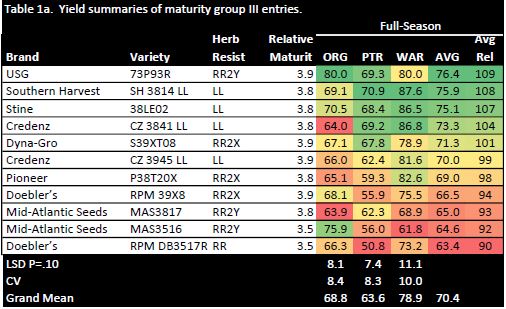
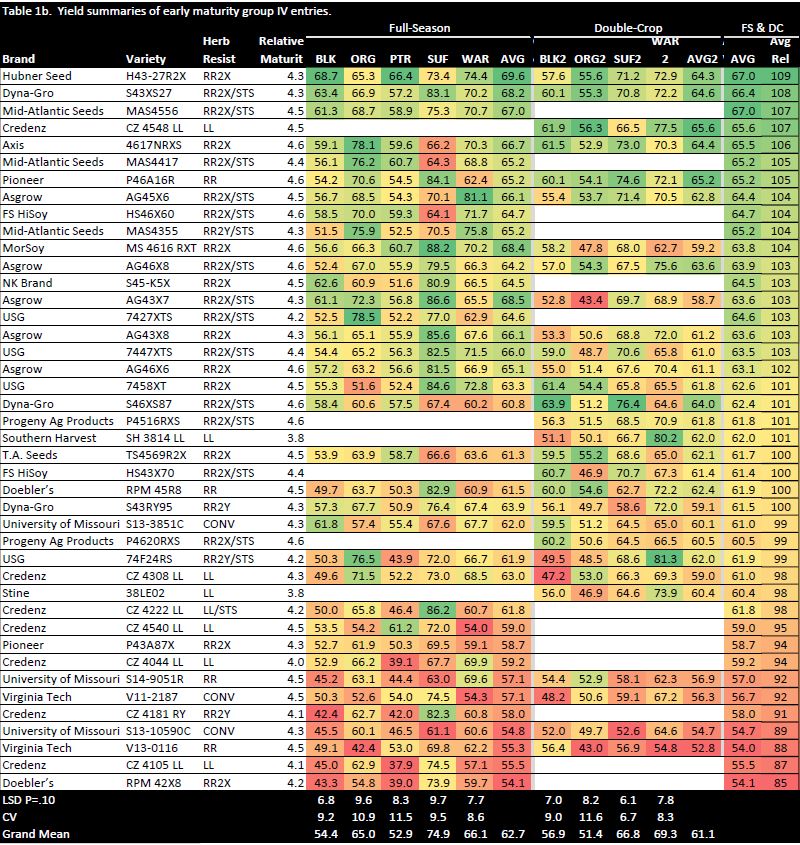
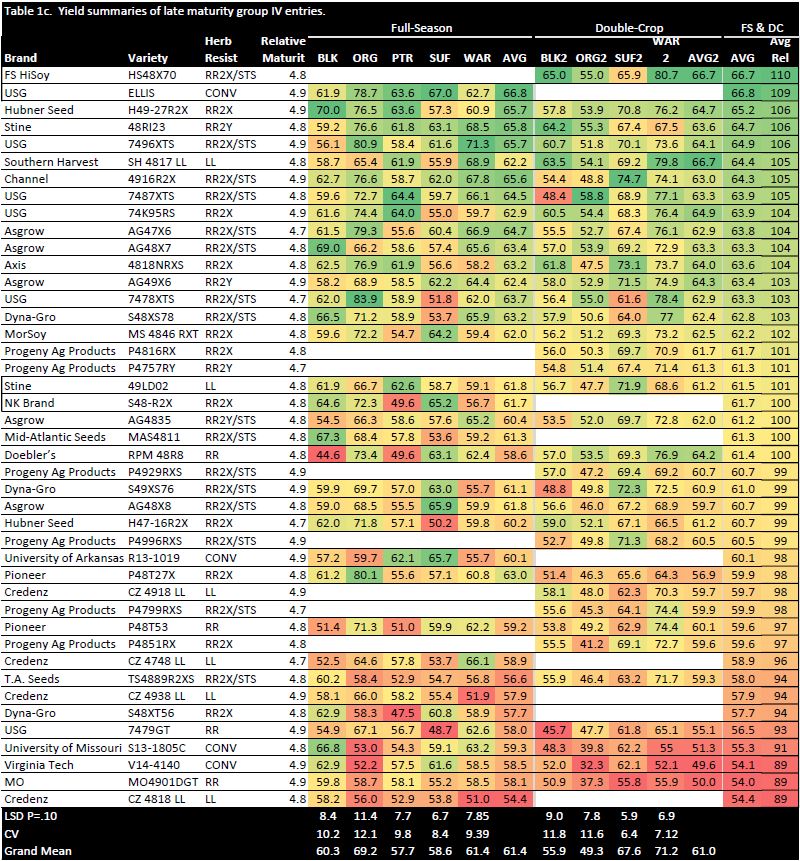
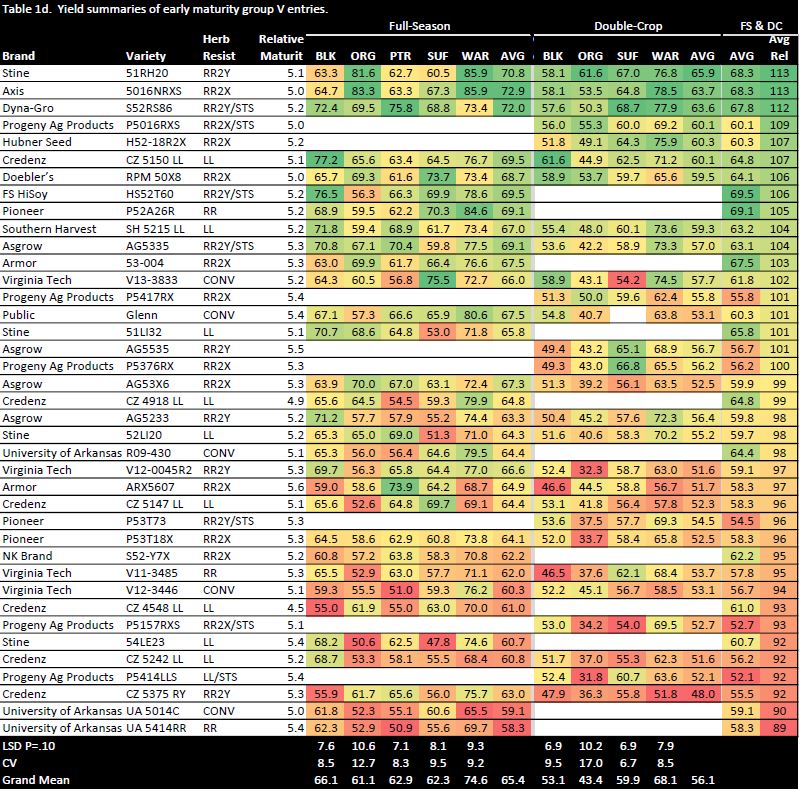
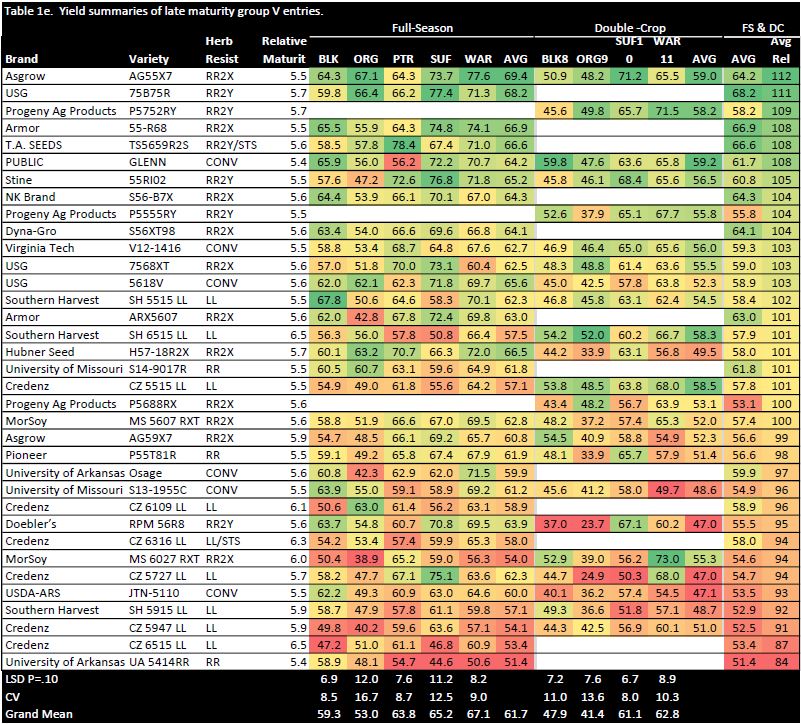
Although I have published preliminary results of the 2017 Virginia Soybean Variety Tests in a previous blog, here are the final results. To obtain a copy of the full publication that contains other performance information, please contact me.
Dicamba Training: Tuesday February 6, 2018 Paul D. Camp CC
For those of you near Franklin, VA, I wanted to let you know of another dicamba training scheduled. BASF will be holding a dicamba training on Tuesday February 6th, 2018 at 4:15pm at the Paul D. Camp Community College Regional Workforce Development Center ( 100 North College Drive Franklin, VA 23851). The training should last about 1 hour.
Just to be clear, this training has been scheduled immediately after the 2018 Virginia Cotton Production Meeting, however, it is not associated with the Virginia Cotton Producers Association nor Virginia Cooperative Extension.
As always, feel free to reach out to Michael or myself with any questions or concerns.
Peanut Variety and Quality Evaluation. I. Agronomic and Grade Data
The 2017 PVQE agronomic and grading results are available here https://pubs.ext.vt.edu/AREC/AREC-231/AREC-231.html. In 2017, 25 peanut breeding lines from the North Carolina State University’s Peanut Breeding program were tested and compared with five commercial cultivars at five locations in Virginia, North Carolina, and South Carolina. At two locations, two digging dates were performed, bringing the number of testing environments to seven. Data include the 2017 released cultivar ‘Bailey II’ tested as line ‘N12008olCLSmT’. Bailey II is a Virginia-type line derived by backcrossing the high oleic seed oil trait patented by the University of Florida into the cultivar ‘Bailey’. Bailey II has approximately 44% jumbo and 43% fancy pods, and seeds with tan seed coat averaging 600 seed lb-1. Bailey II is partially resistant to three of four major regional diseases: leaf spot, Sclerotinia blight, and Tomato Spotted Wilt virus, but it should be considered susceptible to Cylindrocladium black rot. Bailey II has bright pods and flavor comparable with runner-type standards. Yields and the number of days to maturity are similar with Bailey (145 days). In PVQE trials, Bailey II out yielded the popular Bailey in all years of testing.