Distribution of Herbicide-Resistant Italian Ryegrass in Eastern Virginia

Charlie Cahoon, Extension Weed Specialist

Eastern Shore AREC-Virginia Tech

Italian ryegrass is one of the most common and troublesome weeds Virginia small grain producers face.  The weed competes with wheat for essential nutrients, sunlight, and moisture and also interferes with harvest.  In the past, growers have relied upon herbicides, such as Axial XL, Hoelon, PowerFlex, and Osprey, for control of Italian ryegrass.  However, herbicide resistant Italian ryegrass biotypes have developed, limiting the herbicide options available to growers.

During the summer of 2016, the weed group at the Eastern Shore AREC traveled Eastern Virginia in search of resistant Italian ryegrass.  To broaden the survey, we solicited samples from extension agents and members of the agriculture industry.  In total, 82 samples were collected throughout Eastern Virginia (Image 1).  The objective of this survey (and subsequent resistance screening) was to determine the distribution of resistant biotypes in Virginia; allowing growers to tailor management strategies specific to biotypes in their area.

Italian ryegrass heads collected during the summer were allowed to dry down and then threshed to separate the seed.  Approximately 400 seed from each population were planted in a seed tray.  Once Italian ryegrass reached 3.5 to 4 inches in height (1 to 2 leaf), plants were treated with a 1X rate of Axial XL (16.4 oz/A), Hoelon (43 oz/A), PowerFlex HL (2 oz/A), and Osprey (4.75 oz/A). A non-treated check from each sample location was included for comparison purposes.  Visual injury was recorded at 28 days after treatment (DAT) for Italian ryegrass treated with Axial XL and Hoelon.  PowerFlex HL and Osprey are both ALS-inhibiting herbicides and act much slower than the ACCase-inhibiting herbicides (Axial XL and Hoelon).  Therefore, ryegrass treated with these products were evaluated 42 DAT.  Also at 42 DAT, Italian ryegrass biomass (and subsequent % biomass reduction) was determined by cutting and weighing the above ground portion of ryegrass.
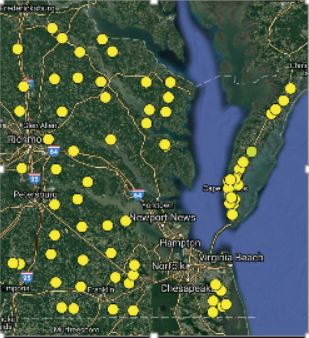
Image 1. Locations of 2016 Italian ryegrass samples collected.

Overall, approximately 23% of all samples collected were resistant to Axial XL (Image 2) compared to 30% that were resistant to Hoelon (data not shown).  Most samples resistant to Hoelon were also resistant to Axial XL.  However, for 6 samples, Axial XL remained effective despite poor Hoelon activity.  Axial-resistant Italian ryegrass is widespread in two of Virginia’s major wheat producing regions (Eastern Shore and southern Chesapeake/Virginia Beach).  Of the 14 samples collected in Northampton Co., 9 were found to be resistant to Axial XL (64%).  In contrast, none of the 5 samples collected from Accomack Co. were Axial-resistant.  In southern Virginia Beach and Chesapeake, 5 of 6 samples collected were resistant to Axial (83% of samples).  Excluding the Eastern Shore and southern Chesapeake/Virginia Beach, only 9% of remaining samples were resistant to Axial XL; 1 samples east of Stony Creek in Sussex Co.; 1 sample south of Waterview in Middlesex Co.; 1 sample northeast of Newtown in King and Queen Co.; 1 sample northwest of Loretto in Essex Co.; and 1 sample south of Somers in Lancaster Co.
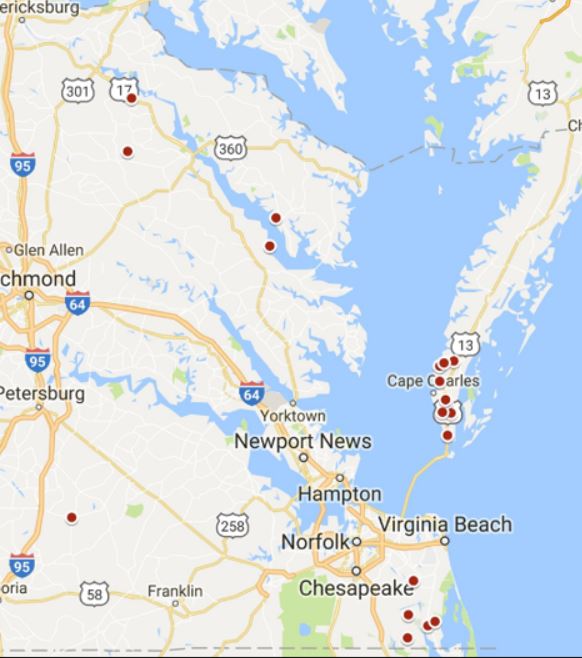
Image 2. Distribution of Axial-resistant Italian ryegrass in Virginia.

ALS-resistant Italian ryegrass is more widespread throughout eastern Virginia.  Of the surveyed populations, 92 and 93% were resistant to Osprey and PowerFlex HL, respectively.  Producers should keep in mind the presence of herbicide-resistant Italian ryegrass nearby does not automatically mean they have a resistant biotype on their farm.  Fields with escaped Italian ryegrass were purposely chosen for this survey.  It is best to rely on field history and performance of herbicides in the past when making management decisions.  However, it is always a good idea to rotate modes of action to delay the development of resistant biotypes.

Unfortunately, if ryegrass is resistant to Axial XL and the ALS-inhibiting herbicides (Osprey and PowerFlex HL), there are no postemergence options left.  In this situation, a residual product that includes pyroxasulfone (Anthem Flex and Zidua) is suggested delayed-preemergence or early postemergence.  These products offer residual control of ryegrass only (they will NOT control emerged ryegrass).  It is imperative that these products are applied and activated by a timely rainfall prior to ryegrass emergence.  Rotating away from wheat also presents an opportunity to control Italian ryegrass (and prevent seed production) with glyphosate early burndown prior to planting corn or full-season soybean.  Be aware that glyphosate-resistant Italian ryegrass is suspected in northeast North Carolina and eastern Virginia.  In this situation, paraquat plus a residual herbicide like s-metolachlor applied to fallow ground during the fall would be in order.
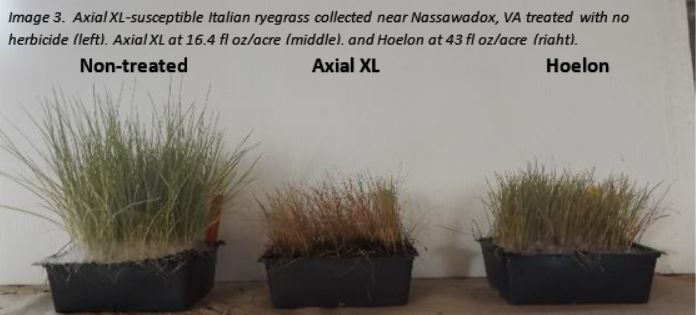
Image 3. Axial XL-susceptible Italian ryegrass collected near Nassawadox, VA treated with no herbicide (left), Axial XL at 16.4 fl oz/acre (middle), and Hoelon at 43 fl oz/acre (right).
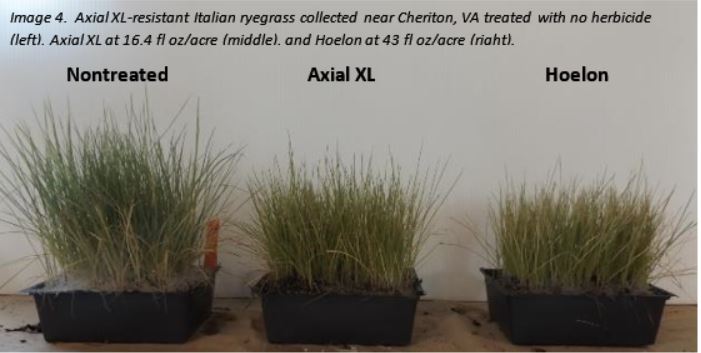
Image 4. Axial XL-resistant Italian ryegrass collected near Cheriton, VA treated with no herbicide (left), Axial XL at 16.4 fl oz/acre (middle), and Hoelon at 43 fl oz/acre (right).


Eastern Shore AREC Field Day CANCELED!

Due to impending rain Tuesday and Wednesday and already saturated soils, the Eastern Shore AREC field day scheduled for Wednesday, September 13, 2017 has been canceled. Let’s hope Hurricane Irma keeps tracking further west. We certainly do not need any more rain!

Estimating Soybean Yield

This is the time of year when many are wondering what kind of yield potential is out there.  You can estimate your yield using the steps outlined below.  But I will warn you that such an estimate is not very accurate until soybean reach the late-R6 or R7 stage.  In my experience, when trying to estimate yields during the late-R5 or early-R6 stages, cut the estimate in half – believe it or not, that usually works!

My point is to use extreme caution.  Never make additional sales based on these “estimates”.  But, such an estimate is useful if you’re thinking about entering a yield contest or just to help ease some worries (or maybe cause more).

To estimate soybean yield:

  1. Calculate the number of pod-bearing plants per acre.  Use the 1/100th of an acre method: Count the number of plants per 70 foot of row (7.5-inch spacing), 35 foot per row (15-inch spacing), or 17.5 foot per row (30-inch spacing) – You can adjust this for other row spacings; then multiply by 1000.  Do this in 5 to 10 locations per field, depending on field size or area of interest.
  2. Estimate the number of pods per plant.  Some say to collect 10 random plants.  I don’t particularly like this method because we tend to select the best plants and overlook the weaker ones with few pods.  I suggest taking 10 plants in a row from the same locations you sampled for plant population.  Divide the number by 10 to get pods per plant.
  3. Estimate the number of seed per pod.  This gets a little more difficult.  You can choose a number from visually observations or you can just use 2, 2.5, or 3 seed per pod to get a range.  If the seed are mature, you can shell and count all pods from several plants at each  sampling location (just remember how many pods you shelled).
  4. Estimate the number of seed per pound.  3,000 seed per pound is about average, but it can range from 3,500 to 2,500 per pound.  Also, be careful with varieties that commonly contain 3 seed pods; the seed of these varieties will almost always be smaller.  Another way to do this is to weigh the seed that you shelled from step 3 – be careful, you need to account for seed moisture and if the seed are not yet mature, they may have not stopped filling.

Use the numbers above to calculate yield using the equation below:

Bushels per Acre  = [(plants/1,000th acre) x (pods/plant) x (seeds/pod)] ÷ (seeds/pound) ÷ (60 pounds/bushel)

The easiest mistake to make is in steps 3 and 4.  I suggest using a range of seed per pod and seeds/pound.  With experience, you’ll get pretty good with yield estimates.

Insect update for Sep. 7, 2017

Most reporting black light trap stations this week had decreased corn earworm moth captures (except for Chesapeake remaining constant). Nightly averages were Chesapeake = 11; Southampton = 1; Suffolk = 8; and Warsaw = 4 moths. Here is the data table:  BLT_7_Sep_2017

No brown marmorated stink bugs were caught this week in the black light traps.

2017 Virginia Soybean Yield Contest

The Virginia Soybean Association in cooperation with Virginia Cooperative Extension would like to announce the 2017 Virginia Soybean Yield Contest. The purpose of the Virginia Soybean Yield Contest is to emphasize and demonstrate the practices necessary to produce maximum economic yields, to recognize those producers who grow high-yielding soybeans, and to gather data on the practices utilized by these outstanding producers. With the help of various seed companies, we reward and promote the achievements of Virginia’s most productive soybean farmers.

There are four Soybean Yield Contest categories: 1) Full-Season, Non-irrigated; 2) Double-Crop, Non-irrigated; and 3) Irrigated (encompasses Full-Season and Double-Crop); and 4) Most Efficient Yield (MEY). First, second, and third place winners of the full-season, double-crop, and irrigated contest will be recognized with appropriate trophies or plaques. In addition, cash awards of $200, $100, and $50 will be presented to the first, second, and third place winners in each of these categories. The winner of the MEY contest will receive a plaque declaring him or her the most efficient soybean producer in Virginia for that year.

In addition, the United Soybean Board is supporting a Soybean Quality Contest for the 2017 season.  The Iowa State University Grain Quality Lab with evaluate these samples for protein, oil, and other quality measures.  You can obtain a sample bag from me.  If you do not have one at the time of harvest, just save a seed sample in a 1 gallon bag and send in to my office.

Printable entry forms and contest details can be obtained from your County Agent or on my website:  (https://www.arec.vaes.vt.edu/arec/tidewater/extension/soybean.html).  I look forward to seeing your entries.

Peanut Maturity in Virginia

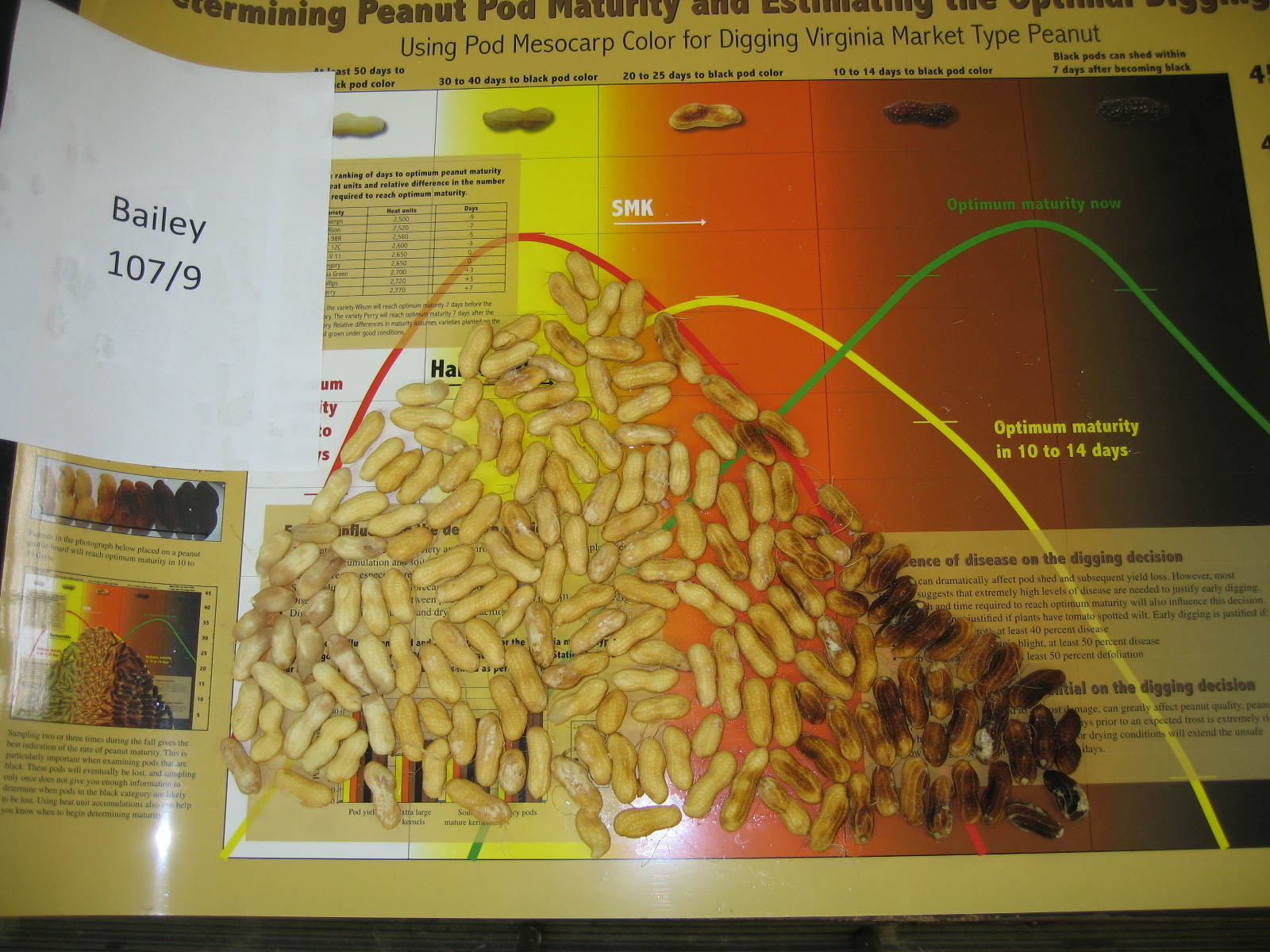
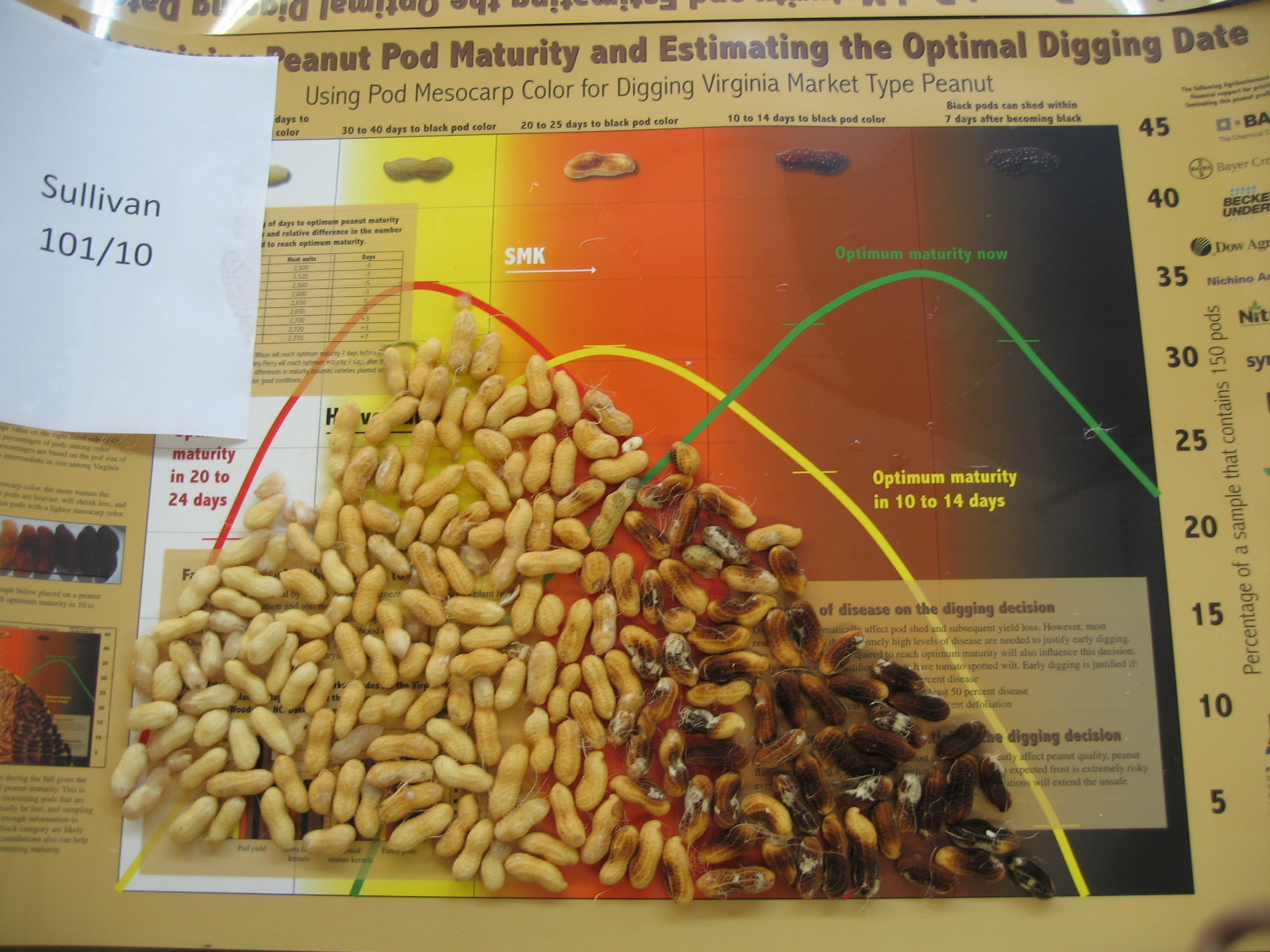
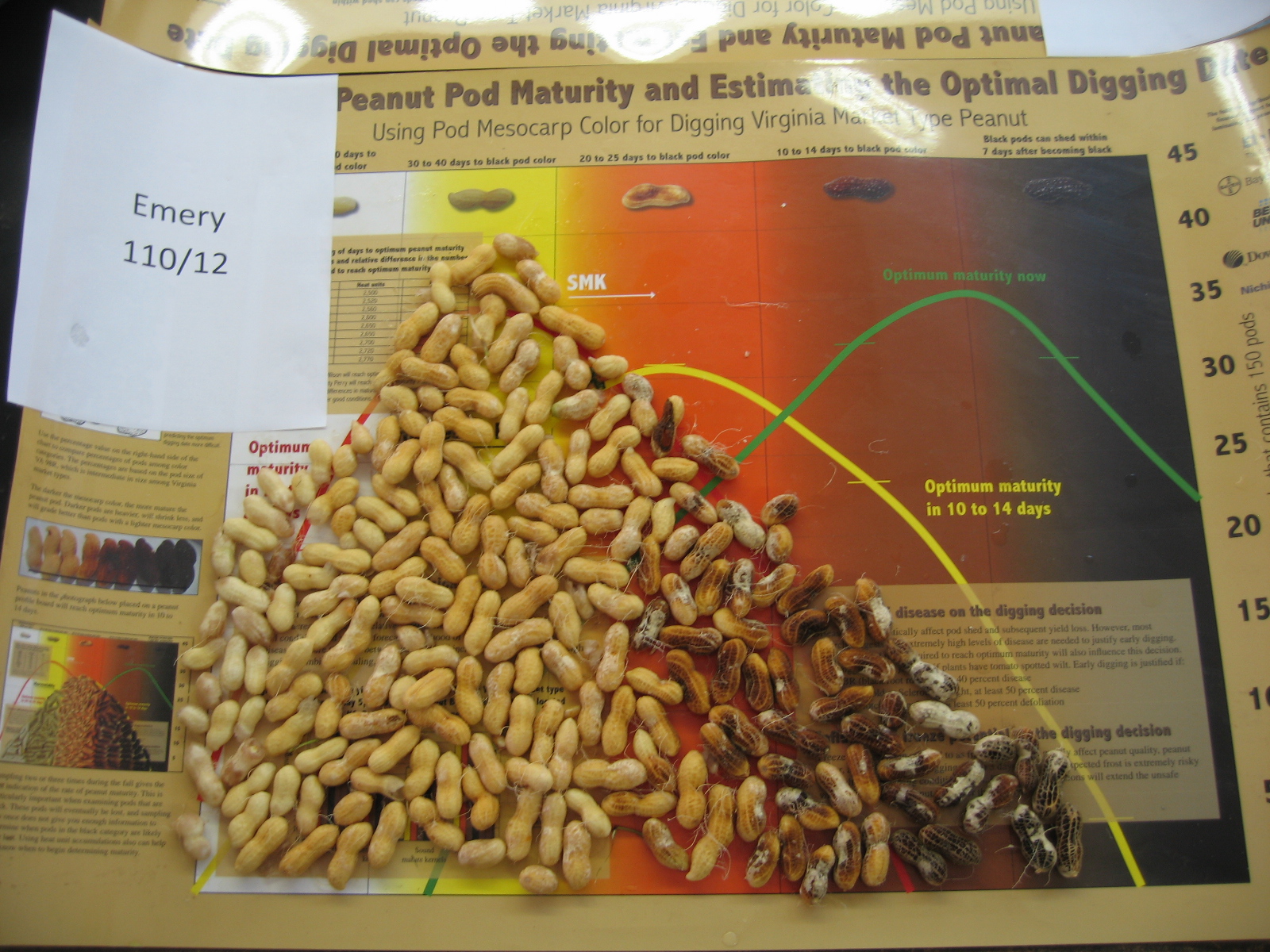
According to the weather recordings (http://webipm.ento.vt.edu/cgi-bin/infonet1.cgi), the heat units received by peanuts grown in Virginia from May 1 through September 5 are in average 2370 °F.  There are, of course, location variations. For example, in Suffolk total heat units from May 1 is 2566 °F, in Southampton 2314 °F, Greensville 2480 °F, and Waverly 2123 °F.  The current Virginia type commercial cultivars predominantly grown in Virginia require in average 2650 °F to optimum maturity. With a daily average of 70 °F recorded in the past week, optimum maturity seems to happen in the next day and a half to 7.5 days. However, would it?

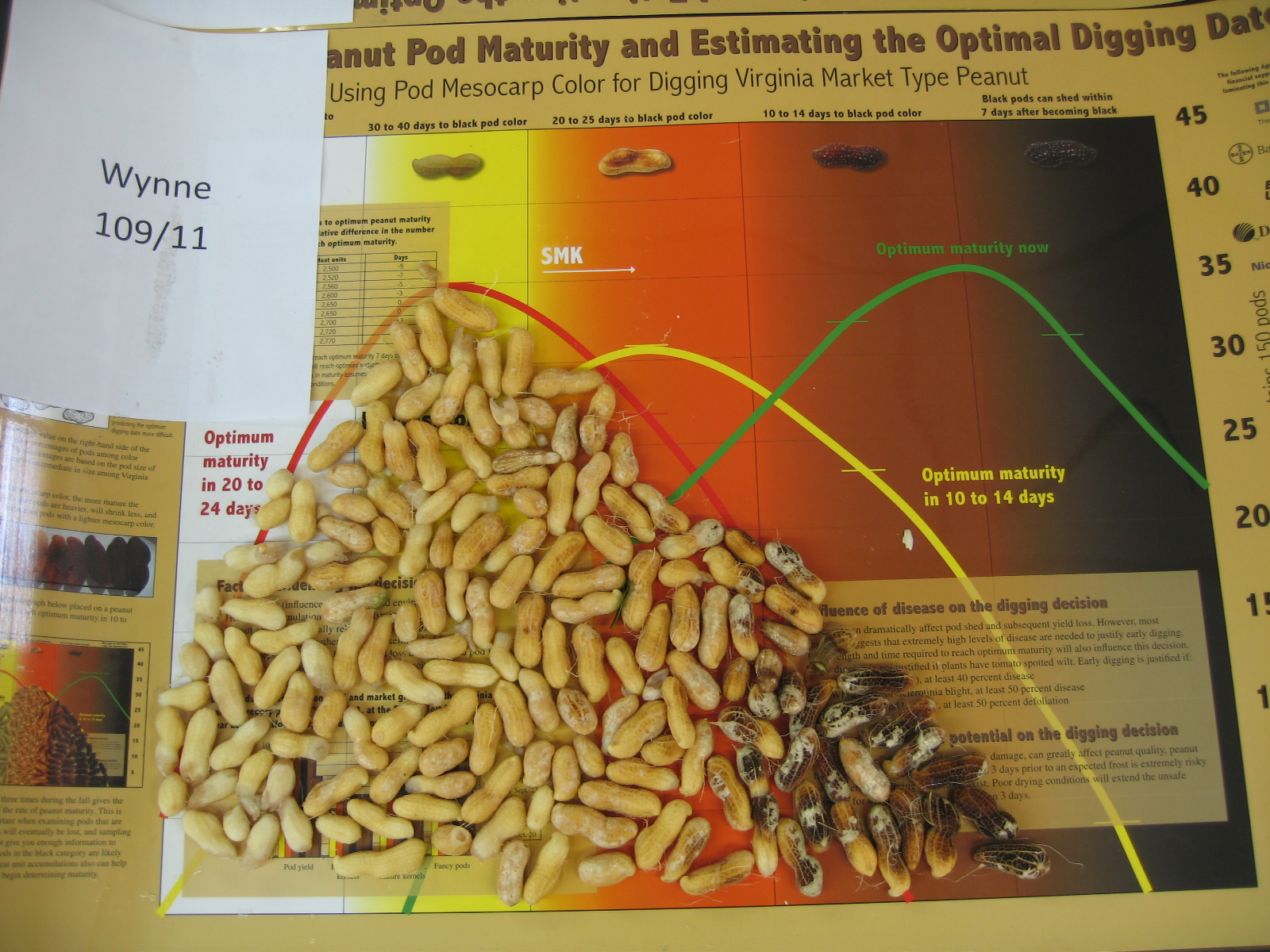
Probably not, and the pictures below prove it. Today, Sep 6, we determined the maturity of four cultivars, Bailey, Sullivan, Emery and Wynn, planted in Suffolk on May 3.  Based on the mesocarp color, when laid on a color maturity chart, it seems that a minimum of 20 to 24 days are still needed to reach the optimum digging for this location and the current season. In average, cultivars only have 1% of black pods, 14% brown, 20% orange, 44% yellow and 22% white.

Pod blasting demonstrations will take place this week Friday, September 8, at the Southampton Fairgrounds from 8:00 AM to noon. It will be a repeat at Indika Farms in Windsor on September 14; times will have to be determined, but probably also in the morning. See you there with your peanut samples to be pod blasted!

Current maturity of Bailey peanut planted on May 3 In Suffolk, VA.

Current maturity of Sullivan peanut planted on May 3 in Suffolk, VA.

Current maturity of Emery peanut planted on May 3 in Suffolk, VA.

Current maturity of Wynne peanut planted on May 3 in Suffolk, VA.

Eastern Shore AREC Field DAY: September 13th, 2017

Please join us for Virginia Tech’s Eastern Shore Agricultural Research and Extension Center (ESAREC) 2017 Research Field Day on Wednesday, September 13th. Registration is free, open to the public and will begin at 8:00 AM at the ESAREC complex located at 33446 Research Drive, Painter, Virginia 23420. The field tour will begin at 9:00 AM and conclude with lunch at 12:30 PM.  See the attached flyer for specific projects to be highlighted and more information.

If you would like more information or are interested in sponsoring this event, please contact Lauren Seltzer at 757-414-0724 ext. 11 or email at mlpeyton@vt.edu.

2017 ESAREC Field Day Announcement

Sweet corn moth trap monitoring in VA – Week of Aug 27, 2017

Monitoring sweet corn for pest moth activity can help reduce the number of insecticide applications.  At Kentland Farm in Whitethorne, VA, we recently harvested the first of several tests, where we followed an IPM approach and compared it to sprays of the pyrethroid lambda-cyhalothrin 3 times per week during silking.  We saw no difference in the level of control from an IPM approach- only spraying when needed and spraying the diamide Coragen first compared with the frequent lambda pyrethroid sprays.   We will be harvesting multiple sites for this experiment and will share these when all of the data are in.  Several commercial sweet corn farms are still being monitored around Virginia for corn earworm and fall armyworm.  However, many fields have been harvested already and trapping has been discontinued.  Moth Trap Catch Data are being recorded by:  Katlyn Catron  (Montgomery Co.); Jason Cooper (Rockingham Co.); Ursula Deitch (Northampton Co.); Helene Doughty (Accomack Co. & Virginia Beach); Kenner Love (Rappahannock Co.); Laura Maxey Nay (Hanover Co.); Steve Pottorff (Carrol Co.); Stephanie Romelczyk  (Westmoreland Co.); Laura Siegle (Amelia Co.); and Mark Sutphin (Frederick Co.).

This week we observed general drop-off in corn earworm moth catch at many locations, but a big jump in numbers in Rockingham County in the Shenandoah Valley.  Fall armyworm moths never really amounted to anything this year. For corn earworm, moth trap catch of less than 1 per night means  low pest pressure and sweet corn sprays can probably be spaced 5-6 days apart during silking.  However, a catch of >1 or >13 moths per night means moderate and high pest pressure, respectively, and a more frequent spray interval (every 3 or 2 days) is justified.  Here are the trap catch results (moths per night) for several locations around Virginia for this week (note we do not have data for all locations):

Week of Aug 27 (avg)
Region County Field CEW/night FAW/night
Eastern Shore Accomack ESAREC – cemetery 3.1 NA
Eastern Shore Accomack ESAREC – woods NA NA
Eastern Shore Accomack ESAREC – sweet corn 2.5 0
Eastern Shore Northampton Bridge Tunnel NA NA
Eastern Shore Northampton Capeville 1 NA 0
Eastern Shore Northampton Cape charles NA NA
Eastern Shore Northampton Eastville NA 0.2
Eastern Shore Northampton Nassawaddox NA 0.4
Virginia Beach Virginia Beach Pungo 1 NA NA
Piedmont Amelia Field 1 NA NA
Piedmont Hanover Farm 1 NA 0.4
Piedmont Hanover Haynes NA NA
Northern Neck Westmoreland Field 1 1.0 0.0
Northern Neck Westmoreland Field 2 NA NA
Shenandoah Valley Rappahannock Field 1 2.7 0
Shenandoah Valley Page Field 1 NA NA
Shenandoah Valley Frederick Farm 1 10.5 0
Shenandoah Valley Frederick Farm 2 15.5 0
Shenandoah Valley Rockingham Farm 1 18.1 0
Shenandoah Valley Rockingham Farm 2 NA NA
New River Valley Montgomery KC 0 0
New River Valley Montgomery KO1 1 0
New River Valley Montgomery KO2 1 NA
New River Valley Montgomery WF1 0 NA
New River Valley Montgomery WF2 0 NA
New River Valley Montgomery WF3 0 NA
New River Valley Montgomery WS1 1 NA
New River Valley Montgomery WS2 0 NA
New River Valley Montgomery WS3 1 NA
Southwest Carroll NA NA

Insect update for Aug. 31, 2017

This week, corn earworm (bollworm) moth captures in the black light trap were down at most locations (steady at Chesapeake and Prince George-Templeton), perhaps partly due to the rainy weather, but some “down” numbers are still pretty high (Suffolk, for example). The table is here: BLT_31_Aug_2017

We had no reports of any brown marmorated stink bugs captured in the black light traps this week.

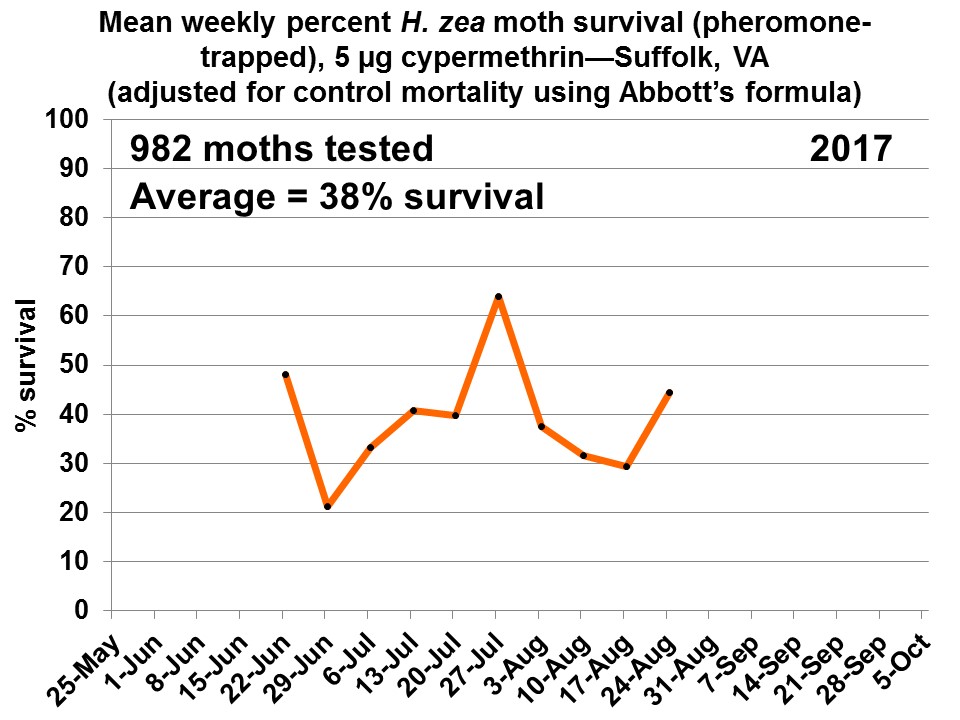
We have vial-tested close to 1,000 corn earworm moths in Dr. Taylor’s pyrethroid resistance monitoring program in 2017, with an average of 38% survival.

Sweetcorn insect pest monitoring across VA for week of Aug 20, 2017

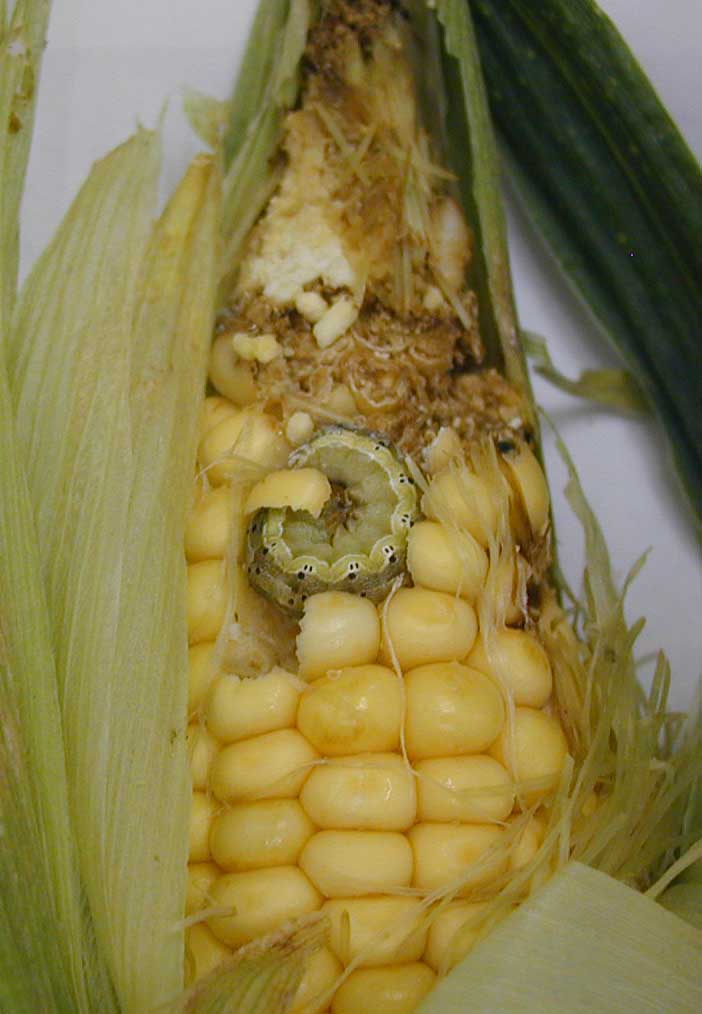
Large corn earworm larva in sweet corn soon getting ready to exit the ear to pupate in the ground.

Monitoring sweet corn for pest moth activity can help reduce the number of insecticide applications.  At Kentland Farm in Whitethorne, VA, we recently harvested the first of several tests, where we followed an IPM approach and compared it to sprays of the pyrethroid lambda-cyhalothrin 3 times per week during silking.  We saw no difference in the level of control from an IPM approach- only spraying when needed and spraying the diamide Coragen first compared with the frequent lambda pyrethroid sprays.   We will be harvesting multiple sites for this experiment and will share these when all of the data are in.  Commercial sweet corn farms are being monitored around Virginia for corn earworm and fall armyworm.  Moth Trap Catch Data are being recorded by:  Katlyn Catron  (Montgomery Co.); Jason Cooper (Rockingham Co.); Ursula Deitch (Northampton Co.); Helene Doughty (Accomack Co. & Virginia Beach); Kenner Love (Rappahannock Co.); Laura Maxey Nay (Hanover Co.); Steve Pottorff (Carrol Co.); Stephanie Romelczyk  (Westmoreland Co.); Laura Siegle (Amelia Co.); Rebekah Slabach (Halifax Co.); and Mark Sutphin (Frederick Co.).

This week we continued to observe moderate (above threshold) corn earworm moth catch at many locations, to warrant continued spraying.  Some of the areas with the highest CEW activity continue to be the Eastern Shore, and Frederick Co.; however, CEW moth catch has increased in Westmoreland, Rockinham, and Hanover Co.   We still have seen few to no fall armyworm moths yet. For corn earworm, moth trap catch of less than 1 per night means  low pest pressure and sweet corn sprays can probably be spaced 5-6 days apart during silking.  However, a catch of >1 or >13 moths per night means moderate and high pest pressure, respectively, and a more frequent spray interval (every 3 or 2 days) is justified.  Here are the trap catch results (moths per night) for several locations around Virginia for this week (note we do not have data for all locations):

Week of Aug 20 (avg)
Region County Field CEW/night FAW/night
Eastern Shore Accomack ESAREC – cemetery 1.4 NA
Eastern Shore Accomack ESAREC – woods NA NA
Eastern Shore Accomack ESAREC – sweet corn 1.4 0.2
Eastern Shore Northampton Bridge Tunnel 8.4 NA
Eastern Shore Northampton Capeville 1 1.3 0
Eastern Shore Northampton Cape charles 1.1 NA
Eastern Shore Northampton Eastville 5.3 0.2
Eastern Shore Northampton Nassawaddox 0.6 0.4
Virginia Beach Virginia Beach Pungo 1 NA NA
Piedmont Amelia Field 1 NA NA
Piedmont Hanover Farm 1 3.4 0.4
Piedmont Hanover Haynes NA NA
Northern Neck Westmoreland Field 1 7.0 0.6
Northern Neck Westmoreland Field 2 NA NA
Shenandoah Valley Rappahannock Field 1 3.5 0
Shenandoah Valley Page Field 1 NA NA
Shenandoah Valley Frederick Farm 1 5.6 0
Shenandoah Valley Frederick Farm 2 14.4 0
Shenandoah Valley Rockingham Farm 1 6.4 0
Shenandoah Valley Rockingham Farm 2 NA NA
New River Valley Montgomery KC NA NA
New River Valley Montgomery KO1 NA NA
New River Valley Montgomery KO2 NA NA
New River Valley Montgomery WF1 NA NA
New River Valley Montgomery WF2 NA NA
New River Valley Montgomery WF3 NA NA
New River Valley Montgomery WS1 NA NA
New River Valley Montgomery WS2 NA NA
New River Valley Montgomery WS3 NA NA
Southwest Carroll NA NA