NIghtly trap averages for corn earworm moths had a wide range this week–please see the attached pdf file for your most local data: CEW_24_Aug
Sweet corn pest monitoring in VA – Moth trap catch for week of Aug 13th
Although corn is not insect pollinated, it doesn’t mean that it doesn’t attract a lot of bees gathering up pollen from the tassels (Fig. 1). Pyrethroid insecticides are quite toxic to bees, so spraying them during pollen shed will undoubtedly result in some bee kills. What can you do if you need to protect your corn from “worm” pests? Spraying an insecticide with low toxicity to bees (i.e., Coragen) during pollen shed can help. Also monitoring for pest activity and possibly limiting the number of sprays can also help.
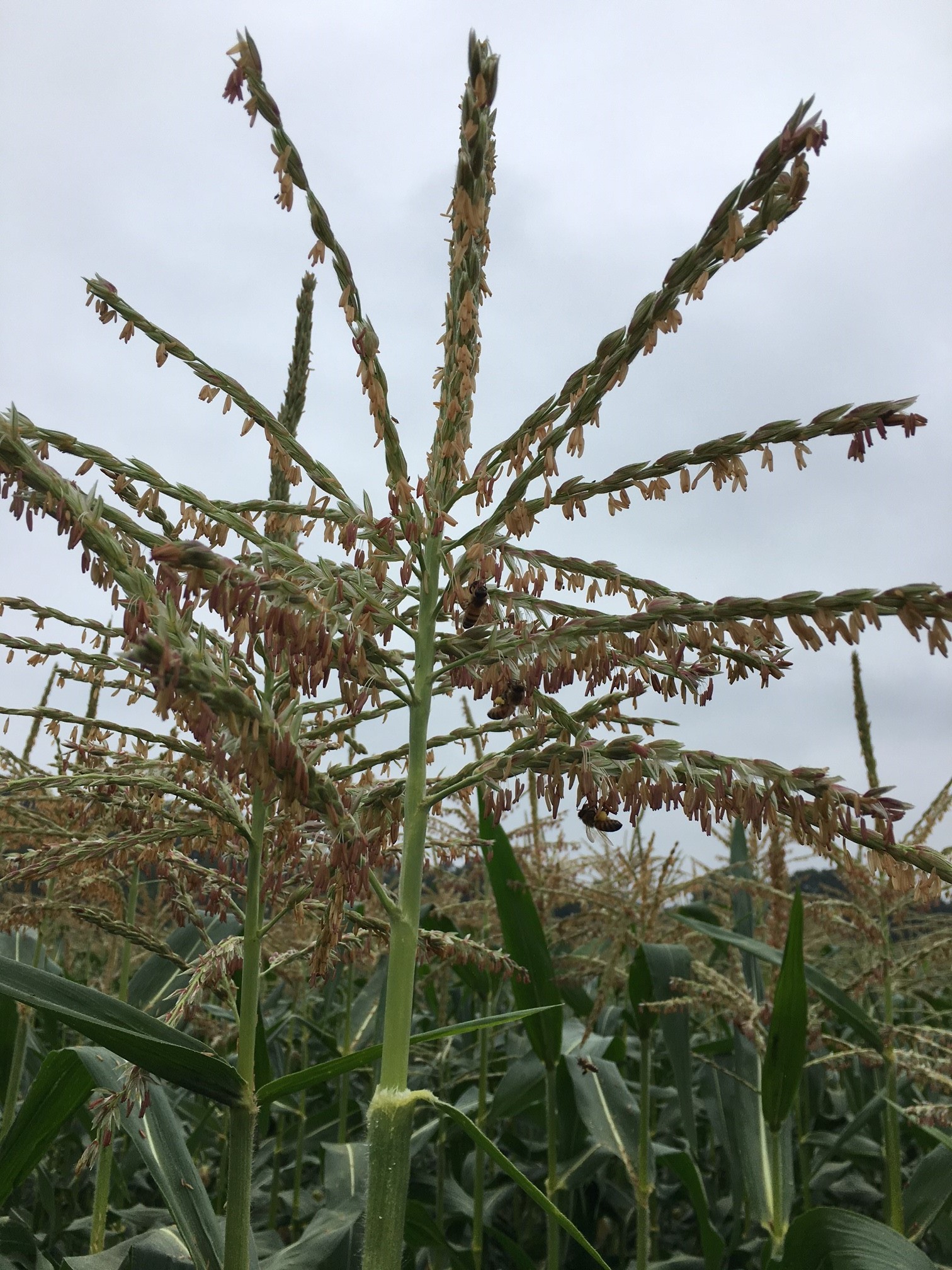
Honey bees gathering pollen from sweet corn at Kentland Farm in Whitethorne, VA.
Sweet corn farms are being monitored around Virginia for corn earworm and fall armyworm. Moth Trap Catch Data are being recorded by: Katlyn Catron (Montgomery Co.); Jason Cooper (Rockingham Co.); Ursula Deitch (Northampton Co.); Helene Doughty (Accomack Co. & Virginia Beach); Kenner Love (Rappahannock Co.); Laura Maxey Nay (Hanover Co.); Steve Pottorff (Carrol Co.); Stephanie Romelczyk (Westmoreland Co.); Laura Siegle (Amelia Co.); Rebekah Slabach (Halifax Co.); and Mark Sutphin (Frederick Co.).
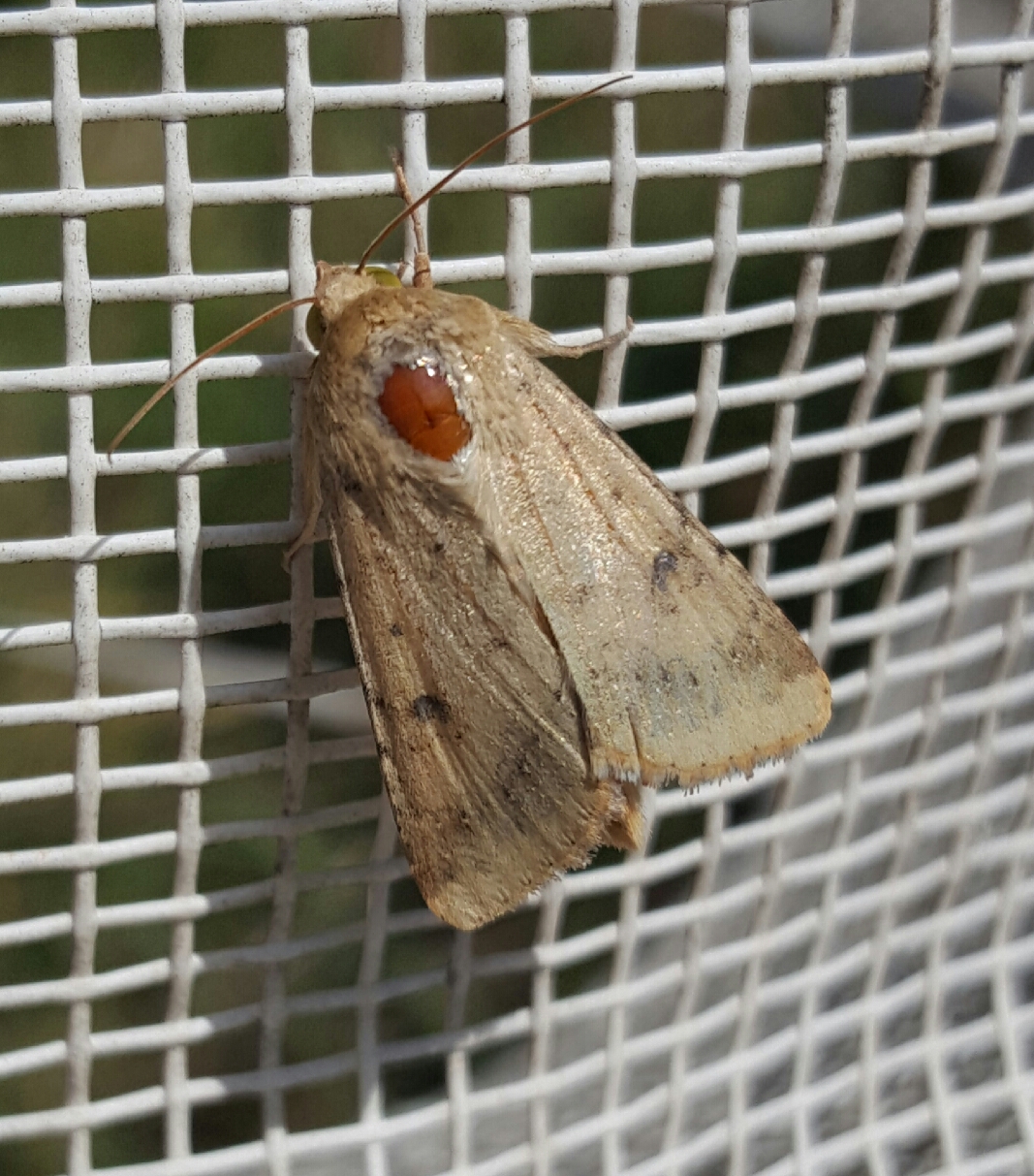
Male corn earworm moth on Heliothis Trap.
This week we continued to observe high corn earworm moth catch at many locations, to warrant frequent spraying. Some of the areas with the highest CEW activity were on the Eastern Shore, Virginia Beach, Frederick Co., Montgomery Co. and Hanover Co. We still have not seen very many fall armyworm moths yet. For corn earworm, moth trap catch of less than 1 per night means low pest pressure and sweet corn sprays can probably be spaced 5-6 days apart during silking. However, a catch of >1 or >13 moths per night means moderate and high pest pressure, respectively, and a more frequent spray interval (every 3 or 2 days) is justified. Here are the trap catch results (moths per night) for several locations around Virginia for this week (note we do not have data for all locations):
| Week of Aug 13 (avg) | ||||
| Region | County | Field | CEW/night | FAW/night |
| Eastern Shore | Accomack | ESAREC – cemetery | 7.0 | NA |
| Eastern Shore | Accomack | ESAREC – woods | 0.2 | NA |
| Eastern Shore | Accomack | ESAREC – sweet corn | 19.7 | 0.2 |
| Eastern Shore | Northampton | Bridge Tunnel | 12.1 | NA |
| Eastern Shore | Northampton | Capeville 1 | 0.8 | 0.5 |
| Eastern Shore | Northampton | Cape charles | 1.2 | NA |
| Eastern Shore | Northampton | Eastville | 3.1 | 0.8 |
| Eastern Shore | Northampton | Nassawaddox | 0.1 | 2 |
| Virginia Beach | Virginia Beach | Pungo 1 | 16.1 | 0.7 |
| Piedmont | Amelia | Field 1 | NA | NA |
| Piedmont | Hanover | Farm 1 | 3.5 | 0.5 |
| Piedmont | Hanover | Haynes | NA | NA |
| Northern Neck | Westmoreland | Field 1 | 0.6 | 0.0 |
| Northern Neck | Westmoreland | Field 2 | NA | NA |
| Shenandoah Valley | Rappahannock | Field 1 | 2.8 | 0.2 |
| Shenandoah Valley | Page | Field 1 | 0.1 | 0 |
| Shenandoah Valley | Frederick | Farm 1 | 5.6 | 0 |
| Shenandoah Valley | Frederick | Farm 2 | 14.4 | 0 |
| Shenandoah Valley | Rockingham | Farm 1 | NA | NA |
| Shenandoah Valley | Rockingham | Farm 2 | NA | NA |
| New River Valley | Montgomery | KC | 0.9 | 0 |
| New River Valley | Montgomery | KO1 | 4.9 | 0 |
| New River Valley | Montgomery | KO2 | 9.4 | 0 |
| New River Valley | Montgomery | WF1 | 1.1 | NA |
| New River Valley | Montgomery | WF2 | 0.6 | NA |
| New River Valley | Montgomery | WF3 | 0.7 | NA |
| New River Valley | Montgomery | WS1 | 2.4 | NA |
| New River Valley | Montgomery | WS2 | 0.9 | NA |
| New River Valley | Montgomery | WS3 | 2.6 | NA |
| Southwest | Carroll | NA | NA | |
Insect update for Aug. 17, 2017
Corn earworm moth captures in the black light traps ranged from 2 to 45 moths per night; brown marmorated stink bug catches ranged from zero to 2.6 per night. Here are the data tables: BLT_17_Aug_2017
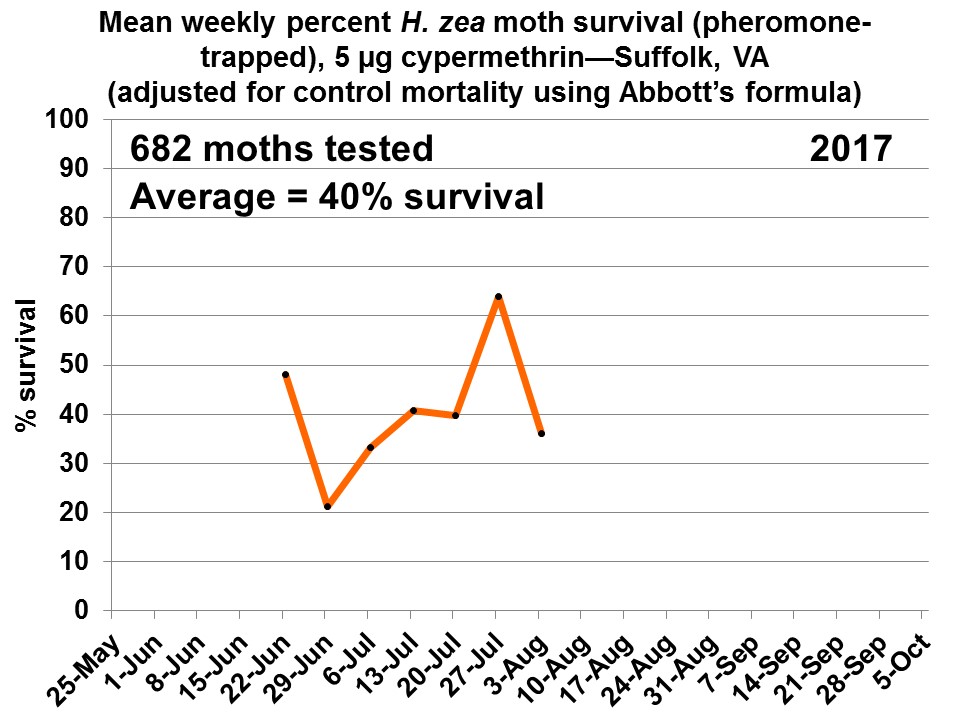
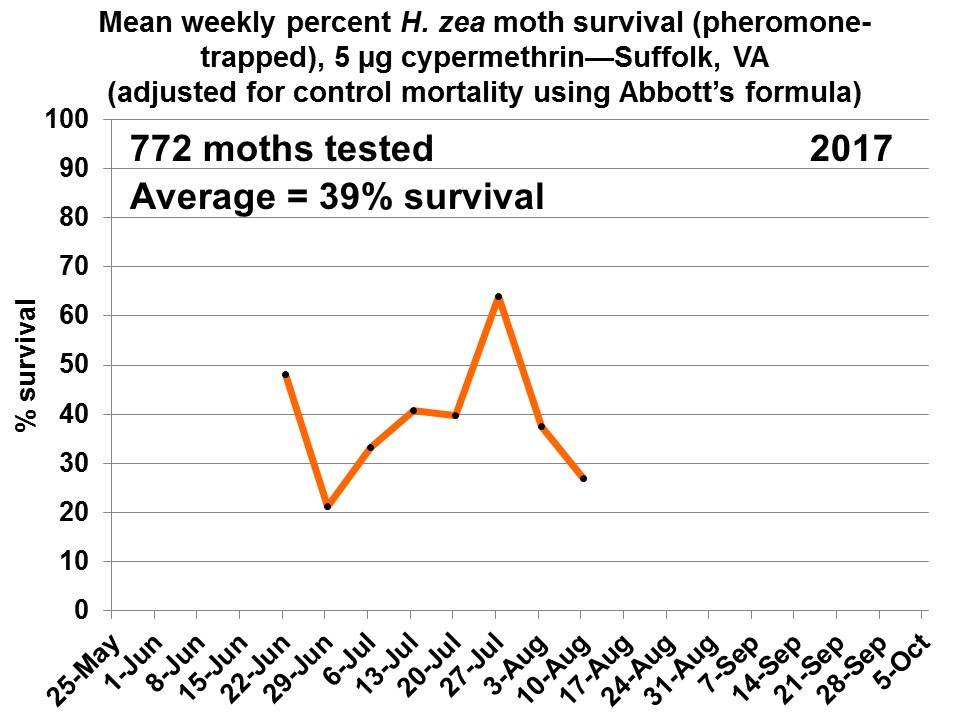
In our corn earworm (bollworm) vial tests, we are averaging 39% moth survival, with 832 moths tested to date.
Sweet corn sampling across Virginia – Moth Catch for Week of Aug 6-10
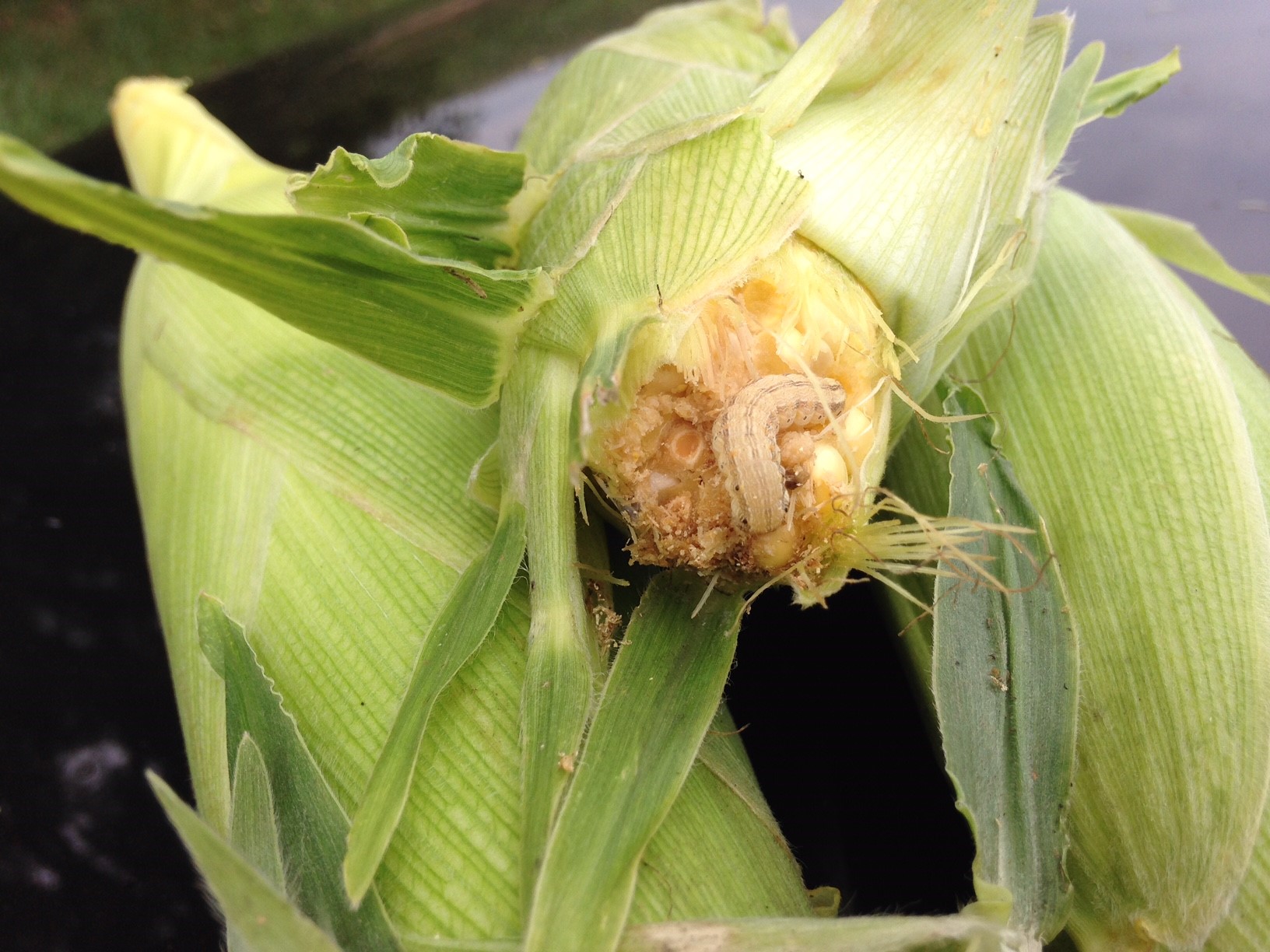
Corn earworm larva developing fine on Bt sweet corn in Page County, VA. Photo by Kenner Love, VCE.
Sweet corn farms are being monitored around Virginia for corn earworm and fall armyworm. Moth Trap Catch Data are being recorded by: Katlyn Catron (Montgomery Co.); Jason Cooper (Rockingham Co.); Ursula Deitch (Northampton Co.); Helene Doughty (Accomack Co. & Virginia Beach); Kenner Love (Rappahannock Co.); Laura Maxey Nay (Hanover Co.); Steve Pottorff (Carrol Co.); Stephanie Romelczyk (Westmoreland Co.); Laura Siegle (Amelia Co.); Rebekah Slabach (Halifax Co.); and Mark Sutphin (Frederick Co.).
Male corn earworm moth on Heliothis Trap.
This week we observed a general increase in corn earworm moth catch at many locations, to warrant frequent spraying. Some of the areas with the highest CEW activity were on the Eastern Shore, Virginia Beach, Frederick Co., Montgomery Co. and Hanover Co. We still have not seen very many fall armyworm moths yet. For corn earworm, moth trap catch of less than 1 per night means low pest pressure and sweet corn sprays can probably be spaced 5-6 days apart during silking. However, a catch of >1 or >13 moths per night means moderate and high pest pressure, respectively, and a more frequent spray interval (every 3 or 2 days) is justified. Here are the trap catch results (moths per night) for several locations around Virginia for this week (note we do not have data for all locations):
| Week of Aug 6 (avg) | ||||
| Region | County | Field | CEW/night | FAW/night |
| Eastern Shore | Accomack | ESAREC – cemetery | 6.0 | NA |
| Eastern Shore | Accomack | ESAREC – woods | 0.2 | NA |
| Eastern Shore | Accomack | ESAREC – sweet corn | 18.6 | 0.9 |
| Eastern Shore | Northampton | Bridge Tunnel | 18.3 | NA |
| Eastern Shore | Northampton | Capeville 1 | 1.0 | 0 |
| Eastern Shore | Northampton | Cape charles | 3.0 | NA |
| Eastern Shore | Northampton | Eastville | 2.7 | 1.8 |
| Eastern Shore | Northampton | Nassawaddox | 0.3 | 0.3 |
| Virginia Beach | Virginia Beach | Pungo 1 | 6.2 | 0.9 |
| Piedmont | Amelia | Field 1 | NA | NA |
| Piedmont | Hanover | Farm 1 | 6.3 | 0.0 |
| Piedmont | Hanover | Haynes | NA | NA |
| Northern Neck | Westmoreland | Field 1 | NA | NA |
| Northern Neck | Westmoreland | Field 2 | NA | NA |
| Shenandoah Valley | Rappahannock | Field 1 | 0.6 | 0.1 |
| Shenandoah Valley | Page | Field 1 | 0.2 | 0.1 |
| Shenandoah Valley | Frederick | Farm 1 | 6.1 | 0 |
| Shenandoah Valley | Frederick | Farm 2 | 28.3 | NA |
| Shenandoah Valley | Rockingham | Farm 1 | 3.4 | NA |
| Shenandoah Valley | Rockingham | Farm 2 | NA | NA |
| New River Valley | Montgomery | KC | 1.3 | 0 |
| New River Valley | Montgomery | KO1 | 18.0 | 0 |
| New River Valley | Montgomery | KO2 | 28.3 | 0 |
| New River Valley | Montgomery | WF1 | 6.8 | NA |
| New River Valley | Montgomery | WF2 | 1.3 | NA |
| New River Valley | Montgomery | WF3 | 6.7 | NA |
| New River Valley | Montgomery | WS1 | 8.8 | NA |
| New River Valley | Montgomery | WS2 | 0.0 | NA |
| New River Valley | Montgomery | WS3 | 4.5 | NA |
| Southwest | Carroll | 0.3 | 0.5 | |
Insect update for Aug. 10, 2017
Black light trap captures of corn earworm/bollworm ranged from 5 to 78 moths per night this week. Brown marmorated stink bug captures ranged from zero to 2 per night. Here are the data tables: BLT_10_Aug_2017
Resistance monitoring of corn earworm/bollworm shows that this season in Suffolk, an average of 39% of moths survived the 24-hour exposure period to the pyrethroid, cypermethrin.
Midsummer peanut updates for Virginia
According with the FSA, 26,323 acres of peanut were planted this year in Virginia; and the crop progresses well so far. The early May planted peanuts are getting close to the full seed growth stage (two pictures of peanut pods and seed are provided here)
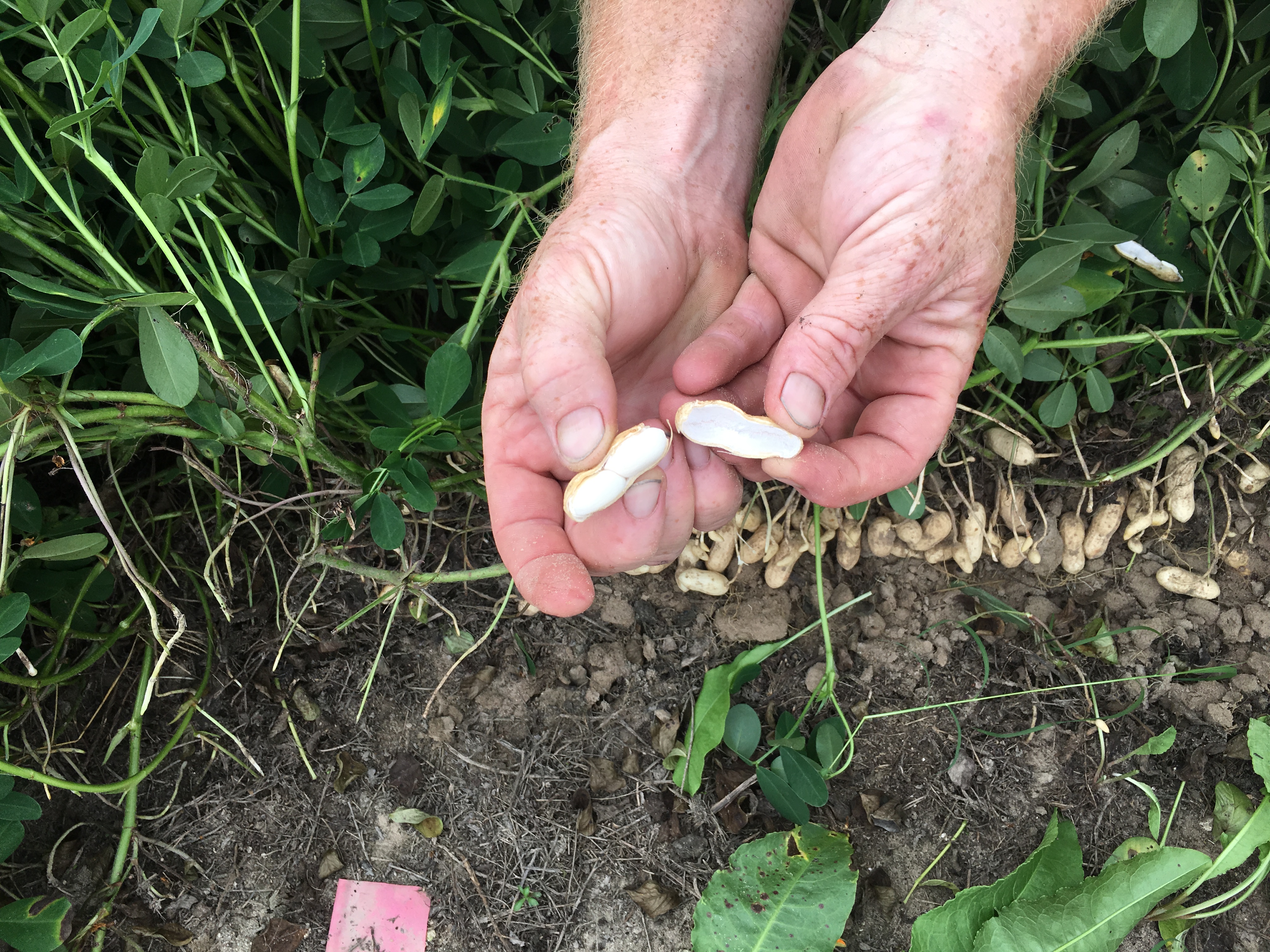
Peanut pod and seed at full seed stage.
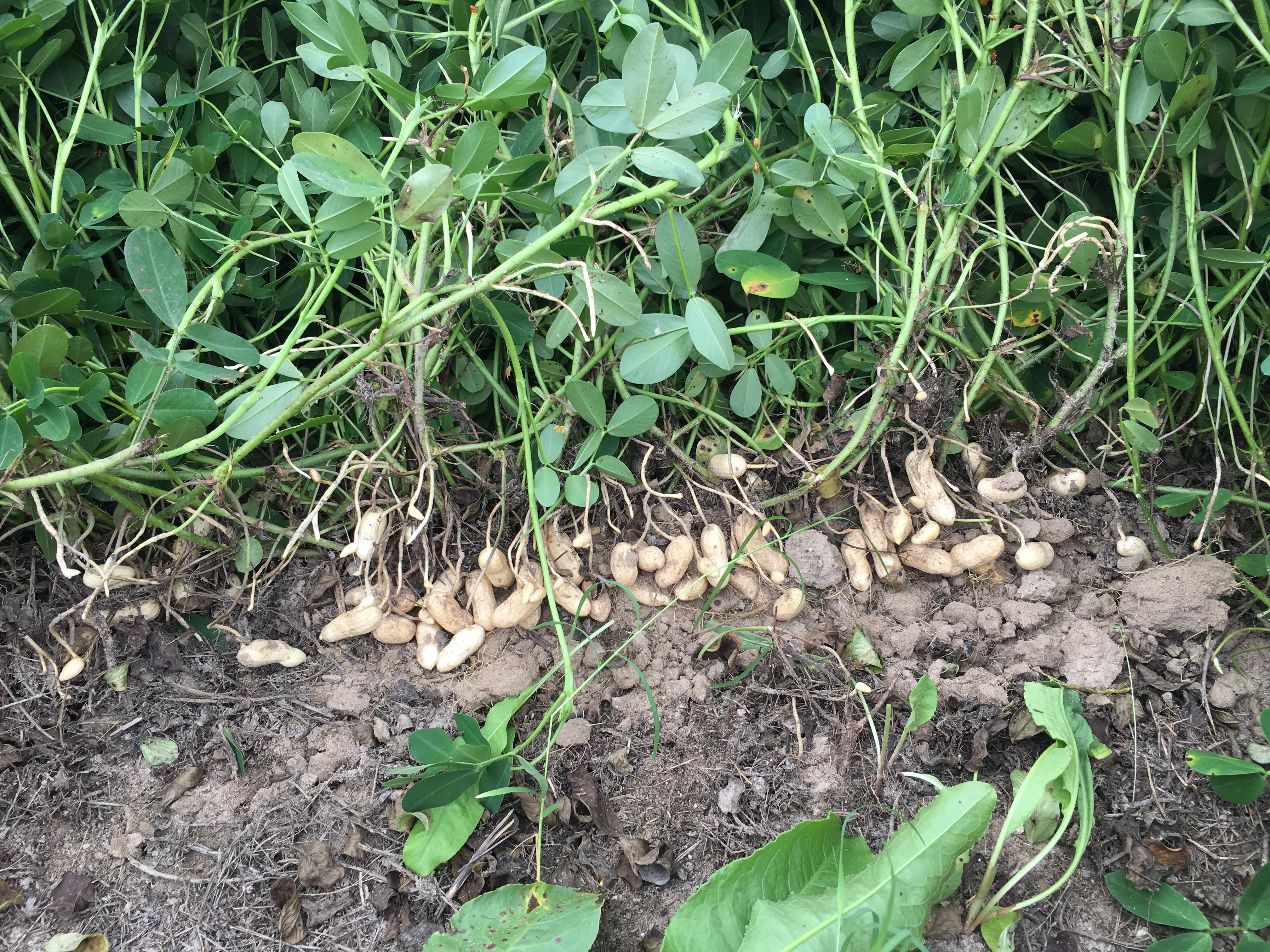
Peanut plants and pods on Aug-7-17 and planted in early May.
.
However, in some sandy fields plants have become yellowish lately. It is difficult to guess the reason for the yellow color. It could be caused by poor inoculation or nitrogen fixing due to drought or water standing; manganese deficiency, which is relatively easy to identify (a picture of manganese deficiency is provided here)
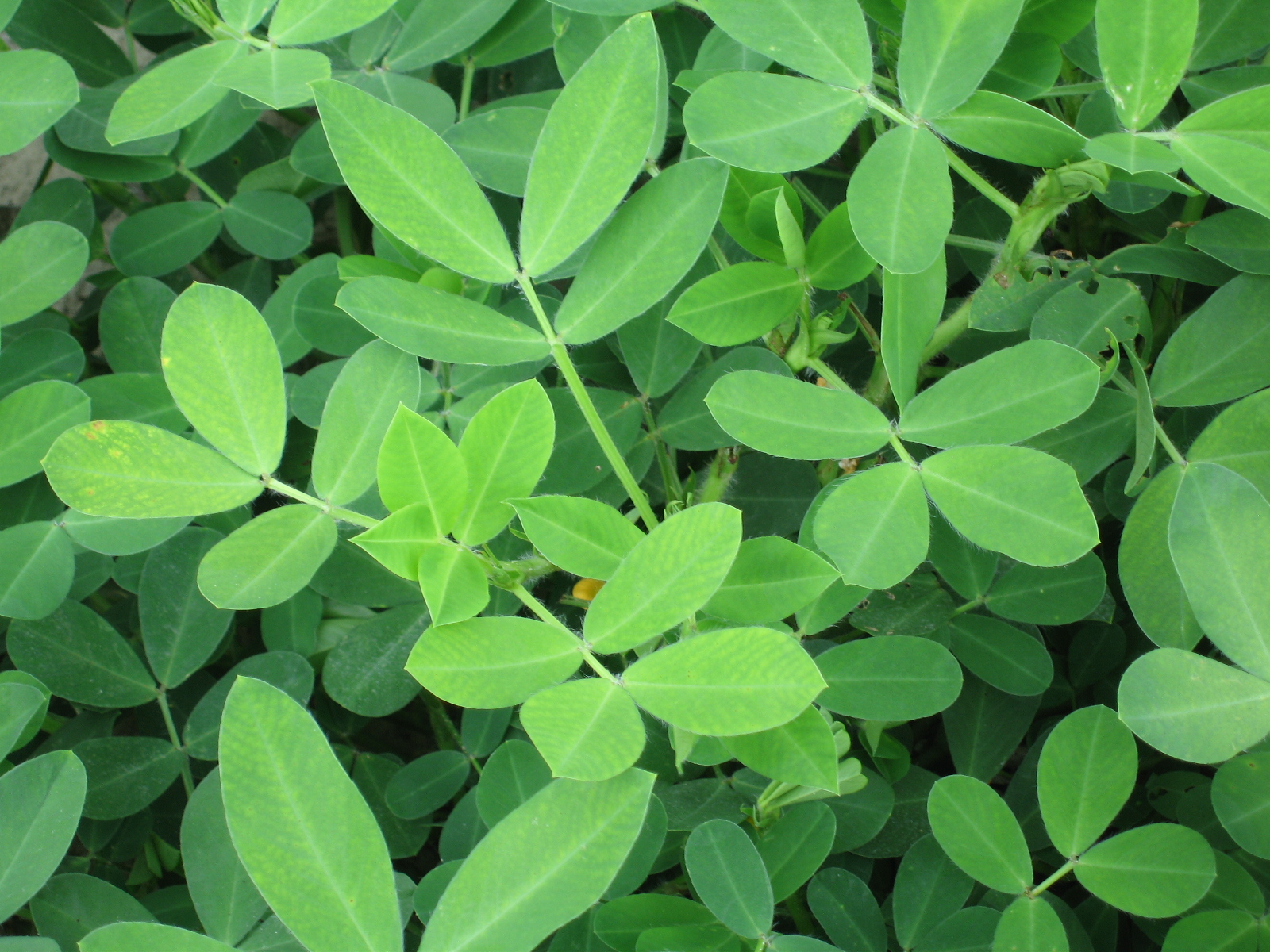
Peanut leaves with manganese deficiency.
; but also acidic soils, which are predominant in south-eastern Virginia. Soil pH directly affects plant growth through its effects on the availability of all nutrients. For example, soils with pH less than 6 may become deficient in calcium, magnesium, phosphorus, potassium, and molybdenum. Molybdenum is essential in biological nitrogen fixation and, even though the nodule numbers may seem sufficient, the result, tissue nitrogen content, may be limited. Gypsum does not alter soil pH; only lime can be used for that, and dolomitic limestone is the desired product as it provides calcium and magnesium. The traditional recommended pH range for peanut land is 5.8 to 6.2, but more towards 6.2 when Virginia-type peanuts are planted. In addition, limestone moves very slowly into the soil, therefore applying limestone early in the planting process and tilling it into the root zone (top 7 inches) is important. Rainfall amount, application of fertilizers containing ammonium or urea, sulfur containing ingredients, and decomposition of organic matter (previous crop residue) also adds to soil acidity. Soil sampling should be taken in the fall and, if the test results indicate a need for limestone, for best results it should be applied in the fall or winter months. If applied just prior to planting and soil is dry, lime will have little effect on the pH.
Going back to the yellow plant color, the best approach for knowing and not just guessing what causes it is to take soil and tissue samples and send to a laboratory for determining the soil pH and tissue nutrient content. The table below shows the sufficiency levels for macro and micronutrients of the peanut vines. It is recommended that 50 whole shoots throughout the field, or problematic areas, should be combined in one sample prior to or at bloom stage.
|
Macronutrients % |
Micronutrients ppm |
||
| Nitrogen (N) | 3.50-4.50 | Iron (Fe) | 60-300 |
| Phosphorus (P) | 0.25-0.50 | Manganese (Mn) | 60-350 |
| Potassium (K) | 1.70-3.00 | Boron (B) | 25-60 |
| Calcium (Ca) | 1.25-2.00 | Copper (Cu) | 5-20 |
| Magnesium (Mg) | 0.30-0.80 | Zinc (Zn) | 25-60 |
| Sulfur (S) | 0.20-0.35 | Molybdenum (Mo) | 0.10-5.00 |
Manganese (1 pound per acre) and boron (up to 0.5 pounds per acre) are regular applications in peanut production during summer, but nitrogen can also be applied if the tissue analysis indicates the need. Rate of 60 to 120 pounds per acre elemental nitrogen (or 285 to 571 pounds per acre of ammonium sulfate) can be applied, depending on the test results; and it is worth applying even at this time (August). After all, there are two more months of peanut growth. Increasingly more fields seem to require potash applications. Peanut is efficient at scavenging phosphorus and potassium left in the soil from previous crops, but for some reason potassium is getting slim each year. An application of 100 pounds per acre of potash may correct that deficiency.
Knowing the history of each field for yield and crop growth, can help to anticipate where nutritional problems may occur and allow for preventive measures even before symptoms are visible. Drone technology can be used to derive soil maps for pH, moisture and yield of each crop in rotation, so that precise locations within a field where problematic spots exist can be known and independently managed using the variable rate technology (VRT). The VRT consists of a control system on an application equipment, planters, sprayers, and spreaders, which allows grower to achieve site-specific application rates of inputs. To work, prescription maps need to be generated and uploaded to the computer within the machine cab that has the VRT. Drones can be used to generated these maps. For example, the last picture in this story shows an image of the soil moisture distribution of a field at the Tidewater AREC. The image was taken before peanut planting with an infra-red camera on a drone; the drone purchased not long ago with funding from the Virginia Peanut Board, the shellers, and Virginia Crop Improvement Association. In the image, the darker the blue the more soil water was available; green color indicated dryer soil sections with the driest spots being colored in yellow and red and located in the patches adjacent to the field.
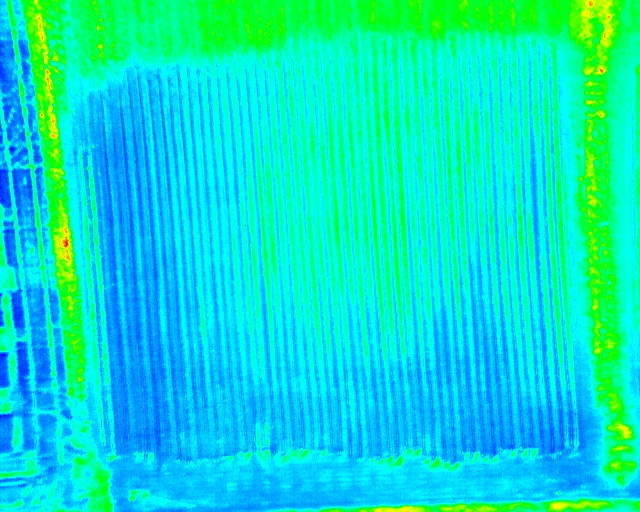
Pre-plant field image taken with an infra-red camera from a drone showing soil moisture distribution.
Potential applications of this technology can help growers to use variable seeding rates and depths depending on the available soil moisture at planting, and monitor irrigation needs throughout the growing season.
Results of the 2017 field corn survey for corn earworm
The attached pdf file is a summary of Dr. Sally Taylor’s corn earworm survey in field corn; it is useful in predicting the corn earworm pressure in other crops such as soybean, cotton, and peanut as moths emerge from the corn. There are many folks to acknowledge this year (also included in the pdf file). Please see: CEW_survey_results_2017
Plant Bug Update – 4 August 2017
Twenty-three representative cotton fields in eight Virginia counties were scouted weekly for mean plant bug density. Data for the July 17th to August 3rd sampling period is represented in the distribution map below (follow link to view). Red dots on the map represent fields that have averaged at or above the spray threshold for plant bug during the sampling period. Plant bug densities for multiple fields has increased substantially since the last update in mid-July. Nineteen of the 23 sampled fields have reached the spray threshold at least once this season since sampling began in late-June. Plant bugs are present in every county sampled and are likely present in at least low numbers in all cotton growing counties in the state. Therefore, we recommend scouting your cotton fields regularly for plant bug.
The spray threshold for plant bug in Mid-Atlantic cotton is eight plant bugs (i.e., adults and nymphs) per 100 sweeps in addition to square retention below 80 percent. We recommend conducting four to eight random 25-sweep samples throughout each field. Once flowering begins, we recommend continuing sweep net sampling and also looking for dirty blooms (pictured below) or sample dime to quarter size-bolls from 25 random plants for internal feeding damage (e.g., warts, stained lint, punctures). Spray treatment may be warranted if dirty blooms and or internal damage exceeds 15 percent and plant bugs are also active in the field. Please refer to the Virginia Cotton Production Guide (pg. 23) or Pest Management Guide (sect. 4, pg. 88) for spray recommendations if spray threshold is reached.
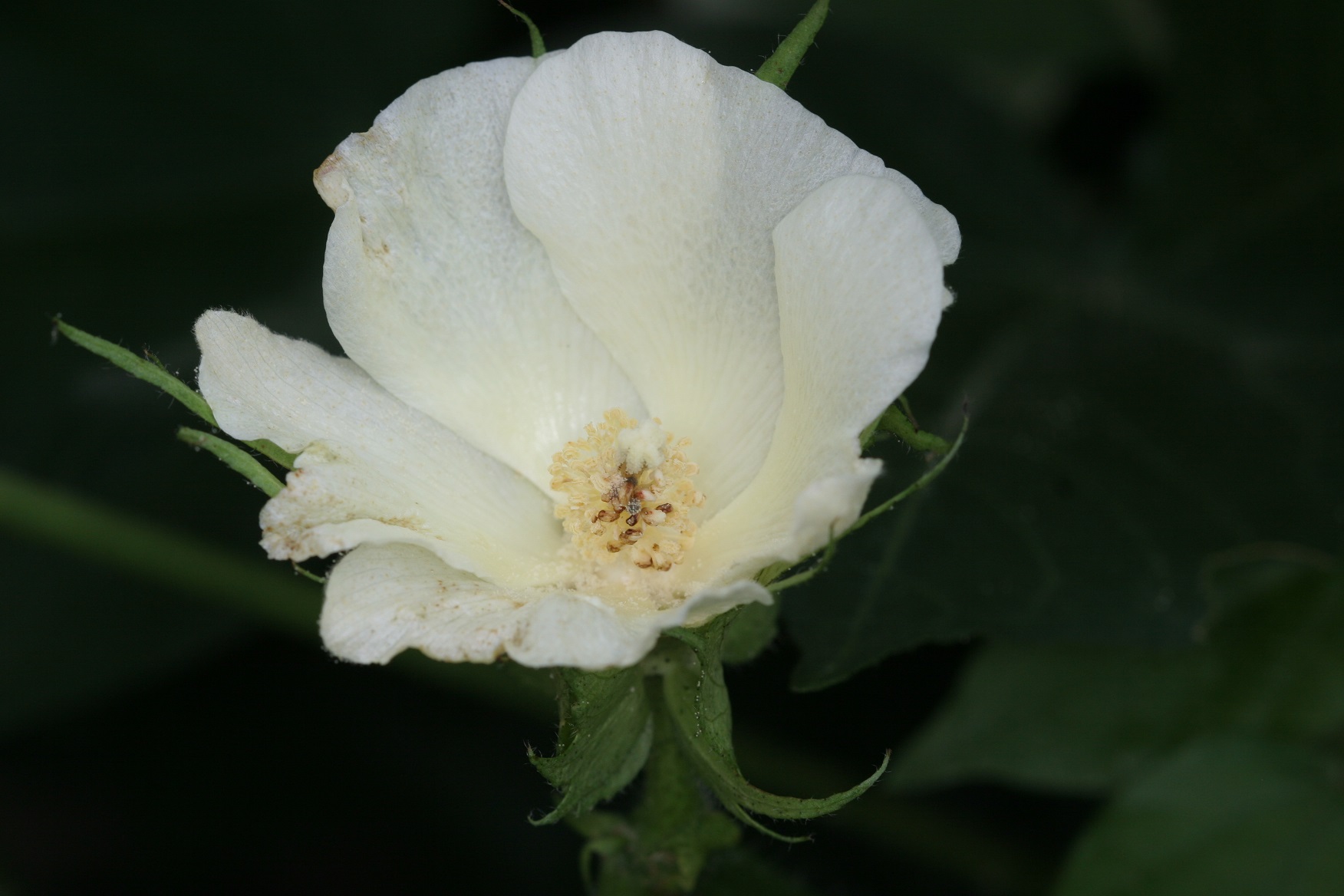
“Dirty bloom” indicative of plant bug feeding.
When viewing the distribution map in full-screen mode, click on the left arrow icon to view map legend. Click on individual fields represented by colored dots on the map to view mean plant bug density for the sampling period as well as total mean density for the season. Mean plant bug densities were calculated by sampling four sweet net samples (25 sweeps per sample) and four drop cloth samples across each field. Total adults and nymphs in a single visit were totaled and averaged for each visit within the sampling period.
View full-screen distribution map
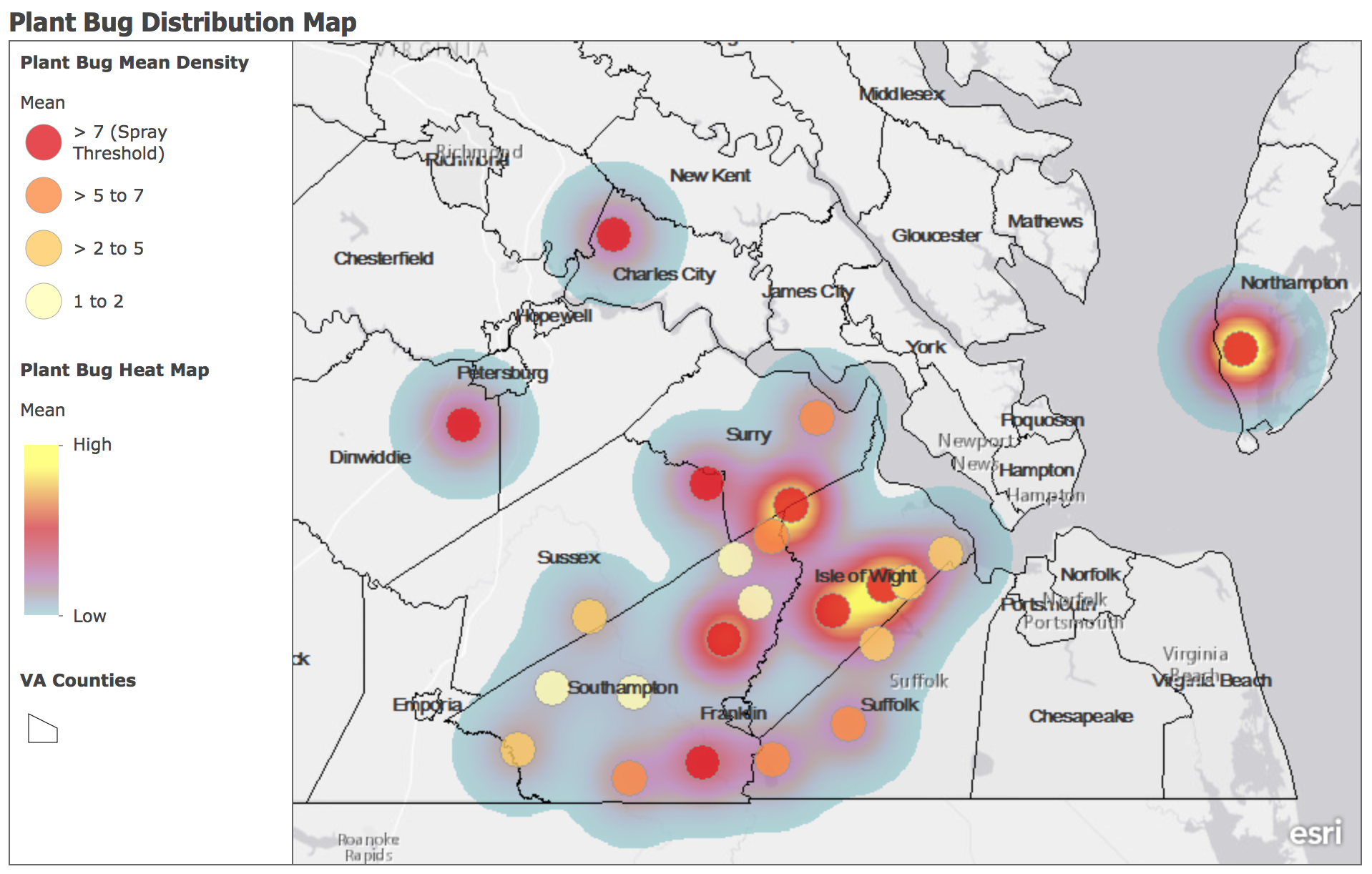
Plant bug distribution map for the July 17th to August 3rd sampling period.
Sweet corn sampling in VA – Moth trap counts for week of July 31
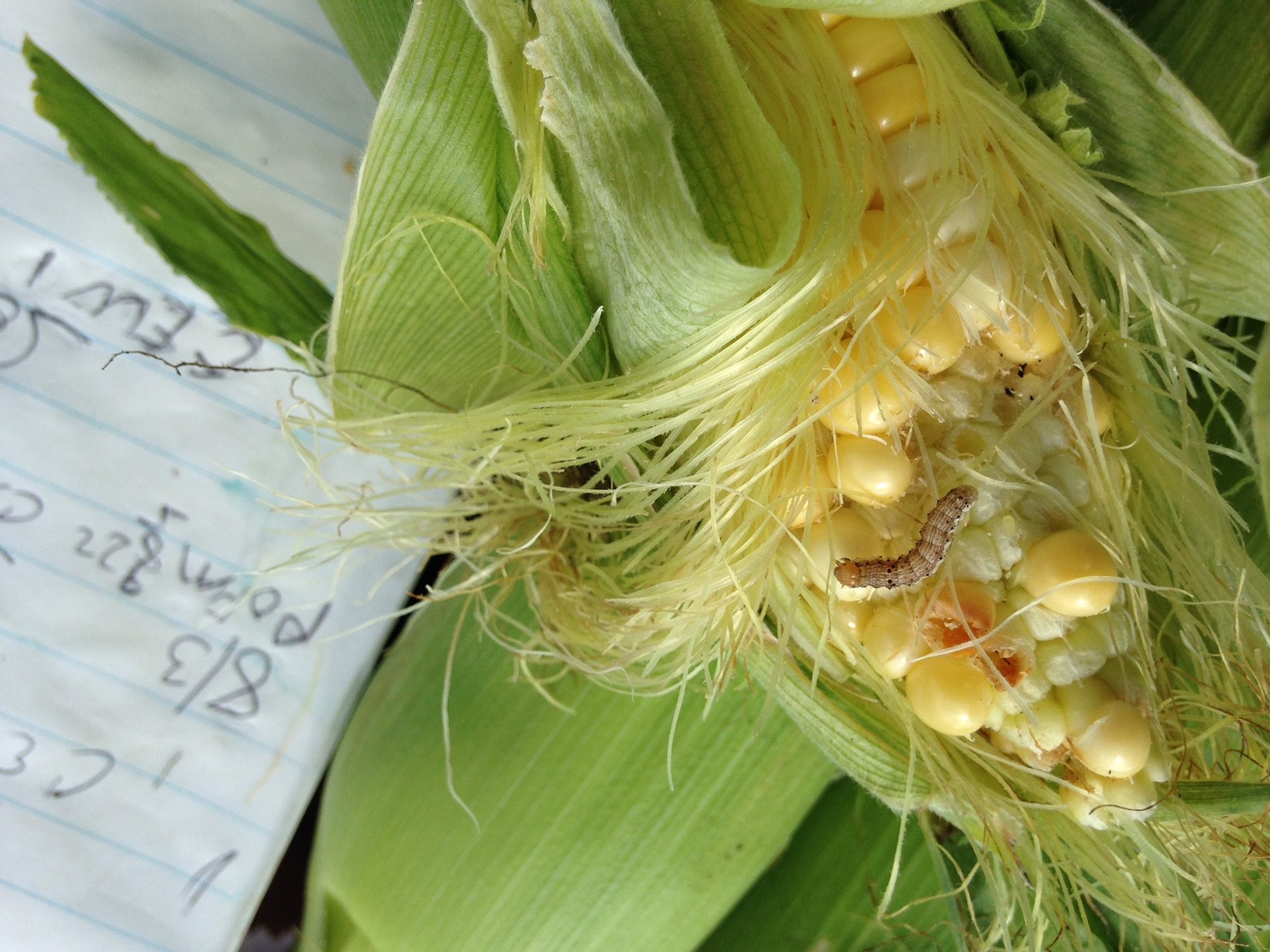
Corn earworm larva in Bt sweet corn in Page County, VA. Photo by Kenner Love, VCE.
Sweet corn farms are being monitored around Virginia for corn earworm and fall armyworm. Moth Trap Catch Data are being recorded by: Katlyn Catron (Montgomery Co.); Jason Cooper (Rockingham Co.); Ursula Deitch (Northampton Co.); Helene Doughty (Accomack Co. & Virginia Beach); Kenner Love (Rappahannock Co.); Laura Maxey Nay (Hanover Co.); Steve Pottorff (Carrol Co.); Stephanie Romelczyk (Westmoreland Co.); Laura Siegle (Amelia Co.); Rebekah Slabach (Halifax Co.); and Mark Sutphin (Frederick Co.).
This week we observed a general drop off in corn earworm moth catch at many locations, but still enough moth flight activity to warrant frequent spraying in many locations such as the Bridge Tunnel in Northampton County, Virginia Beach, Frederick Co., and Hanover Co. We still have not seen very many fall armyworm moths yet. For corn earworm, moth trap catch of less than 1 per night means low pest pressure and sweet corn sprays can probably be spaced 5-6 days apart during silking. However, a catch of >1 or >13 moths per night means moderate and high pest pressure, respectively, and a more frequent spray interval (every 3 or 2 days) is justified. Here are the trap catch results (moths per night) for several locations around Virginia for this week (note we do not have data for all locations):
| Week of July 31 (avg) | ||||
| Region | County | Field | CEW/night | FAW/night |
| Eastern Shore | Accomack | ESAREC – cemetery | 6.3 | 0.1 |
| Eastern Shore | Accomack | ESAREC – woods | 0.0 | NA |
| Eastern Shore | Accomack | ESAREC – sweet corn | 1.1 | 0.1 |
| Eastern Shore | Northampton | Bridge Tunnel | 15.1 | NA |
| Eastern Shore | Northampton | Capeville 1 | 0.6 | 0 |
| Eastern Shore | Northampton | Cape charles | 2.4 | NA |
| Eastern Shore | Northampton | Eastville | 2.3 | 1 |
| Eastern Shore | Northampton | Nassawaddox | 0.4 | 1 |
| Virginia Beach | Virginia Beach | Pungo 1 | 11.6 | 0.3 |
| Piedmont | Amelia | Field 1 | NA | NA |
| Piedmont | Hanover | Farm 1 | 7.8 | 0.0 |
| Piedmont | Hanover | Haynes | 6.9 | 0.0 |
| Northern Neck | Westmoreland | Field 1 | 3.0 | 0 |
| Northern Neck | Westmoreland | Field 2 | NA | NA |
| Shenandoah Valley | Rappahannock | Field 1 | 0.6 | 0.1 |
| Shenandoah Valley | Page | Field 1 | 0.2 | 0.1 |
| Shenandoah Valley | Frederick | Farm 1 | 1.4 | 0.9 |
| Shenandoah Valley | Frederick | Farm 2 | 9.1 | NA |
| Shenandoah Valley | Rockingham | Farm 1 | NA | NA |
| Shenandoah Valley | Rockingham | Farm 2 | NA | NA |
| New River Valley | Montgomery | KC | 0.1 | 0 |
| New River Valley | Montgomery | KO1 | 3.0 | 0 |
| New River Valley | Montgomery | KO2 | 1.7 | 0 |
| New River Valley | Montgomery | WF1 | 2.9 | NA |
| New River Valley | Montgomery | WF2 | 1.1 | NA |
| New River Valley | Montgomery | WF3 | 2.0 | NA |
| New River Valley | Montgomery | WS1 | 2.3 | NA |
| New River Valley | Montgomery | WS2 | 2.0 | NA |
| New River Valley | Montgomery | WS3 | 1.7 | NA |
Insect update for Aug. 3, 2017
Black light trap catches of corn earworm (aka bollworm) moths increased at most reporting stations, ranging from 5 to 58 per night this week. The pheromone traps at Suffolk also caught about 20 moths per night. Mike Arrington reported that he was seeing cotton fields (Bt and conventional) very close to egg threshold for bollworm in Suffolk and Southampton Counties.
Brown marmorated stink bugs ranged from zero to 1.7 per night. The data tables for corn earworm and BMSB are here: BLT_3_Aug_2017
Corn earworm moth survival in the cypermethrin vial tests was 36% for the week, and 40% for the seasonal average (to date).