Stripe Rust Found in North Carolina Wheat

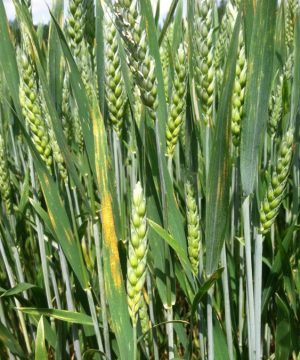
This week, stripe rust was found in Robeson County, NC. The disease was observed in wheat variety SS 8404 which is susceptible to stripe rust. Current weather conditions (cool, wet) are generally favorable for spread and development of stripe rust, and it will likely move north into Virginia before the end of the wheat growing season. However, stripe rust is typically a problem only in susceptible varieties. With this in mind, it is important for growers to determine which of their planted varieties are susceptible to stripe rust so they will be prepared to scout and apply a fungicide once the disease makes its way to Virginia. One popular variety, Shirley, is very susceptible to stripe rust, and outbreaks of this disease were observed in some fields planted to Shirley in 2016. Stripe rust and other disease ratings for wheat in Virginia can be found in the link below for the VCE Publication Small Grains in 2016. A link to the Diseases in Small Grains chapter from the 2017 Pest Management Guide for Field Crops is also attached. This includes management recommendations and a fungicide efficacy table for stripe rusts and other diseases of wheat.  Several different fungicides are available that are rated “Excellent” for stripe rust control, but fungicides are most effective when applied prior to disease development. Thus, if you know you have a variety is that is susceptible to stripe rust you should be scouting those fields and apply a fungicide if stripe rust is observed. There is no need to spray wheat for stripe rust at this time, but it is important to be aware and be prepared. If you suspect you have stripe rust, you can send a photo and/or sample to Dr. Hillary Mehl at the Tidewater AREC (hlmehl@vt.edu).

Small Grains in 2016 (variety disease susceptibility ratings)
PMG2017: Small Grains Disease


Strip versus conventional till for peanut

Research at the North Carolina State University showed that peanut yields were lower when planted on fine-textured soiled in strip tillage in comparison with conventional tillage.  Yield reduction appeared to be associated with greater pod loss in the digging process for the strip versus conventional tillage. Use of stale seedbeds, by bedding rows without other tillage operations sometime after the harvest of previous crop and 4 to 6 weeks prior to planting peanut, was further proposed as a tillage practice that could alleviate yield reduction due to strip tillage. Research using corn, cotton and grain sorghum as rotation crops showed that, indeed, depending on year and location peanut yielded greater in stale seedbed and strip tilled land versus just strip-tilled soil. For example, in 2006 at Rocky Mount, NC, when soil was bedded and strip tilled, pod yield was 3620 pounds per acre, significantly more than 2570 pounds per acre when peanut was planted directly into stripped soil and crop stubble. However, similar responses were not observed in 2002 at either Lewiston or Rocky Mount; which probably denotes that more research is needed to document if stale beds in crop stubbles and in strip tillage peanut production work. According with these researchers, peanut yield in longer rotations was higher than yield of shorter rotation, but the rotation crop had no effect. The full article is here peanut-notes-2017-no-23-peanut-strip-tilled-into-grain-sorghum-stubble.

EPA review of pyrethroids

The EPA is in the process of reviewing some of our older, broad-spectrum classes of insecticides. The comment period is now open for the preliminary ecological risk assessment of pyrethroids. I strongly support the need for continued availability of these materials because they are relatively safe for mammals and biodegradable. Importantly, pyrethroids are the only option for pest control of certain insect pests in some cropping systems. Entomologists, including myself, at universities throughout the Southeast have expressed their support for pyrethroids in a letter to the EPA. However, the EPA is really looking to hear from people that use these products responsibly. The below link provides a tool to make comments on EPA dockets without looking up each product individually. It also includes the type of information that is most helpful and a template to follow if so desired. Comments from our Virginia growers will be much appreciated!

https://www.votervoice.net/PWG/campaigns/48706/respond

Reminder for the 2017 Mid-Atlantic Strawberry Programs in Virginia Beach

The following is being issued on behalf of Roy Flanagan, Virginia Cooperative Extension ANR Agent, Virginia Beach (meeting information and registration forms can be found on my January 30, 2017 blog). This is a reminder for folks to register if you plan to attend any of the 2017 Mid-Atlantic Strawberry Programs in Virginia Beach. The room block with Fairfield Inns and Suites filled up quickly, we have increased that group of blocked rooms at the special rate of $86 per night.  If you tried to register and had issues, please email Roy Flanagan directly and he will get you in touch with the right person to get your room issues taken care of and get the reduced rate.

If you have questions, please contact Roy Flanagan.

Agriculture Extension Agent/ Virginia Beach

Office: 757-385-GROW (4769)

Email: RFlanaga@vbgov.com

Information on the pesticides under European Union scrutiny

The European Union (EU) is reviewing the current maximum residue levels (MRLs) for pesticides, some being used in peanut production. The process started in 2016 and will continue in 2017. As expected, peanut imports in EU may be affected by these changes. I am providing here information on these products (credit David Jordan and American Peanut Council), and I will continue to do so when I have new information. Although under review, please note that not all pesticides may have their MRLs lowered. peanut-notes-2017-no-12-comments-on-pesticides-eu-peanut-imports peanut-notes-2017-no-11-wto-communication-on-pesticides-and-mrls

peanut-notes-2017-no-11-wto-communication-on-pesticides-and-mrls


Peanut Variety and Quality Evaluation 2016 Report

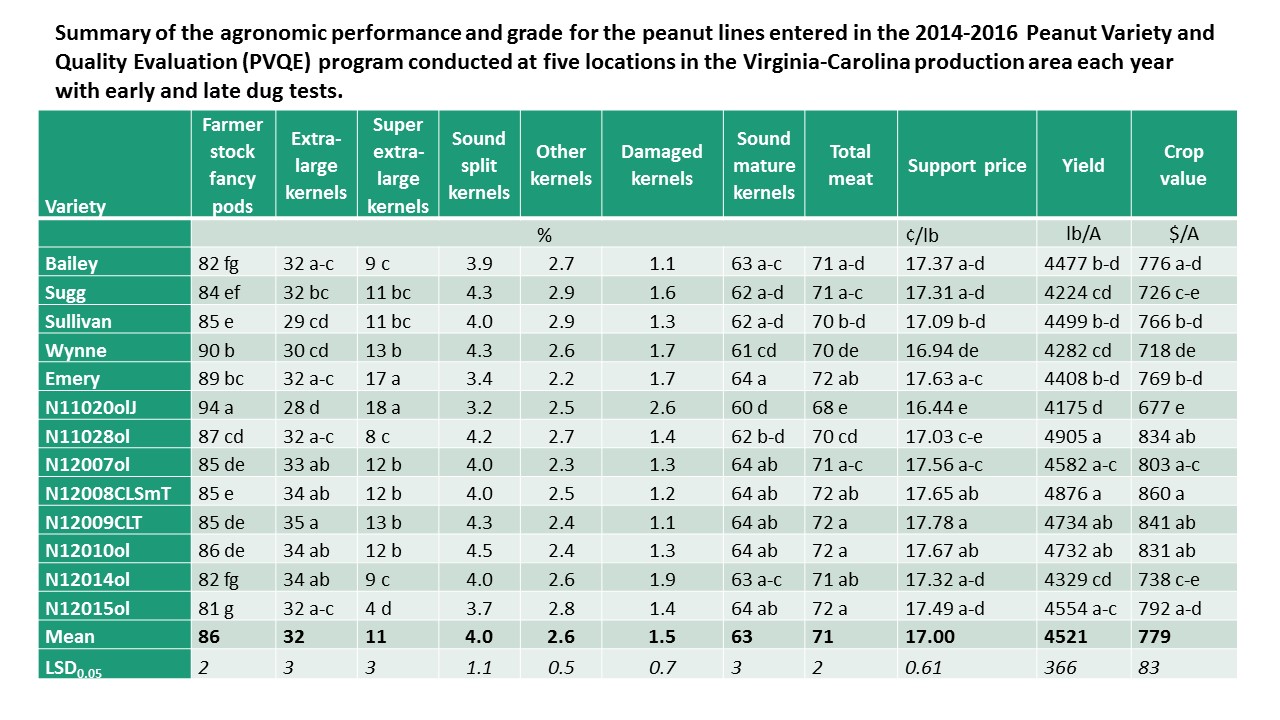
Growers in Virginia, North Carolina, and South Carolina are always in need for high yielding, disease resistant and early maturing peanut varieties with good grading and processing quality. The multi-state Peanut Variety and Quality Evaluation (PVQE) program evaluates advanced breeding lines from the North Carolina State University and University of Florida breeding programs that can further be released as Virginia-type cultivars suitable for the region. These lines are compared with the current commercial cultivars, ‘Bailey’, ‘Sugg’, ‘Sullivan’, ‘Wynne’, and ‘Emery’ for yield and quality throughout the production region in Virginia, North Carolina and South Carolina. The 2016 report with the agronomic and grade PVQE data is available here :http: //pubs.ext.vt.edu/AREC/AREC-198/AREC-198.html. A summary of the 2014-2016 agronomic and grade performance is presented in the table below. In average of 3 years and five locations each year, ‘Bailey’ produced 4,477 pounds per acre and the crop value was 776 dollars per acre. Some of the new lines, however, significantly exceeded ‘Bailey’ for both pod yield and crop value; lines N11028ol and N12008CLSmT in particular. Unlike ‘Bailey’, which has normal oil chemistry, all the breeding lines tested recently in the PVQE program are high oleic. This means they have over 75% of their oil content made of oleic fatty acid; and this characteristic extends the freshness and shelf life of the peanuts from 4 to 32 weeks.

Summary of peanut 2014-2016 results

Summary of peanut 2014-2016 results

View the Program: Virginia Eastern Shore Ag Conference and Trade Show

We look forward to seeing you January 25th and 26th at the 27th Annual Eastern Shore Ag conference & Trade Show! You can find the program online at: https://onedrive.live.com/?authkey=%21AEczhxLIHkUCwmY&cid=05F6B732110DB231&id=5F6B732110DB231%2129963&parId=5F6B732110DB231%21813&o=OneUp. Virginia pesticide re-certification and Certified Crop Adviser credits will be available. See the program for more information.

The event will be held at the Eastern Shore Community College Workforce Development Center, 29300 Lankford Highway, Melfa, VA 23410. When you enter the driveway to the Community College, we will be meeting in the building to the left.

The Annual Oyster Roast will be held on Wednesday night, January 25th beginning with a social at 6:00 pm and oysters served at 6:30 pm. Along with oysters, there will be all-you-can-eat barbecue, sides and beverages. Tickets will be $35.00 in advance and $40.00 if purchased the day of the oyster roast.

If you have any questions or concerns please contact either Theresa Pittman (tpittman@vt.edu) or Ursula Deitch (ursula@vt.edu) for accommodation. Thank you!

Virginia Cooperative Extension logo

Virginia Eastern Shore Ag Conference and Trade Show

Join us in Melfa, VA for the 27th Annual Eastern Shore Agricultural Conference and Trade Show on January 25-26, 2017. This event is free, open to the public, and will be held at the Eastern Shore Community College Workforce Development Center. We will offer Virginia Pesticide Recertification credits for categories 1A, 10, 60, and 90. We will also offer Certified Crop Adviser Credits for nutrient management (2), soil and water (1), integrated pest management (4.5), crop management (6), and professional development (0.5). Click on the following link for topic areas being presented: ag-conf-press-release-2017