Soybean Seed Quality Continues to Deteriorate

The warm and wet September combined with early planting of early-maturing varieties have led to some rather severe seed quality problems in soybean this year.  Our harvest to date indicates that seed quality in our Northern Piedmont is pretty good, but declines as one moves south.  There also seems to be a good correlation with lack of rotation, earlier maturity groups, and earlier planting showing most of the problems.  The issues can usually be attributed to the diseases phomopsis seed decay and purple seed stain, which I’ll describe in more detail below.  Other diseases such as Alternaria, anthracnose, and frogeye leaf spot can also cause seed discoloration and quality issues, but are less common.  The bottom of the plant usually has more seed decay than the top.  But if harvest is delayed, the entire plant will be infected.

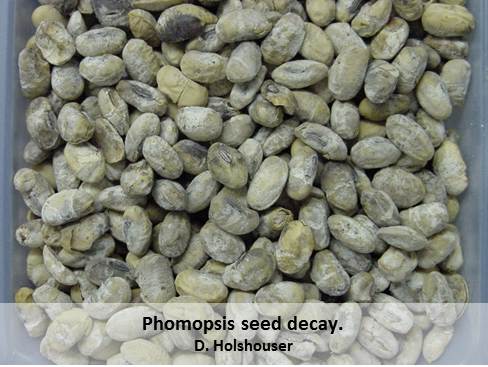
Phomopsis Seed Decay.  When soybeans mature during warm and wet conditions, we can expect seed quality to deteriorate.  Because this disease develops more rapidly on plants that are maturing under warm and wet conditions, we usually have more problems with early-maturing varieties.  We can however have seed decay on our later- maturing varieties if October is warm.  Although pods can be infected earlier, seed decay does not usually begin until after physiological maturity (R7).

Infected seed are shriveled, elongated, and cracked.  Severely infected seed may appear white and chalky.  The fungus secretes enzymes that degrade the seed coat proteins.  Test weight can be lower.  High occurrence of these seed can lead to discounts or rejection.
There are a few things that can be done to reduce the disease incidence.  It resides in the soil and on infected residue.  So, rotation is very important.  More decay will occur in a crop deficient in potassium, infected with viruses, and heavily attacked by insects.  Later-maturing varieties and later planting dates that delay maturity into the cooler parts of the year will reduce the incidence.  Still, timely harvest is the best management strategy.  The longer you leave the soybeans in the field, the worse the disease.  So, only plant as many early varieties as you can harvest in a timely manner.  Foliar fungicides will decrease the incidence of seed decay if applied from pod development (R3-R4) to early seed filling stages (R5).  My experience is that a single R3 will do little to prevent seed decay; it will usually take a second application at R5.

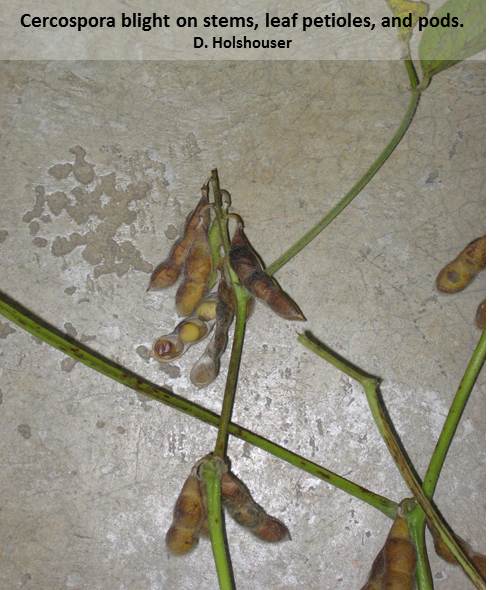
Purple Seed Stain.  Purple seed stain is caused by the organism Cercospora kikuchii, the same organism that causes Cercospora blight.  Before maturity, fields with Cercospora blight can be recognized by reddish leaves and reddish purple blotches on the stem and leaf petioles.  When severe, defoliation of the upper leaves of the plant will take place.  In many cases, the blotching progressed up the stem and to the pods.  Dark, nearly black pods may appear on some varieties.  Once it progresses to the pods, there is a higher likelihood that the seed will be stained.
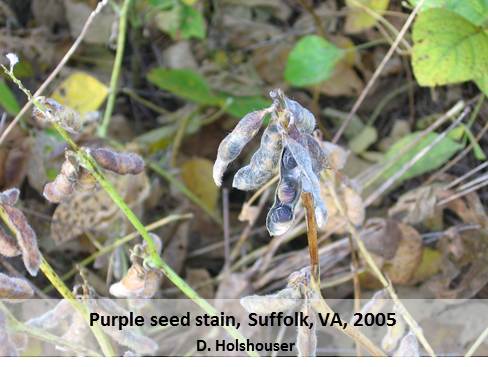
Purple seed stain is very noticeable.  The seed will contain pink to pale purple to dark purple splotches, which can cover the entire seed coat.  The purple stain itself does not reduce yield, but seed with nearly 100% discoloration may be lower in oil and higher in protein.  A lot of staining can result in discounts.  Germination of seed with 50% or more staining will likely be delayed.

Usually, the disease first appears on the plant during early seed development.  If conditions are right (average temperatures over 80o for several days), then the disease will build up rapidly.  Other weather factors do not generally affect seed infection.  Severity of the infection is largely related to amount of infected leaf debris and residue.  Therefore, rotation with a non-legume crop is critical for control.
Other control measures include variety selection, planting high quality seed free of visual staining, and fungicides.  Varieties differ in their susceptibility of Cercospora kikuchii, but that information is rarely available in seed catalogs.  We routinely evaluate purple seed stain in our variety tests.  Fungicides will give some control if applied during pod or seed formation.
Stop peanut digging until frost potential passes

Due to the frost and freeze advisories in effect from Sunday through Tuesday night (Oct 19 through Oct 21) in the V-C region, I recommend that peanut digging be stopped after today (Thu, Oct 15).  Peanuts will need three days to dry in order to not be affected by frost. Resume digging only after temperatures become milder.

Frost advisory is available at http://webipm.ento.vt.edu/cgi-bin/listfrost


Virginia Frost Advisory

The Virginia Frost Advisory predicts that a frost is expected next Monday morning (10/19) for Suffolk, Capron, Waverly, Skippers, and Lewiston.  A copy of the report can be downloaded below. For up-to-date frost advisories for the region, see the Peanut-Cotton Infonet (http://webipm.ento.vt.edu/cgi-bin/listfrost).

Frost Advisory 10-12-2015

Pre-harvest sorghum sprouting in some parts of Virginia

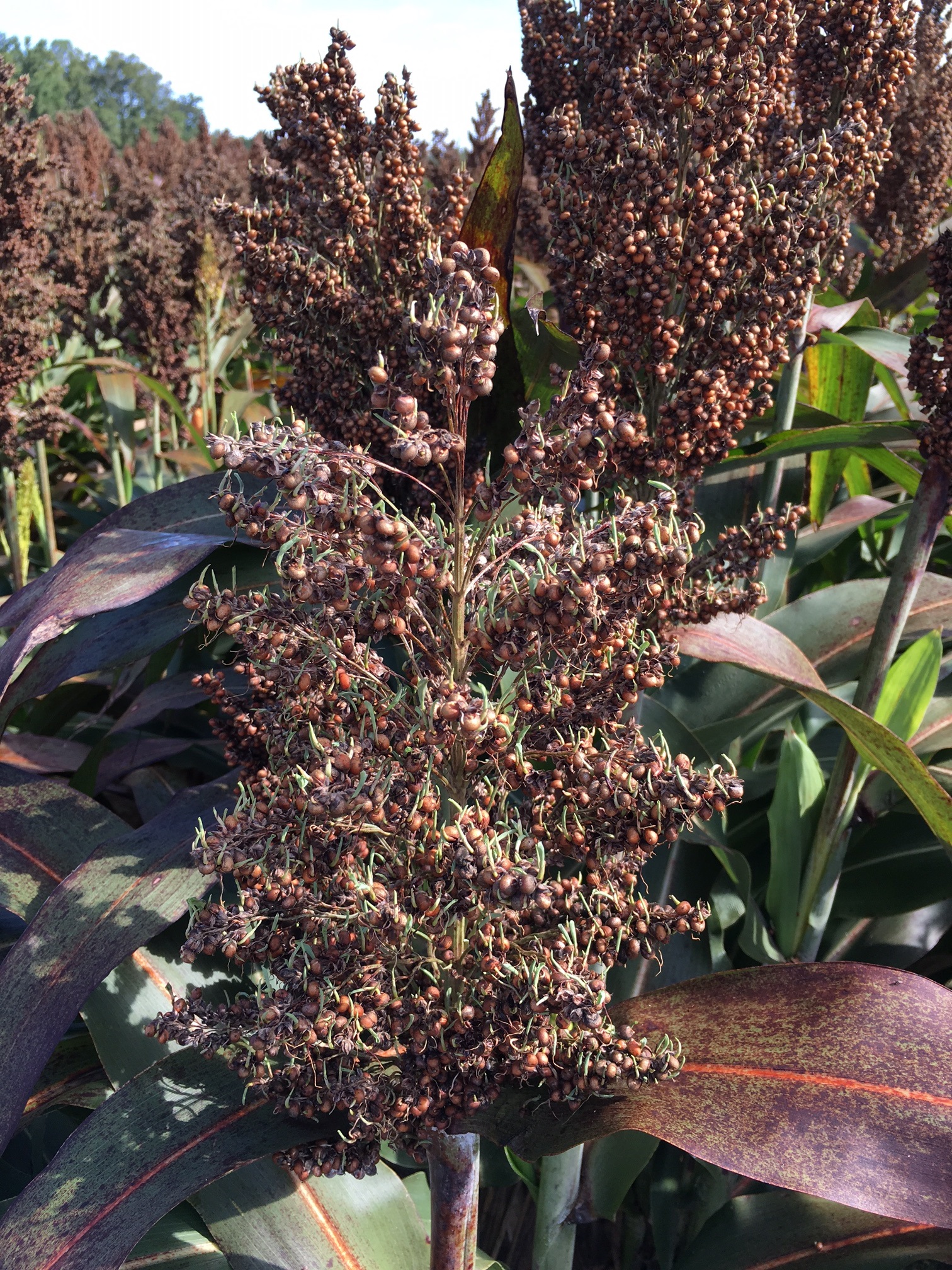
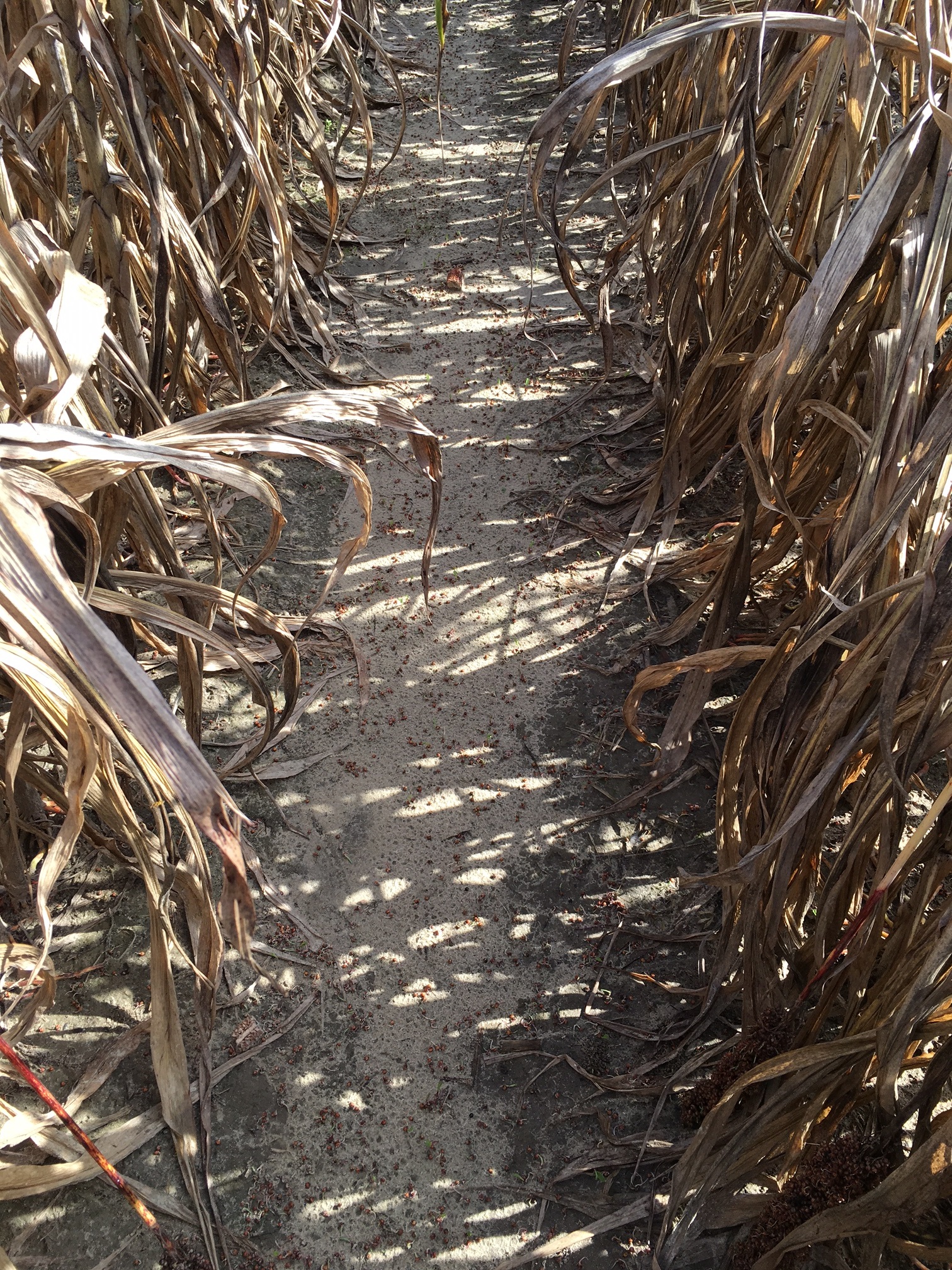
Ample amounts of rainfall, humidity and the warm weather recently experienced by southeastern Virginia resulted in grain sorghum sprouting

Sorghum kernels shattered because of moisture and sprouting

Sorghum grains sprouting in the head.

Sorghum grains sprouting in the head.

and shattering. This was observed in Suffolk, Isle of Weight, and Eastern Shore, with variable severity due to the weather conditions specific to each location and field.

Sorghum has small seeds and does not take much water to germinate. If the weather is right, prolonged moisture, humidity, and high temperatures, it may sprout before harvest. Radicle and coleoptile will extrude from the kernels still attached to the head while feeding on the endosperm starch reserve for growth. Because of this, kernels will become lighter (test weight will be substantially reduced), trashier and, in some instances, discolored. After rainfall stops, radicles and coleoptiles will eventually dry and die. Weathered sorghum nutritional value for feedstock and poultry uses is not significantly altered; but kernels become more prone to mold infection and mycotoxin contamination after sprouting.

Maturity and desiccation play significant roles in the severity of sprouting. For example, late planted sorghum after wheat may not sprout because the germs are not yet fully developed. Among the early planted sorghums, the early maturing hybrids are less prone to pre-harvest sprouting because their seed moisture is low compared with late maturing hybrids and requires more water to imbibe. None the less, our tests this year clearly show that timely desiccation in preparation for harvest (when seeds have around 25% moisture) significantly reduced kernel sprouting.

At this time, I do not know how much price will be reduced, or what quality markers will be used to evaluate quality when delivering sprouted sorghum to Murphy Brown. I attach here Waverly-Milo-Discount the discount schedule at the Waverley Mill and I will keep you informed on this topic.

Wet Conditions May Lead to Soybean Seed Sprouting

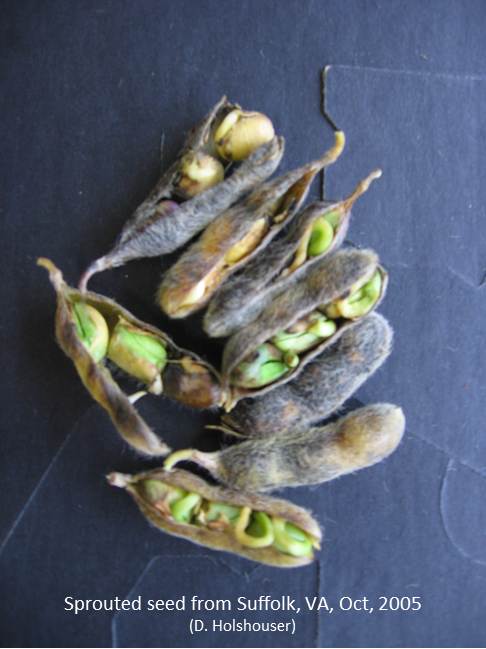
One of the most disturbing late-season issues can be pod splitting and/or seed sprouting in the pod.  Pod splitting is most common when pods develop and seed begin to grown (R4 to R6 stages) during dry conditions and seed finish filling under wet conditions.  Sound familiar.  This is more-or-less what we experienced this year.  Seed sprouting is usually caused by extremely wet conditions after the crop is mature and seed moisture has dropped below 50%.

What causes pod splitting?  The reason is not clear, but here are my observations.  Generally pod splitting happens when the crop is under severe stress, usually drought conditions up until the full-seed stage (R6).  Pods are generally small due to the drought.  Then rains set in between R6 (full seed) and R7 (physiological maturity).  The seed grow and grow, and seem to outgrow the pods, causing them to split.  Obviously, this splitting can then lead to seed quality issues.  It can also open the plant up to seed sprouting,

Even if the crop does not experience the above conditions and pods do not split due to rapid seed enlargement, wet conditions after the crop is mature can lead to sprouting seed.  Sprouting seed is not always directly related to the pod splitting; pods may not split until seed sprout.  I’ve seen up to 30% of pods with sprouted seed when conditions are perfect for this.  Although an unusual occurrence, seed sprouting can occur if soybean seed drop below 50% moisture, then increase to 50% or more moisture.

In addition, I have seen more sprouting in pods showing Cercospora blight (very dark pods).  I do not understand why and could not definitively relate the sprouting to this disease.  But, there appeared to be a relationship. Sprouting occurred primarily at the top of the plant where the dark pods were located.  In contrast when pods were not dark, I have observed most sprouting at the bottom of the plant where the relative humidity is greater.

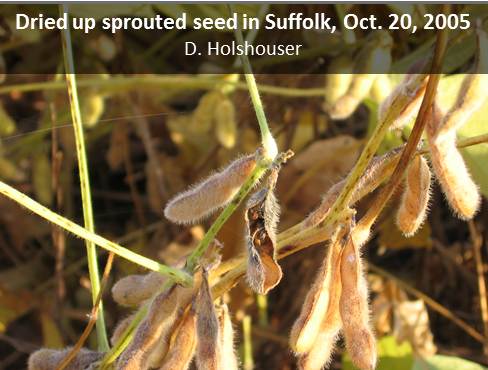
Usually, the number of split pods and sprouting seed is low and yield and seed quality effects are minimal.  After a week of drying conditions, the sprouted seed will dry up and may fall out of the pods.  At the worst, there could be some lower test weight and seed could contain more foreign material (from the dried up sprouts).  However, the light seed will likely be blown out the back of the combine.  If you do observe the problem and it is severe, I suggest that the air on the combine be adjusted to remove those light, sprouted seed at harvest.  Too many sprouted seed in the bin could lead to rejection by the buyer.

Wheat seeding rate and drill calibration, 2015-16

Based on previous research we know we need at least 70-80 heads per square foot to reach optimum wheat yields. That typically requires a seeding rate of 30-35 seeds per square foot, which is equivalent to 20-22 seeds per foot of row in 7.5 inch rows. The reason we advise seeding based on actual number of seeds per seed lot, and not on a pound per acre basis is that seed size varies considerably among wheat varieties and over years for the same variety. The number of seeds per pound is determined both by genetics and by environment. A few of the entries in our state wheat variety test are listed below and it’s obvious that a range of 30% or larger exists among varieties within a year. The consequence of not calibrating grain drills to deliver the optimum seeding rate can vary. If too little seed is planted, yield potential may be compromised. Overseeding increases seeding cost and in a year with smaller profit margins in wheat, we certainly need to avoid both. This management activity is an investment of time, but spending that time can result in greater profit.


2016

2015

2014

Mean

% Dev.

———–seed/lb———–

Massey

13046

12371

10318

11912

23%

Jamestown

13472

14277

11762

13170

19%

Shirley

11100

10861

9722

10561

13%

Pioneer Brand 26R20

12825

14157

11378

12787

22%

Pioneer Brand 25R32

13593

13488

13353

13478

2%

Featherstone 73

14099

12304

11436

12613

21%

VA10W-119

10993

11756

9578

10775

20%

Pioneer Brand 26R10

10509

12587

11073

11390

18%

Pioneer Brand 26R41

11979

10682

10913

11192

12%

Pioneer Brand 26R53

11671

11988

11947

11869

3%

Avg. by year 12329 12447 11148 11975


Mid-Atlantic Crop Management School Registration

The program for the 2015 Mid-Atlantic Crop Management School (MACMS) has now been set and the online registration website is now active. Everyone is welcome to attend! Virginia nutrient management credits and Certified Crop Adviser (CCA) credits will be offered. Local and regional farmers, independent consultants, certified crop advisers, nutrient management consultants, and agency and university professionals will join together to learn the latest on a wide range of topics from local, regional, and national speakers.

The Mid-Atlantic Crop Management School (MACMS) will be held from Nov. 17 to Nov. 19, 2015 at the Princess Royale in Ocean City Maryland. Some of the notable speakers include Dr. Bob Nielsen (Mr. King Corn) from Purdue University, Dr. Dewey Lee from the University of Georgia, Dr. David Langston from Virginia Tech, Dr. Randy Taylor from Oklahoma State University, Dr. Gordon Johnson from University of Delaware, Dr. Jarrod Miller from University of Maryland Extension, Mr. Mark Dubin from University of Maryland Extension and U.S. EPA Chesapeake Bay Program Office, Dr. Scott Bretthauer from the University of Illinois, and many others.

Register for MACMS online at: https://www.SignUp4.net/public/ap.aspx?EID=20154802E. If you prefer a pdf version of the MACMS brochure, please email Richard Taylor at rtaylor@udel.edu.

Sessions on pest management, crop management, soil and water management, fertility management and some interactive sessions will be offered. Certified Crop Adviser (CCA), Nutrient Management, and Pesticide credits are available. Continuing education credits are available from a number of states in the region including Delaware, Maryland, West Virginia, Virginia, New Jersey, and Pennsylvania. There are 43 different talks to choose from over the 2.5 day school. Some of the topics that will be covered are:

Effects of Stress on Corn Early in the Season

High Yield Soybeans: Is There a Recipe? A Roundtable Discussion

Row Crop Planters – Wider, Faster, or Both

A Path to Higher Yields: Part ll. Reducing Stress through Plant Health and Management

Lime Rate and Its Relationship to Fertility and Soil Type

Nitrogen Release from Non-chemical Fertilizers

The Intersection of Cover Crops and Weed Control

Future Technologies for Herbicide Resistance Weed Management

Understanding and Identifying Stalk Rots in Corn

Fumigant Control of Nematodes in Vegetables

Pest Management Trivia Challenge

Delaware’s Cropland Transect Survey – We’re Looking for Residue, Have You Seen Any?

Soil Health Principles and Manure Incorporation

Water Quality Trading in the Chesapeake Bay

Drainage Basics and Drainage Water Management

Forage and Field Crop Identification Hands-On Workshop

Evaluating Quality in Fruits and Vegetables Hands-On Workshop

Produce Food Safety Hands-On Workshop

Using Crop, Soils, Pest, and other Ag Apps on Your Tablet or Mobile Phone Hands-On Workshop

If you have questions, please contact us.

Dr. Richard W. Taylor
Extension Specialist—Agronomy
Dr. Amy Shober
Extension Specialist—Nutrient Management
University of Delaware
Email: rtaylor@udel.edu and ashober@udel.edu

Lodging and It’s Effect on Soybean Yield

As I’ve driving throughout Virginia these past few weeks, one thing that is evident is the large amount of vegetative growthDrought Painter 20150908_082955 web on our full-season soybean.  While adequate vegetative growth is necessary for maximum yield, it can work against the crop in seasons that experience August/September droughts.   In much of Virginia, soil moisture was depleted rapidly due to this large amount of growth and the lack of rain in August and September resulted in pod and seed abortion.  I’ve seen many fields that look relatively good from the windshield, especially after some rains perked up the plants.  But, closer examination revealed few pods or few seed in the pods.  In general, I think that farmers will be disappointed in their full-season yields.

On the other hand, timely rains during August and/or September in sohigh-yield soybeanme parts of Virginia allowed these full-season soybean to match this seemingly excessive growth with lots of pods and seed.  In such scenarios, 60 to 80 bushels per acre are possible. The only thing that may work against such a crop is, ironically, excessive vegetative growth that is causing or might lead to lodging.  I always remind those that complain about lodging that 20 bushel soybean do not usually lodge.

Now we have Hurricane Joaquin bearing down on us.  This could greatly change our yield potential, especially in our large full-season soybean with a good pod and seed set that is not yet fully mature.  With this in mind, I thought that I would review lodging’s effects on soybean yield.

How much will the lodging cost us in yield?  This will depend on the degree of lodging and the stage that the soybeans were in.  In general, I’d say that our full-season crop is rapidly approaching maturity.  Fields planted to earlier maturity groups are physiologically mature (R7, 98-100% of the final yield has accumulated), some are ready for harvest.  Many fields are still in the R6 (full seed) stage.  Most double-crop soybeans are in the R5 (beginning seed, seed are not yet touching in the pod) and R6.  Yield is most severely affected by lodging when the lodging occurs at the R5 stage.  Although yield is still affected at R6, yield losses are only half as severe at this stage.  Although at a more susceptible stage, double-crop soybeans are much shorter and will not likely have as severe lodging as more full-canopied full-season soybean.

So, what’s my estimate on the amount of yield loss?  First, we have to distinguish harvest or traffic loss from physiological yield loss.  Harvest losses can vary anywhere from 3-10% depending on many factors.  In some cases, we may have to run the combine of the most severely lodged soybeans in one direction.

There is little data on physiological yield loss, but what’s out there seems to be pretty consistent.  What do I mean by physiological yield loss?  That’s the loss in yield from lodging if all of the soybeans that are now on the plant can be harvested.  In controlled studies where researchers simulated lodging and compared it to a crop that was artificially supported, losses have ranged from 0% to over 30%.  Why such a range in yield loss?  It depends on the severity of lodging and the stage of development in which the lodging occurred.

Let’s first address the severity of lodging.  Soybean researchers have traditionally rated lodging on a scale of 1 to 5 as follows:

1.0          = almost all plants erect

2.0          = either all plants leaning slightly, or a few plants down

3.0          = either all plants leaning moderately (45O angle), or 25-50% down

4.0          = either all plants leaning considerably, or 50-80% down

5.0          = all plants down

Yield loss will be minimal unless most plants are leaning at a 45O angle or more.  Otherwise, yield losses can range from 10-35%, depending on the stage in which the lodging occurred.

Why does lodging cause yield loss?  It’s not completely clear, but the generally accepted reason is a reduction in net photosynthesis.  With less photosynthesis, there is less energy going to the developing pods and seeds.  When plants are lodged, relatively less of the upper leaves and more of the lower leaves are exposed to sunlight.  The upper leaves are more photosynthetically active and the lower leaves are less active.  When lodging occurs, the entire energy-producing mechanism is disturbed.  In other words, we are now exposing less of the most productive leaves and more of the least productive leaves to the sun.  So, yield will decline.

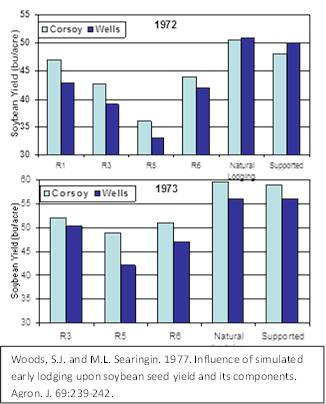
Let’s assume that lodging rated above 3.0 will cause a 10-30% loss.  Now the severity of the yield loss will depend on the development stage that the soybean plant was in.  As I said earlier, there’s little hard data on this subject, but a few older experiments give us some information.  In a study conducted in 1972-73, S.J. Woods and M.L. Swearingin of Purdue University indicated that the R5 stage was the most critical time for lodging to occur.  At this stage, yield was reduced by 18-32%.  At stages R3 and R6, yield was reduced by 12-18% and 13-15%, respectively.  Details of that experiment are shown to the right.

In that study, the plots were manually lodged with a long aluminum bar at the indicated soybean stage.  Although lodging ratings were not given, I would consider it to be in the 3.5 to 4.0 range from the description given.  Two varieties were tested. ‘Corsoy’ was more susceptible to lodging, but was able to branch more; therefore, it yielded higher when lodged.  ‘Wells’ is more resistant to lodging, but did not branch as much; therefore, was unable to compensate as much for the lodging.  In the natural lodged plots, only slight (2.0 or less) lodging occurred.

From the above data and a few other studies, I’d estimate that where lodging is moderate to severe and the soybean are in the early R6 stage, we could lower our yield potential by 10-15%.  If the plants are still in the R5 stage and lodging is severe, losses could be 15-25%.  If soybeans are in even later stages (mid-R6), yield loss will be less.  If physiologically mature (R7, one pod on the plant has reached is final mature color), 98 to 100% of the dry matter has accumulated and losses will be nearly zero (assuming no harvest losses).  Most of our full-season soybeans are close to physiological maturity (R7).  Plus, plants with fewer leaves lodge less.

In summary, there may be some yield loss due to Hurricane Joaquin.  Yield losses will be greater with later maturity groups or in double-crop acres that have good growth.  But, hopefully, the hurricane will move off the coast and the only soybean we need to worry about lodging are those with very high yield potential.

Sugarcane aphid update


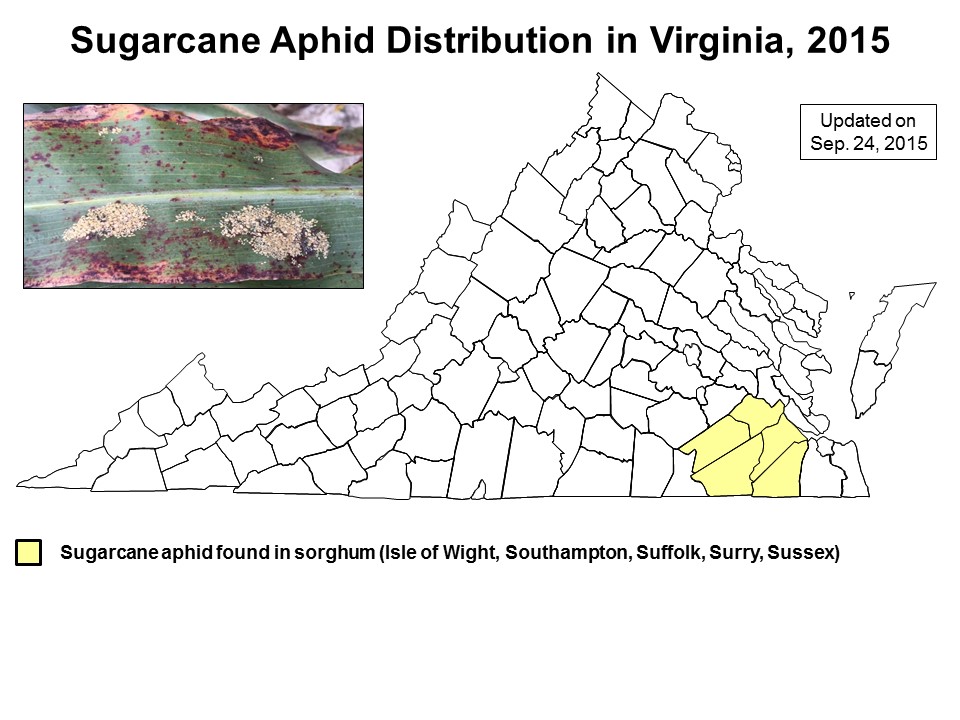
Sugarcane aphid (SCA) infestations have been documented in sorghum fields in 5 Virginia counties (Suffolk, Southampton, Surry, Sussex, and Isle of Wight—see infestation map, below). The area of the infestation likely includes more counties, but this is just a guess. Fortunately we are late into the season and many fields have either been harvested or desiccated in preparation for harvest. We maintain that there are fields still at some risk—those that will not be harvested for several weeks, especially any late planted fields. We are not concerned about loss caused by direct feeding, but the build-up of honey dew and sooty mold on leaves and heads. SCA infestations begin on lower leaves and these are not as important at this point in the season and pose less risk if they get covered with sooty mold. But if infestations move up the plant to upper leaves and heads, problems with combining could occur.

If you have been keeping up with pervious advisories you know that the insecticides most commonly recommended for control of SCA are Sivanto (Bayer CropScience) and Transform (Dow). But only Sivanto is currently labeled. We attempted to secure a Section 18 Emergence Exemption for the use of Transform but hit a snag. Following are the recent comments from the EPA reviewer regarding the status of our request. “Due to the federal court’s recent (September 10th) decision vacating EPA’s unconditional registration of sulfoxaflor the authorization of our request is on hold and remains pending.  The EPA is reviewing the court’s opinion to determine their next steps”. So, right now it does not sound promising for the Section 18 use of Transform in Virginia before the end of the use season.  It definitely means we don’t have use of the product for the recently found infestations. So Sivanto would be the best alternative, but hopefully, fields will not have to be treated.

SCA_map_24_Sep_2015

Helicoverpa zea (corn earworm/bollworm) adult vial test update for Sep. 24, 2015

We’re not catching many moths in our pheromone traps this time of year, but we are still conducting the adult vial tests on those that we do catch.  We are currently seeing many more dead moths after 24 hours of exposure to the pyrethroid insecticide, cypermethrin, at the 5 microgram per vial rate.  Less than 20% as you can see in the line graph below.  For the season, the average survival rate is 33.4% (bar chart, below).

CEW_AVT_24_Sep_2015_aCEW_AVT_24_Sep_2015_b