Another Virginia county has been found with sugarcane aphid in sorghum. Please see the attachment for more details. SCA_advisory_Sep_18_2015
Sugarcane aphids found in sorghum field in Suffolk, Virginia
Dr. Ames Herbert confirmed the presence of sugarcane aphids, Melanaphis sacchari, in a sorghum field at the Tidewater Agricultural Research and Extension Center in Suffolk, Virginia, on Sep. 17, 2015. Sugarcane aphid spreads as winged adults on wind and storm fronts so infestations can spread rapidly—so to be on the safe side, sorghum fields should be scouted.
There are several other aphid species that can infest sorghum but sugarcane aphid can be differentiated from the others being smooth, cream yellow, with two, short dark cornicles (“tailpipes”) on the hind end.
Research by Mike Brewer, Texes AgriLife, and David Kerns, LSU, has provided the most up-to-date Econominc Injury Level (EIL) of 50 to 125 aphids per leaf at sorghum prices of $4/bu; and the currently recommended Economic Threshold (when the insecticide needs to be applied to prevent the population from reaching the EIL) of 25 – 30% infested plants with 50 aphids per leaf.
After heading, according to work in other states, one of the more effective insecticide products is Sivanto (Bayer CropScience). Please refer to the Section 2(ee) Recommendation for the lower (but effective) rate of Sivanto @ 4-7 oz/A here: http://www.cdms.net/ldat/ldC4K023.pdf (please take note of the pre-harvest intervals and other directions found in the Section 2(ee)).
BMSB and kudzu bug soybean scouting report update for Sep. 16, 2015
Scouts Ed Seymore and Jamie Hogue have found multiple soybean fields in Virginia this week (early to mid-September) with threshold levels of brown marmorated stink bug (BMSB)–please refer to the figure for locations and numbers, noting that the columns for BMSB nymphs and BMSB adults need to be added together for calculating threshold numbers (more on that below). Of course this is just a small sample of the fields out there, but their reports stress the need to scout your fields, especially those fields at the late R4 growth stage (full pod, where pods are 3/4-inch [2-cm] long at one of the four uppermost nodes) and at R5 (beginning seed, where seed is 1/8-inch [3-mm] long in the pod at one of the four uppermost nodes on the main stem).
Due to their concentrations along field edges, BMSB should be sampled using 2-minute visual counts, 15-sweeps with a net, or beat cloth (wide rows only), by walking 10-20 feet into a field, taking several samples in different parts of the field edge, and determining the average. The thresholds for BMSB (adults + medium and large nymphs) in soybean, where BMSB is the predominant species, is 3-5 in a 2-minute visual count; 3-5 per 15 sweeps; or 0.5 per row foot using a beat cloth. If a threshold is met, an edge-only insecticide treatment with a labeled pyrethroid, carbamate, or organophosphate at the R5 soybean growth stage can provide high levels of control. As always, please be sure to read and follow the label.
Note that if your sampling finds a mix of stink bug species (e.g., BMSB, green, and brown) throughout the field, use thresholds of 5 per 15 sweeps or 1 per row foot (total all species, adults and nymphs).
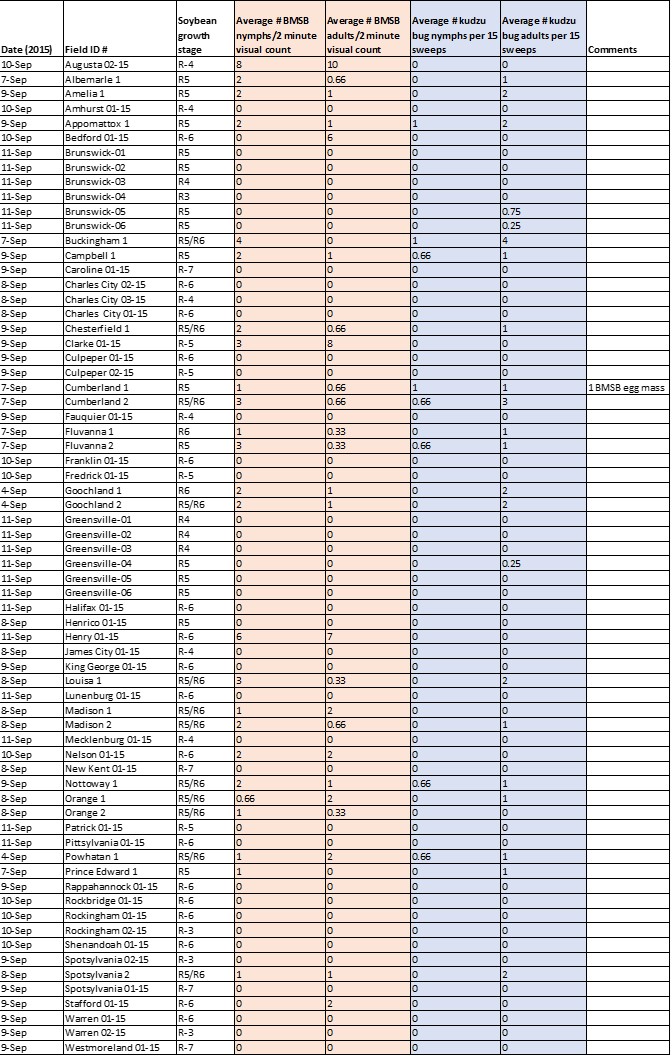 Kudzu bug numbers are generally low.

Late-Season Drought Hurting Soybean in Virginia
I had never seen fields as wet as they were back in the second week of July. But, things change very rapidly.
In August, it appeared that full-season yield potential was 60 to 80 bushels per acre. Growth was excellent and the crop was loaded with pods and seed. Likewise, corn yield potential was excellent. Double-crop soybean did not look nearly as good, struggling with general poor growth due late planting, wet feet early, and dry soils later.
Now the situation is just the opposite. Well almost – corn yields are coming in very good. But, pods and seed on our full-season soybean crop are rapidly aborting due to the dry weather. Leaves are falling. It appears that the crop is maturing more rapidly. This is not a good thing as yield strongly depends on the length of seed filling. I’ve even seen some soybean dying in the corners of center pivots on the Eastern Shore. Irrigation will definitely pay off this year. As shown in the precipitation deficit map, we are below our seasonal average rainfall over the past 60 days.
This photo was taken this past Tuesday 8:30 am in the Official Variety Test at our Eastern Shore AREC. 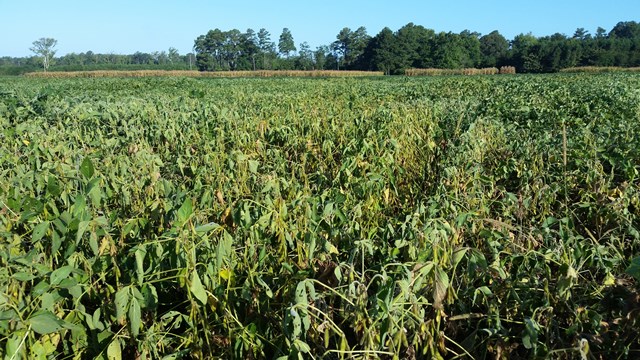 It looks like maturity group 3 varieties will out-yield group 4s, which will yield better than group 5s. However, a timely rain this week may salvage the late 5s. I don’t expect yields to top 40 bushels and they could possibly be less than 20 bushels if the drought persists.
On the other hand, I feel much better about double-crop soybean. Although there is little growth, these soybean are not showing signs of drought, at least not to the extent of the full-season crop. This photo is from the field adjacent to the full-season soybean shown above.
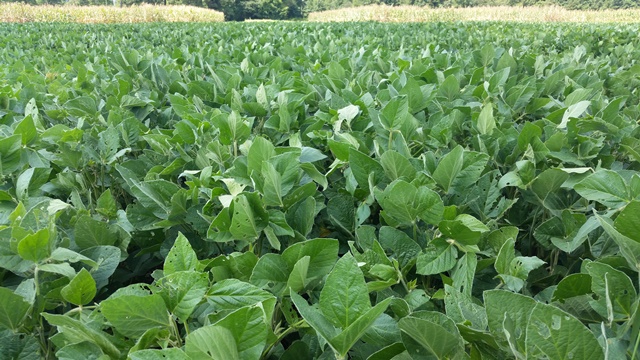 The main reason for this lack of visual stress is less vegetative growth (usually not an advantage) pulling less moisture from the soil. We also started the season with a soil profile full of water, but not excessive moisture (probably because the wheat had more-or-less depleted the soil moisture by May). Furthermore, these double-crop soybean are just now entering the pod and seed development stages. The seed is not yet requiring great amounts of water. These soybean can also “wait” for a rain as, at this time, there are still excess pods on the plant.
Below are a few more images that show flower, pod, and seed abortion.
The number of seed per acre controls yield most – the number of seed is mainly 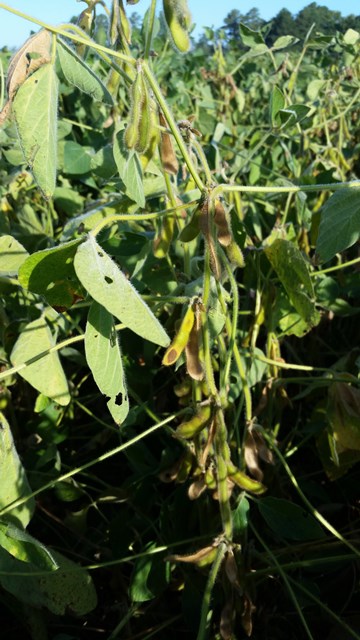 controlled by the the number of pods at harvest; seed per pod has less effect. Seed size can also greatly affect yield, but not to the extent of seed number. With late-season rains, we can still increase seed size substantially, especially where there has been lots of seed and pod abortion.
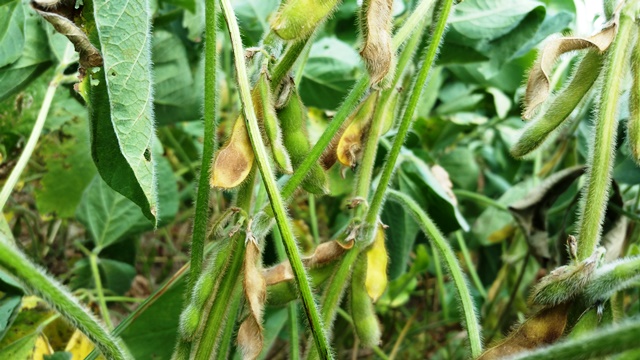
Is there anything to be done about this? No, not really – short of irrigation. There’s nothing that you can apply to relieve the stress. But, we can learn from such devastating experience and apply these learnings to the future.
- First and foremost, diversify. Although early-maturing varieties don’t usually do as well in full-season systems as those best adapted to a given area, it may be worth it to devote some acreage to such varieties. It may also help to plant a few varieties that mature a little later than the ones you normally plant.
- Keep double-crop small grain-soybean systems in your cropping mix. Not only will it increase total income and improve your soils without a cover crop, it will reduce risks by diversifying your crop mix.
- Review university, on-farm, and company variety test results to help select drought-tolerant varieties. Not since 2010 have we seen drought to this extent in our variety tests; therefore, we have little information on how current varieties perform under drought stress conditions.
- Other stresses such as vascular disease and nematodes will greatly enhance the effects of drought. Identify those poor-yielding fields or parts of fields and take corrective actions next year.
- Improve your soils with no-till and cover crops. Better soil structure, more organic matter, and better chemical and biological activity will minimize drought stress.
Black light trap report for the week ending September 10, 2015
Average black light trap catches this week ranged from 1 to 9 corn earworm moths per night; no brown marmorated stink bugs were captured in the traps. Please see the attached table for more details. BLT_10_Sep_2015
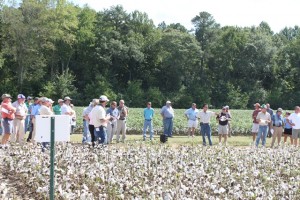
Tidewater AREC Pre-Harvest Field Crops Tour – Sept 17
Thursday, September 17, 2015 – 8:00 a.m.
Tidewater AREC Research Farm, 1045 Hare Rd., Suffolk, VA 23437
Registration begins at 7:30 a.m.
WEST-SIDE TOUR STOPS
 8:00 & 10:00 Integrated Disease Management for Peanut and Cotton – Dr. H. Mehl and Dr. Joseph Opoku
8:30 & 10:30 Monitoring and Thresholds for Managing Pests and Protecting Non-Target Species in Soybean & Cotton – Dr. A. Herbert
9:00 & 11:00 Potassium Fertility in Cotton – Dr. H. Frame
9:30 & 11:30 Potassium for Soybean – Ms. A. Stewart & Dr. D. Holshouser
EAST-SIDE TOUR STOPS
8:00 & 10:00 Sorghum OVT Fertility and Disease – Dr. J. Oakes and Mr. B. Acharya
8:30 & 10:30 Mid-Atlantic Double-Cropping Initiative – Dr. D. Holshouser
9:00 & 11:00 New Fungicide Decision Aid for Soybean – Dr. H. Mehl and Mr. Tian Zhou
9:30 & 11:30 PVQE Updates and UAV Peanut Drought Research – Dr. M. Balota and Dr. Joseph Oakes
JOINT WEST- AND EAST-TOUR PARTICIPANTS:
12:00 noon Nozzle Technology Dr. M. Flessner
CERTIFIED CROP ADVISERS – The field day has been approved for the following CEUs:
Nutrient Management: 1.5
Integrated Pest Management: 2
Crop Management: 1
Also during tour:
Industry & Educational exhibits
Updates from FSA and NRCS
Private and Commercial Pesticide recertifications
Immediately following the field tour, participants are invited to stay for lunch provided by The Filling Station of Robersonville, N.C. This year’s menu will include fish, shrimp, fried chicken and all the fixings.
Pre-registration is required for the tour/lunch.
Please contact Pam Worrell at 757-657-6450, ext. 401
or e-mail pamdw14@vt.edu by September 4th.
Soybean aphid being found at threshold levels in soybean fields
For reasons I cannot explain, our soybean field scouts have recently reported finding large numbers of soybean aphids in many soybean fields. Threshold levels have been found in soybean fields in 11 counties (Goochland, Buckingham, Cumberland, Culpeper, Fauquier, Rappahannock, Warren, Clark, Fredrick, Shenandoah and Rockingham). We typically see only a very limited number of fields infested with soybean aphids so this widespread infestation is very unusual. From past investigations we determined that soybean aphid likely does not overwinter in Virginia, as their required winter host plant, buckthorn, is very uncommon in our state. We believe it migrates in from the north central states and Canada when large infestations develop in those areas. The alates, or winged forms, take flight and can be transported long distances by prevailing winds and storm events. What is unusual is that soybean aphid seems to prefer a climate that is cooler than our normal summertime temperatures so have been the most troublesome only in summers that were cooler. I think we can all agree that our summer has NOT been a cool one. So why this widespread infestation? Not sure!
Soybean aphid is not hard to identify on soybean as there are no other aphid species that reach these high numbers—basically a light yellow/green aphid with black tips on the cornicles. There are good economic thresholds for determining if a field needs to be treated. A treatment is suggest when an average of 250 or more are found per plant, in two consecutive field visits 5-7 days apart, and beans are in the R2-R5 growth stage (see the attached threshold chart). Between R5 and R6 the number can be much higher and after R6, fields are safe. From our past experience, if a treatment is warranted most pyrethroids registered for use in soybeans will do a good job of controlling them.
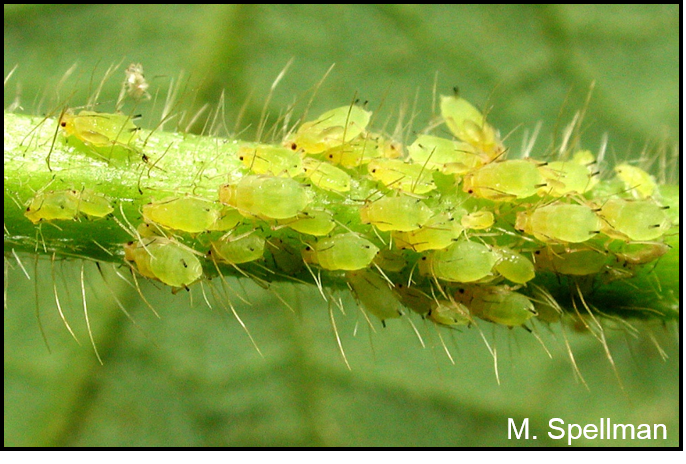
Sugarcane aphid update—spread and control options
Sugarcane aphid has advanced as far north as Halifax County, North Carolina—about 30 miles south of the Virginia border. To prepare for the possibility of sorghum field infestations, we have pursued a Section 18, Emergency Exemption for the use of Transform insecticide. This process involved a lot of good cooperation by VDACS who put the request together and forwarded it to the US EPA. We are awaiting approval. If approved, Transform (sulfoxaflor) can be used at 0.75-1.5 oz/acre and has a 14 day preharvest interval. Having Transform will give us access to the two insecticides that most states are relying on to combat sugarcane aphid—Transform and Sivanto. Since controlling heavy infestations it is taking two applications, having these options provides insecticides with different chemistries—always a good strategy.
We do not know if sugarcane aphids have infested sorghum fields in Virginia as we do not have a statewide sorghum pest surveillance program. According to FSA records, 12,245 acres of sorghum are grown for grain in 45 different Virginia counties, ranging from as few as 10 acres to as many as 1,000 depending on the county (view the attachment for a summary and FSA web site acreage source). With a crop that is this variable and widespread, it will be up to growers, crop advisors and local VCE agents to check fields for sugarcane aphids. As we have mentioned in earlier advisories, the crop is vulnerable until harvest.
Please let us know if an infestation is found so we can track this pest for future program development.
Black light trap report for the week ending August 27, 2015
Average black light trap captures of corn earworm moth ranged from less than one to 20 per night; brown marmorated stink bug captures ranged from zero to almost 4 per night. Numbers were similar to what we saw last week. Please see the attached tables for further details. BLT_Aug_27_2015
Corn earworm/bollworm moth vial test update for Aug. 27, 2015
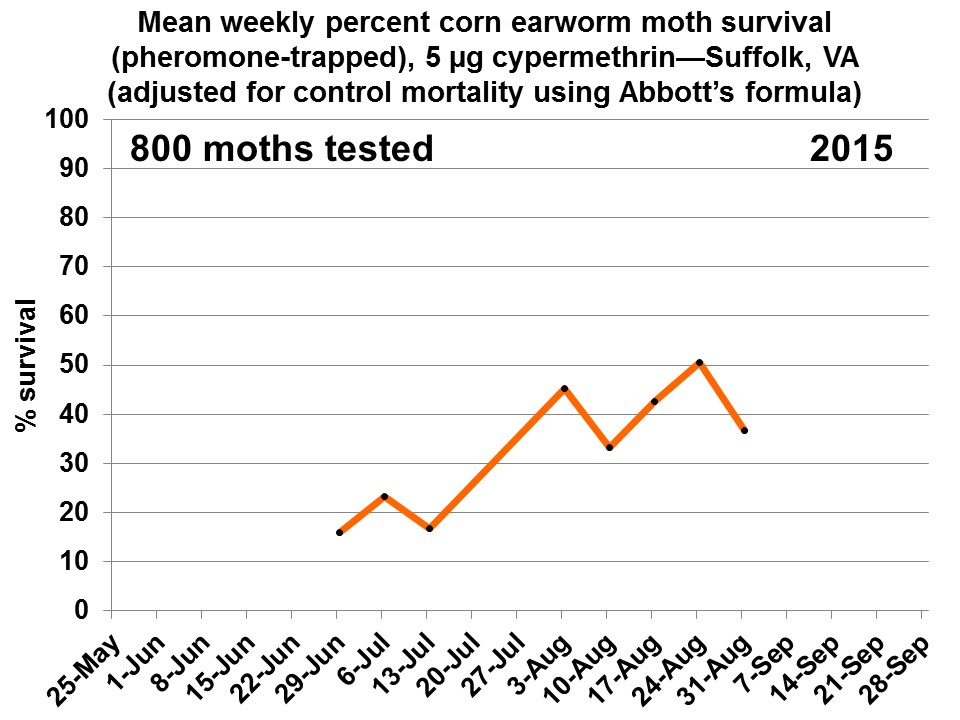
So far this week we have tested 41 moths, with 37% surviving the 24-hour vial-test exposure to 5 micrograms of the pyrethroid insecticide, cypermethrin. This percentage falls very close to our seasonal average of 39% survival (n = 800 moths tested). The line graph, below, indicates our results to date.