
Corn earworm moth captures ranged from zero to 2.3 per night in area black light traps; brown marmorated stink bug nightly averages ranged from zero to 1.3. Please see the attached data tables for more details. Thanks to the following for their reports this week: Mary Beahm, Keith Balderson, David Moore, Scott Reiter, Austin Brown, Mike Parrish, and Ames Herbert’s entomology crew. Special thanks to those hosting the black light trap locations! BLT_30_Jul_2015
Corn disease update — July 28, 2015
In an update to my previous post, southern corn rust has now been confirmed in Chesapeake, VA. This is a few days earlier than in 2014 (August 3), but most of the field corn in the region is mature enough (dent stage) that yield should not be impacted. Late planted corn in fields with good yield potential (120 bu/ac +) may need to be protected with a foliar fungicide. Strobilurins are good preventative fungicides whereas triazoles are recommended once sporulation is observed in a field due to their curative activity. A combination fungicide is a good option as long as a strobilurin fungicide has not been applied previously. Wet, warm weather favors disease development. Once sporulation occurs, symptoms of rust are relatively obvious. Lesions start out as raised, blister-like pustules then break open to reveal orange spores. Samples of corn plants with symptoms of southern rust can be submitted to the disease clinic at the Virginia Tech Tidewater AREC (contact Dr. Hillary Mehl, hlmehl@vt.edu).
Unusual yellow peanut color
I have recently seen several peanut fields or spots in the fields around the Tidewater AREC with yellow plants resembling nitrogen deficiency. Colleagues in North Carolina are also getting concerned with peanuts needing late season nitrogen applications. Similarly, in one of my research fields we noticed a part of the field with yellow plants resembling nitrogen deficiency next to dark green plants for the rest of the area. Indeed, early this summer Kelvin Wells, Extension Agent in Sussex county VA, brought in some samples of yellow peanut plants. Right away I identified nitrogen deficiency because there were no nodules on the roots and plants were starting blooming; also the farmer did not inoculate at planting. It was easy. But with the plants from my own field trial it is not so easy! Yellow and smaller plants had larger nodules than the bigger and greener plants and in a similar number on July 17 when I checked. Nodules from both plants, green and yellow, were dark red when cut, indicating active nitrogen fixation (pictures are attached here Unusual peanut color). The green plants were planted on May 10 and the yellow ones on May 22. I really do not have any other explanation than probable negative effect of high temperatures and dry conditions experienced by late planted peanuts in Virginia this year. This could have affected root growth and nodulation for young seedlings and carried nutritional imbalances over to later stages.
Corn disease update – July 26, 2015
Much of the field corn in the region is near or at the dent stage and no longer at risk for yield loss from foliar diseases. One disease I frequently receive questions about is southern corn rust. Southern corn rust is a potentially aggressive disease, but the fungus does not overwinter in Virginia and it is typically seen late in the growing season if at all. In 2014, southern corn rust was confirmed in Virginia on August 3, which is relatively early compared to other years. As of this week, southern corn rust has been confirmed from four North Carolina counties (Hyde, Lenior, Beaufort, and Camden) but it has not been observed in Virginia. We very well may see southern corn rust in southeastern Virginia within the next couple of weeks, but there is no need to panic. Yield of corn at or near the dent stage is unlikely to be impacted by the disease, but late planted corn in fields with good yield potential (120 bu/ac +) may need to be protected with a foliar fungicide. Strobilurins are good preventative fungicides whereas triazoles are recommended once sporulation is observed in a field due to their curative activity. A combination fungicide is a good option as long as a strobilurin fungicide has not been applied previously. Wet, warm weather favors disease development. Once sporulation occurs, symptoms of rust are relatively obvious. Lesions start out as raised, blister-like pustules then break open to reveal orange spores. Samples of corn plants with symptoms of southern rust can be submitted to the disease clinic at the Virginia Tech Tidewater AREC (contact Dr. Hillary Mehl, hlmehl@vt.edu).
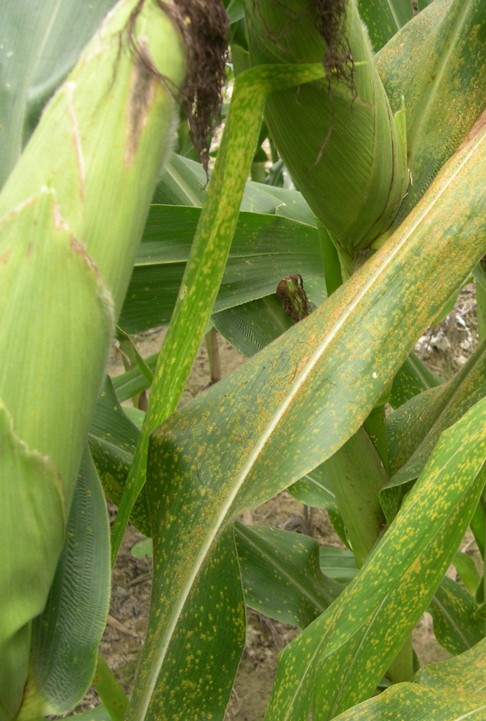
Southern corn rust
July 23, 2015 update for brown marmorated stink bug and kudzu bug survey of soybean
In soybean, our scouts have detected BMSB in Bedford, and kudzu bug in Brunswick, Campbell, Cumberland, Dinwiddie, Greensville, Nottoway, Prince Edward, Suffolk, and Surry. Kudzu bug has been observed on other hosts (i.e., kudzu) in Appomattox, Buckingham, Isle of Wight, and Southampton. Please see the attached maps for further details. BMSB_KB_23_Jul_2015
Black light trap captures for the week ending July 23, 2015
Corn earworm moth captures were low this week, ranging from zero to 0.7 per night. BMSB catches ranged from zero to 2 per night. Please see the attached file for the data tables. Thanks to the following for their reports this week: Mary Beahm (Warsaw), Scott Reiter (Prince George), David Moore and intern Taylor Sabo (Middlesex), Austin Brown (Southampton), and Dr. Herbert and the entomology crew in Suffolk. BLT_23_Jul_2015
Advisory on Pollinator Protection and the Use of Foliar Insecticides in Flowering Cotton
We have received several calls about the issues regarding the foliar application of insecticides to flowering cotton. Because of the oil and livestock feed uses of cotton, it is considered to be a food crop—so many of the insecticides used in cotton now include pollinator protection statements on their labels. These insecticides include, but are not limited to the neonicotinoids: Admire Pro, Centric, Belay, Endigo, Leverage, and others.
According to the new label restrictions, these insecticides are not to be used on cotton while bees are foraging, and they are not to be used until flowering is complete and all petals have fallen unless one of the following conditions is met:
1) The application is made to the target site after sunset and before sunrise.
2) The application is made to the target site when temperatures are below 55˚F.
3) The application is made in accordance with a government-initiated public health response.
4) The application is made due to an imminent threat of significant crop loss, and a documented determination consistent with an IPM plan or predetermined economic threshold is met.
Conditions 1, 2, and 3 are either not practical or will likely not apply to the cotton crop. But condition 4 could be a viable option for growers but it needs some clarification—specifically, what is an imminent threat, who makes the determination, and how is the determination documented?
WHAT CONSTITUES AN IMMINENT THREAT OF SIGNIFICANT CROP LOSS, AND WHO DECIDES?
- According to a guidance document by the State FIFRA Issue Research and Evaluation Group (SFIREG) (further details follow), the criteria to determine when an imminent threat exists would need to be determined by the applicator in consultation with a Cooperative Extension agent, crop consultant, certified crop advisor, or a state recognized pest management model/tool.
- According to VDACS, “….ideally the determination of what an ‘imminent threat of significant crop loss’ is would be made and supported by a subject expert, for example, extension agent, crop advisor etc., prior to the application and the decision to apply can be shown to be consistent with an IPM plan or based upon an established economic threshold.”
HOW IS THE DETERMINATION DOCUMENTED?
- According to VDACS, regarding required documentation, “…the label does not contain, thus there does not exist, a requirement for any specific records or documentation to be kept by the applicator. It is, however, in everyone’s best interest to have thorough application records and that would include documenting ‘imminent threat’. It would be prudent for the applicator to have some ‘evidence’ to support their use of the product as an outdoor foliar application on a labeled crop. The ‘evidence’ could be a letter or email from one of many experts, or a reference to a pest management guide or other such literature.”
- Our current insect pest management recommendations for Virginia cotton can be accessed in the VCE publications, Pest Management for Field Crops, http://www.pubs.ext.vt.edu/456/456-016/456-016.html, and Managing Stink Bugs in Cotton: Research in the Southeast Region, http://www.pubs.ext.vt.edu/444/444-390/444-390.html.
- Also according to VDACS, the label language (regarding documentation) is purposely vague to allow flexibility and rather than making the documentation requirement too prescriptive, they are following the general guidance document from the State FIFRA Issue Research and Evaluation Group (SFIREG), http://www.aapco.org/documents/bee_label_guidance_2014.pdf, and will consider the documentation provided to satisfy the condition has been met on a case by case basis.
So, as I see it, cotton can be treated with a neonicotinoid insecticide during flowing if the need is determined by a trained professional or there is some evidence that the treatment was based on published thresholds—and it would be best to document it via a letter, email, or some other written record. Using any insecticide with the pollinator protection label language (and it is likely that in the future these restrictions will be applied to more products) will raise the bar in terms of both understanding and adhering to insect thresholds in not only cotton, but all food crops where pollinators forage during flowering. This would leave no room for ‘automatic’, ‘tank mix’, ‘convenience’, or ‘insurance’ treatments—as these could not be justified as adhering to thresholds.
Note that there are a number of other requirements regarding notifying nearby beekeepers prior to insecticide applications. Details are provided in the SFIREG document mentioned, above. Always read and follow the label. If you have further questions about the pollinator protection label language or how VDACS will handle this, you should contact your local Pesticide Investigator http://www.vdacs.virginia.gov/pesticides/directoryinvest.shtml or the Office of Pesticide Services at 804-786-3798. If you need further help in understanding the thresholds, please contact your local VCE ANR Agent, or Ames Herbert at the VT Tidewater Agricultural Research and Extension Center.
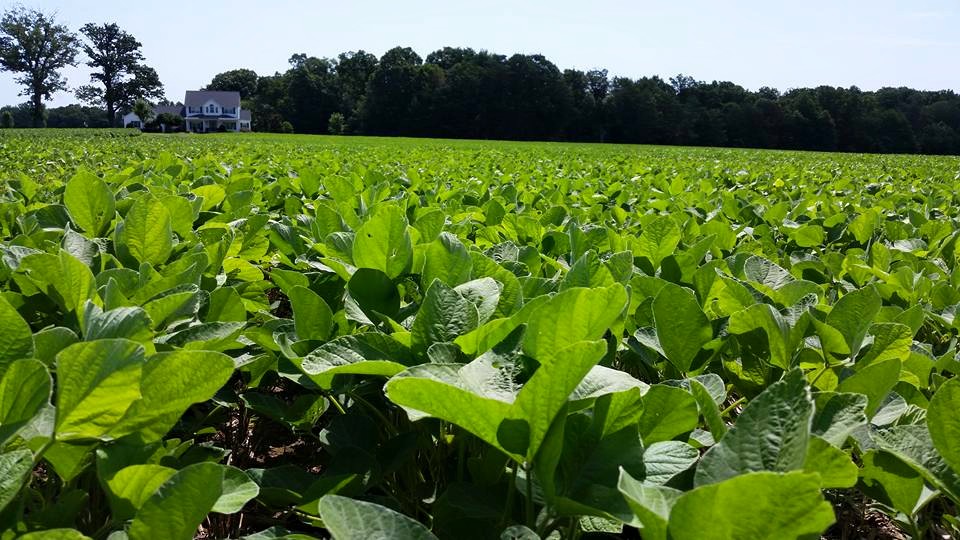
Should I Apply a Foliar Feed to My Soybeans?
The high prices over the last few years have allowed many of us to experiment with certain practices that, at best, might occasionally increase yields. The return of investment usually only required one bushel (or less), depending on the input. But that was when soybeans were $13, $15, and even $17 per bushel. But now, you may be able to sell your crop for $10-11 (if you still have any in storage) and the future prices are reflecting record acreages.
So, it seems that I’ve been asked, “Should I apply a foliar feed to my soybeans?” more this year than in the past few years.
First, I still stand by what I’ve said in the past and still say today: “Feed the roots and not the foliage.” Soybean will remove 3 to 4 lbs of nitrogen, 0.8 lbs of phosphorus, and 1.4 lbs of potassium per bushel of seed produced. These large amounts will need to come via root uptake; it is not economically possible to apply these amounts through the foliage.
But, once the soil needs are met, will additional fertilization help?
First, an application of Manganese may be needed if your soil pH inches much above 6.5. 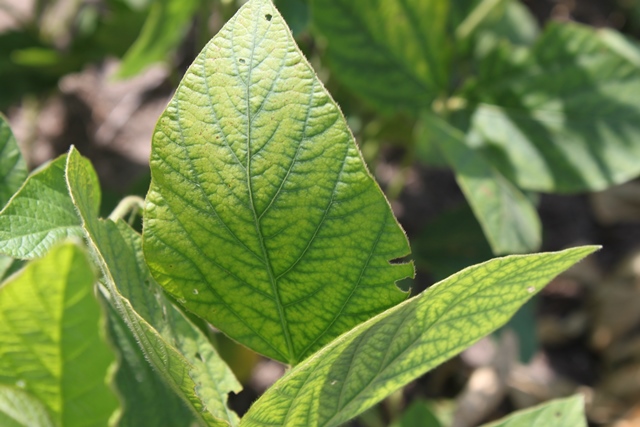 I’ve even seen Mn deficiencies when the pH is as low as 6.2 (using fall/winter soil test levels) and the soil is “wet natured” or if lime was recently applied. There are also certain varieties that tend to show Mn deficiency sooner than others. So, if you see the characteristic interveinal chlorosis of Mn deficiency or if soybean are growing in a field that typically exhibits such a deficiency, then spray Mn.
Another issue that I’m seeing this year is a general yellowing of plants, usually just in seemingly random spots in the field. Upon closer inspection, these are usually very wet areas (there are plenty of those this year) or sandy knolls. In the saturated soils, the yellowing is likely due to lack of oxygen and/or poor nodule development. The only cure for lack of oxygen is for the soil to dry out. Poor nodulation is indirectly a response to lack of oxygen – the nitrogen-fixing bacteria have temporarily stopped functioning. But they will recover and provide the nitrogen when the plant needs it the most, when the pods are forming and seed are filling. Will a shot of foliar nitrogen help? Yes, it will green up the plant if lack of nitrogen is the problem. Will this shot of nitrogen (assuming that nitrogen is the problem) increase yield? Maybe. Maybe not. If lack of oxygen is the problem, then probably not. Even if lack of nitrogen is the problem, probably not.
I want to caution everyone to not make assumptions that lack of nitrogen is the problem.
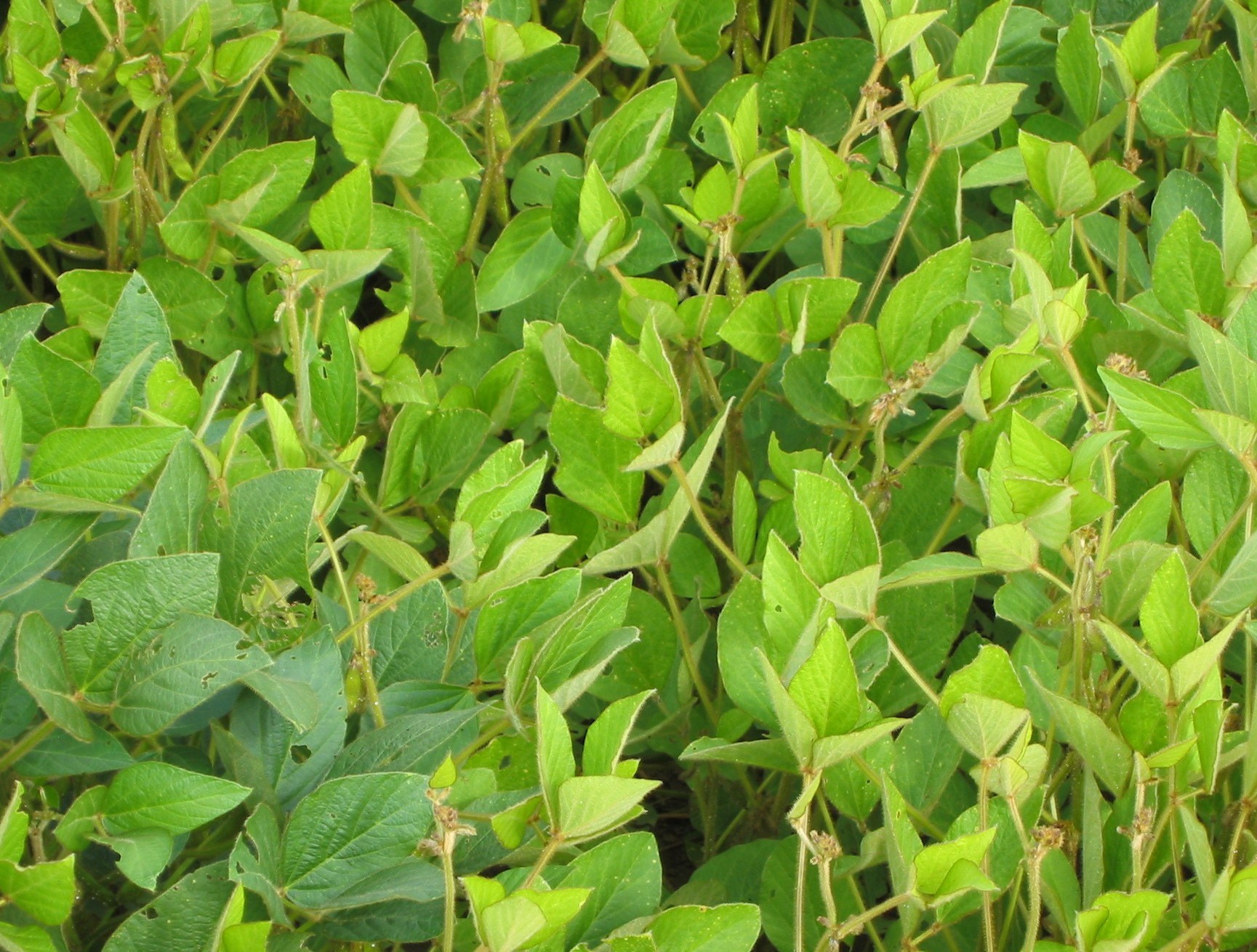
Is this N or S deficiency?
The only way to know for sure is to take a tissue sample. A deficiency that closely resembles nitrogen deficiency is sulfur. On those sandy knolls, I’ve seen sulfur deficiencies. Sulfur will leach just like nitrogen. But, soybean will not produce its own sulfur. A shot of nitrogen would do nothing to help in this case. The take home message is to determine the cause, then act on that information.
But what about other nutrients? What if there is no visual symptoms of nutrient stress? What if my yield potential is very good? My attitude towards this is that it usually won’t hurt (but be careful mixing with other chemicals), so do what makes you sleep better at night. If you think it is helping your crop, then make the application. It’s your money. You know your fields better than anyone. But, I have rarely seen a response to foliar feeds if you have maintained adequate soil fertility levels and have managed the crop for maximum economic yields. Again, yield response to foliar fertilizers is, at best, inconsistent.
Kudzu bug distribution update for July 16, 2015
Our scouts (Ed Seymore, Jamie Hogue, and Dr. Herbert’s Entomology team) have started sampling soybean fields across Virginia for kudzu bug and brown marmorated stink bug. The file attached at the end of this paragraph indicates the counties where kudzu bug has been found (blue counties = kudzu bug found in soybean; maroon counties = kudzu bug found on other hosts such as kudzu). Please note that we have not yet sampled all counties on our survey route. I will continue to provide weekly updates on this, including pest population levels, as the season progresses. KB_7_16_2015
Black light trap captures for the week ending July 16, 2015
Corn earworm moth catches from reporting stations were low this week. Nightly averages were: Warsaw=zero; Southampton (Courtland)=zero; Suffolk=0.4. Brown marmorated stink bug nightly averages were: Warsaw=zero; Southampton (Courtland)=1.3; Suffolk=zero. Thanks to the following for their reports this week: Mary Beahm, Austin Brown, and Dr. Herbert’s Entomology team. The image of the “bucket style” black light trap is courtesy of Austin Brown. 