
The following advisory is from Dr. Hunter Frame: Tissue Testing During Bloom in Virginia Cotton
Fungicide Resistant Frogeye Leaf Spot Present in Virginia
Fungicides are an important and effective tool for management of fungal diseases of crops including soybean. Unfortunately, over time fungal pathogens have the potential to develop resistance to specific fungicide modes-of-action. Mutations conferring resistance to fungicides are relatively rare, but multiple applications of the same fungicide chemistry impose selection pressure on pathogen populations and increase the frequency of those mutations over relatively short periods of time. Thus, specific fungicide chemistries have the potential to lose their effectiveness over time. Fungicide resistant isolates of Cercospora sojina, the causal agent of frogeye leaf spot in soybean, have recently been confirmed throughout the southeast including in North Carolina in 2013 and Virginia in 2014. In 2014, a small preliminary survey was conducted to determine if fungicide resistance is occurring in Virginia populations of frogeye leaf spot. Four fields were tested, and two of those fields had fungicide resistant strains. The resistance is specific to strobilurin (QoI, FRAC group 11) fungicides, which are highly effective for control of fungal foliar diseases but to which resistance can rapidly occur within fungal populations. Effective foliar disease management requires appropriate fungicide chemistry selection based on the specific pathogens present and their sensitivity to different fungicide modes of action.
Additional isolates of the frogeye leaf spot pathogen from throughout Virginia need to be collected and tested for fungicide resistance so that appropriate fungicide recommendations can be made. Other states have already initiated fungicide resistance monitoring programs for the causal agent of frogeye leaf spot (C. sojina), and we will implement a similar program in Virginia. Soybean leaves with symptoms of frogeye leaf spot will be collected throughout the 2015 growing season, the fungus will be isolated, and isolates will be tested for resistance to strobilurin (QoI) fungicides. If fungicide resistance is widespread in Virginia, recommendations for foliar fungicides and/or cultivar selection may need to be modified. If incidence of fungicide resistance is low, we will continue to monitor fungal populations and assess the risk of fungicide control failures on a year-by-year basis.
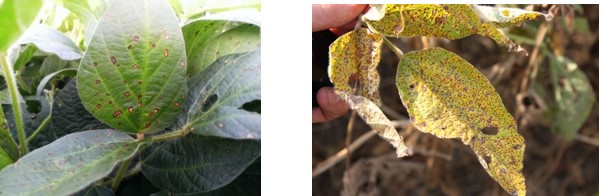
In order to implement an effective fungicide resistance monitoring program, we are requesting that leaf samples from soybean fields with symptoms of frogeye leaf spot (see pictures above) be submitted to the Tidewater AREC for testing. For more information on submitting samples, please contact Dr. Hillary Mehl (757) 657-6450 ext. 423 or hlmehl@vt.edu.

How Late Can You Plant Soybean?
Heavy rains over the last two weeks have prevented timely planting of much of our double soybean acreage.  We are slowly drying out and many are anxious to get back into the field. After mid-June, we lose about 1/2 bushel of soybean for every day we delay planting. While this is concerning, going back into the field too early may not be your best choice.
Planting into saturated fields may do more more harm than waiting a couple more days to plant. Tracking and rutting up fields means compaction, which can greatly lower yields and undo much of the good that continuous no-till has accomplished. In addition, opening the soil with disk openers will smear the sidewall and this “micro-compaction” may not allow young roots to develop properly. My general rule of thumb with no-till fields is to wait one more day to plant after you think you can get back into the field.
So, how late can I wait to plant?
With that said, today is July 9! So, how late can you wait to plant? I’ve planted as late as the third week of July and made decent yields (25-30 bushels) without changing varieties. The good thing about all of this rain is that the soil profile is full of water. That is not always the case with double-crop soybean. So, early-season moisture stress (which I think is partially responsible for the temporary cessation of growth after emergence) should not be a problem. Plants should grow fast and yield potential at this late planting date should still be good. My cutoff date is usually July 15-20.
Should I move to an earlier maturing variety?
Late-planted soybean are going to develop more rapidly than those planted in May and June. That is one reason that yields are lower. With every 4 to 5 days delay in planting, you will delay maturity by 1 day. If you are 15 days late planting then you will likely delay maturity by only 3 to 4 days. Choosing an earlier-maturing variety can make up this small difference, but is that the best choice?. This may not be an issue, as most varieties have been purchased and you may not be able to exchange them. But if you do have a choice, and you have experienced that your favorite varieties have barely matured before frost when planted late, then yes you may want to move to a variety that would mature a few days earlier. Half a maturity group or less should do it.
I do suggest to start planting the remainder of your latest maturing varieties first and then finish up with the earlier ones. I would also suggest that you plant your earlier maturing varieties on your best soils as that will minimize the potential yield loss from planting an early-maturing variety late.
What if I can’t plant by the middle of July?
For “prevented planted” acres, I would suggest planting a cover crop to maintain soil quality. With something green growing, your soil chemistry, biology, and structure will greatly benefit. Remember that nothing but weeds grow on bare soil.
Your choice of cover should reflect your plans for next year. If you plan to grow wheat or corn or sorghum, then a legume to fix some nitrogen would be a good choice. If you are going to plant a non-grass crop, a grass cover such as sorghum-sudan or millet would be a good choice for the summer. Come fall, there are several options. Check your insurance policy and see what options are available.
Black light trap report for the week ending July 9, 2015
This week, corn earworm moth captures in black light traps were zero at Warsaw, Suffolk, and Southampton. Brown marmorated stink bug catches (nightly averages) were 0.1 for Warsaw, zero for Suffolk, and 0.3 for Southampton. Thanks to Mary Beahm, Ames Herbert and crew, and Austin Brown for their reports this week.
Excess rains and leaching of nitrogen, potassium and sulfur
The following advisory is from Dr. Hunter Frame: Excess rains and leaching of nitrogen
Kudzu Bug Overwintering Emergence and Predictions for the Coming Season
Please see the attached report (pdf document) by Dr. Herbert: Kudzu_bug_prediction
Peanut Disease Update
Recent warm, wet weather has been optimal for both plant growth and fungal disease development in peanut and other crops. Early planted peanut in southeastern Virginia is near the R3 (beginning pod) stage, so it is almost time to make the first fungicide application for leaf spot. The first spray can be delayed until two weeks after R3 on Bailey. Last effective spray dates for leaf spot can be found on the Virginia Peanut-Cotton Infonet website.
Sclerotinia blight risk in based on temperature, rainfall/humidity, and crop growth. Temperature and rainfall have been conducive for Sclerotinia blight, but Sclerotinia risk is considered low to moderate prior to canopy closure. However, rapid growth of the peanut crop in some fields has resulted in thick canopies that provide the moist micro-climate necessary for disease development. Thus, now is the time to start scouting for Sclerotinia blight in peanut fields, especially if vines are within six inches of touching. If the wet weather continues, Sclerotinia blight risk is expected to be high within the next couple of weeks.
Corn Disease Update
Recent warm, wet weather has favored development of foliar diseases in corn and other crops. Northern corn leaf blight has been confirmed in southeastern Virginia over the past week, and gray leaf spot has been observed on corn in the region. Corn in much of the state is at or just beyond tasseling, and it is not too late to consider a foliar fungicide application. Several factors increase the risk of corn yield loss to foliar diseases and the chances that application of a fungicide will be profitable.
- Susceptibility of corn hybrid to disease. Varieties have a high turnover rate so check with your local extension office or seed dealer for current information on which varieties have some level of resistance to diseases in the region. Be aware of the specific diseases your hybrid is susceptible or resistant to.
- Yield potential. If yield potential is low, you do not have much to gain and fungicide applications are less likely to be profitable.
- Previous crop and cropping system (e.g. no till). Many pathogens are able to survive on crop residues. Keep in mind that some diseases overwinter on crop debris in Virginia (e.g. gray leaf spot) whereas others require a living plant host and must move in from warmer regions each year (e.g. southern corn rust).
- Crop growth stage and timing of fungicide applications. Diseases are more likely to impact yield at particular growth stages of the crop (typically during development of the grain) so timing fungicide applications accordingly is key.
- Disease pressure. Which diseases, if any, are present, and how widespread are they? Scouting and accurate pathogen/pest identification are critical components of any IPM program. Presence of a disease on lower leaves (2nd or 3rd leaf below the ear) at or near tasseling may indicate the need for a fungicide application. Yield loss can occur if diseases reach the ear leaf prior to grain fill, but the appearance of foliar disease following the dent stage is unlikely to impact yield. A “Corn Disease Scouting and Fungicide Guide” can be downloaded below.
- Weather. Temperature and humidity greatly influence the onset and development of disease. Even if the crop is susceptible and a pathogen is present, the risk of yield loss to disease may be low if environmental conditions are not conducive pathogen growth and reproduction. Warm, humid conditions are favorable for many diseases in our region. In some cases, the micro-climate within a field may be conducive for disease development even when ambient conditions are relatively dry, especially when high plant populations and a dense canopy are present in a field.
Corn Disease Scouting & Fungicide Guide
Preliminary 2015 Hulled and Hulless Barley OVT results posted
The 2015 barley OVT trial data have been posted to the Corn and Small Grain Management website. By-location, 2015, two and three year data are summarized in Excel format. The links can be found on the website:
http://www.grains.cses.vt.edu/
Or by using these direct links to the excel files.
http://www.grains.cses.vt.edu/Testing_results/barleytables2015.xlsx
http://www.grains.cses.vt.edu/Testing_results/hullesstables2015.xlsx
Corn earworm and BMSB black light trap report for week ending July 2, 2015
Thanks to Austin Brown, Mary Beahm, and Ames Herbert & crew for their reports this week. Corn earworm moth nightly average black light trap catches were: Warsaw-zero; Suffolk-2.1; Southampton (Courtland): zero. Brown marmorated stink bug black light trap catches (nightly averages) were Warsaw-zero; Suffolk-zero; Southampton (Courtland)-0.5