
We just received confirmation that kudzu bug adults have been found in two counties, one on a trap at the VT Tidewater Ag Research and Extension Center in Suffolk, and several on the side of a building in Mecklenburg County (see the attached map). These adults are the overwintering population getting active as the weather warms. They are about a month later than our first reports in 2014–the first in that summer emerged the first week in March in Chesapeake. This winter has been pretty cold and wet compared to some and could have caused this delay. Most likely more reports will start coming in soon. Updates will be posted. Kudzu_bug_traps_7_Apr_2015
Getting Ready for a New Peanut Season
Variety selection. For Virginia and Carolinas (VC) the preferred Virginia market-type cultivar was Bailey followed by Sugg, in 2013 and 2014. Both have good disease package, Bailey more than Sugg, but none has the high oleic trait. This may not be a major concern for farmers (even though I hear that shellers pay premiums for the high oleic cultivars) but is increasingly so for shellers, processors and, most importantly, consumers. High oleic oil profile alternatives with very good disease resistance are Sullivan and Wynne, 2013 releases. Sullivan is similar in seed size with Bailey and yielded better than Bailey in variety trials across the VC region in 2014. It was more resistant to diseases than Bailey, too (credit to Dr. Mehl). Wynne is a larger seeded cultivar, larger than Sugg, with excellent yields in 2013. Seed of Sullivan and Wynne may not yet be abundantly available to farmers but, if you can get some, I encourage you to try these two new cultivars this year.
Potash. This note was inspired by some of Dr. Jordan’s notes to the Extension Agents in North Carolina. For some growers, soil test results recommended application this year of potash for peanut and they did not know what to do. Usually, potassium is not a common application for peanut but, due to excessive soil moisture we have had in 2014 and up to now, potassium may have been leached through the soil profile. I have a similar situation in my own backyard. If the soil tests recommend potash application, do so. Of course, make sure after this to apply the required rate of gypsum at the optimum recommended time by the VA Peanut Production Guide. VA Peanut Guide 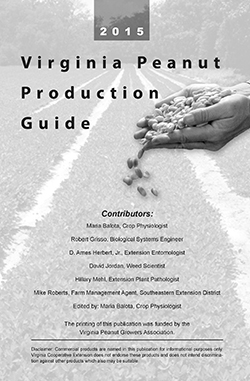
Inoculant. Here we are again! Remember last year when we recommended applying inoculant regardless the number of years of peanut rotation? It was because too much water standing in the field and we speculated that this could have killed the bacteria. Do the same this year. Trials conducted by Dr. Jordan in North Carolina from 1999 through 2014 showed 1,565 lbs/acre yield increase in new peanut land and almost 200 lbs/acre in regular peanut fields by applying in-furrow liquid or granular inoculant. For best results however, the inoculant needs to be delivered right on top of the seed and not on the soil aside. We use Optimize Lift brand mixed with Admire-Pro and Proline for several years, just like Dr. Herbert’s group. Ammonium sulfate did not increase yield relative to the no-inoculant and no-ammonium sulfate treated controls in half of the tests conducted by Jordan in North Carolina.
Save the Date: “Early Summer Row Crops Tour”
The “Early Summer Row Crops Tour” will be held the morning of June 4, 2015 at the Virginia Tech Tidewater AREC’s Hare Road Research Farm. More details will be provided in future posts.
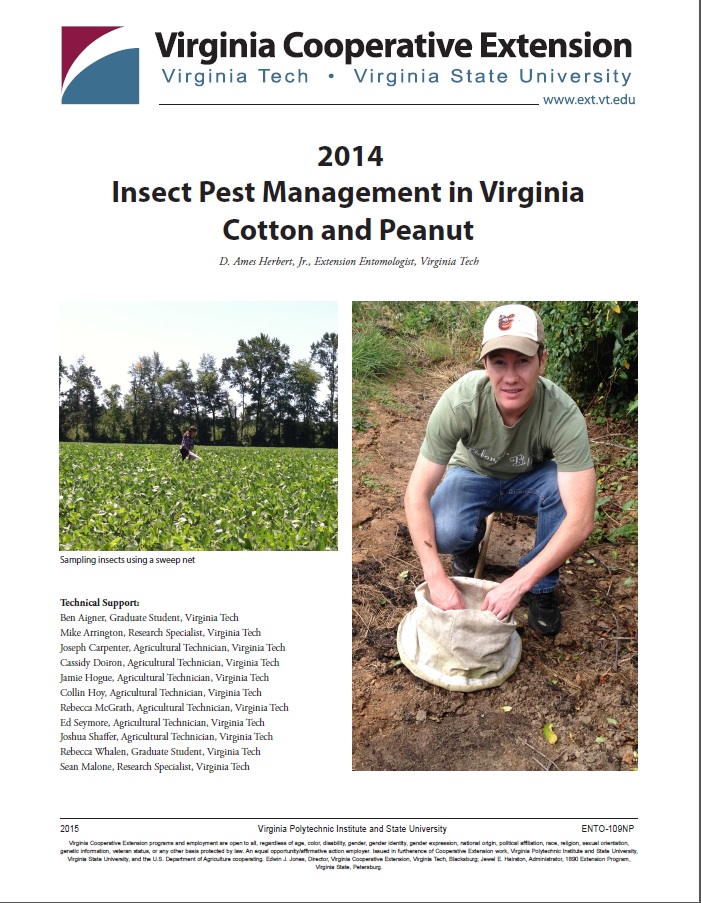
Insect Pest Management in Virginia Cotton and Peanut, 2014
Dr. Ames Herbert’s annual research summary booklet for cotton and peanut entomological research in 2014 is now available on the Virginia Cooperative Extension “Publications” website: http://www.pubs.ext.vt.edu/ENTO/ENTO-109/ENTO-109.html
New Survey Shows High Level and Widespread Resistance of Thrips to Neonicotinoid Insecticides
Please see the attached report by Dr. Herbert (Virginia Tech) and Dr. Kennedy (North Carolina State University) regarding thrips resistance to neonicotinoid insecticides. NeonicThripsResistance
Corn seed trait tables
Dr. Dominic Reisig (Entomologist, North Carolina State University) has shared these slides showing (1) corn trade names, their Bt protein(s), and their effectiveness against corn earworm and fall armyworm; and (2) corn seed treatment trade names, their active ingredient(s), and their effectiveness against billbug, white grub, and wireworm. In these two attached tables, P = Poor, F = Fair, G = Good, VG = Very Good, E = Excellent, and NL = Not Labeled. Please click on the pdf document at the end of this sentence to access the tables: corntraits
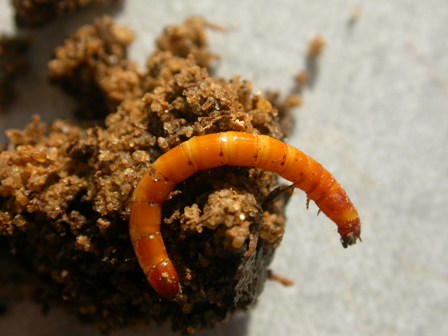
2015 Wireworm Control Options in Potatoes
As potato planting is on everyone’s mind, control options for wireworms are of importance, particularly since some of those need to be made immediately prior to or at planting.
Below is a document on wireworms and their control in potatoes to assist in the management of this important pest:
VA State Peanut Meeting
The State Peanut Meeting this year is scheduled for Feb 2nd at the Airfield 4-H Center in Wakefield, VA. The address is: 15189 Airfield Road, Wakefield, VA 23888. The meeting starts at 9:00 AM and ends after lunch with the VA Peanut Growers Business meeting. Kelvin Wells, Sussex County Extension Agent has the details. See you there!
16th Annual Virginia Cotton Meeting
Please click on the attached pdf file (at the end of this sentence) for information about the upcoming “16th Annual Virginia Cotton Meeting” to be held on February 19, 2015 at the Paul D. Camp Regional Workforce Development Center, Franklin, VA. cottonmeeting2015
The Best Sorghum Hybrids for VA and the Mid-Atlantic
Not long ago, it was estimated that the break even yield for grain sorghum grown in the Mid-Atlantic is 85 bu/ac at the current seed price. Based on OVT testing in SC, NC, VA, and MD in 2013 and 2014 it seems that a good hybrid selection exists for growing sorghum as a single crop per season but not for planting after wheat as a double crop. For example 13 hybrids in VA and 19 across the four states produced average yields from 94 to 128 bu/ac in 2014. [2014 Sorghum OVT Summary] From these, five hybrids (DEKALB DKS 51-01 and 44-20; Pioneer 83P17; Mycogen 1G855; and Sorghum Partners NK6638) were also top performers across the Virginia-Carolina region in 2013 with yields at or over 100 bu/ac. At such high yield potential, they can produce 85 bu/ac and over in a regular farm setting. But double crop sorghum produced at the most 80 bu/ac (DKS51-01) across the Mid-Atlantic and 75 bu/ac (ALTA AG2103) in VA in 2014. Double crop grain sorghums did not perform better in 2013 either, when averaged across the region. There were a few exceptions; in NC certain hybrids (DKS33-88, 51-01, 44-20, and 55-33; ALTA AG2115 and 2101, Richardson Seed 92123; Southern Harvest 5964, 8064; and Southern States SS540) performed well under double cropping production. But, is this sufficient to conclude otherwise when neither in VA, MD, nor SC yields of double cropped sorghum exceeded 80 bu/ac? Better hybrids with improved adaptability to the region and this type of cropping would seem to be needed for grain sorghum to have a place in this region and where double cropping is practiced over hundreds of thousands of acres. We will continue to search for better hybrids in a double crop system within the OVT trials in 2015 and, hopefully, beyond.
Drs. Ron Heiniger, Bob Kratochvil, and Chris Ray and their teams are gratefully acknowledged for providing the OVT data from NC, MD, and SC, respectively.