Summary of 2014 Peanut Variety and Quality Evaluation Results

Created in 1968, the Peanut Variety and Quality Evaluation (PVQE) program is a multi-state data support program for the Virginia-type cultivar development. Led by the TAREC researchers and staff, the PVQE is a NIFA multi-state joint effort with major universities in NC and SC. Among current priorities, development of Virginia-type cultivars with the high oleic fatty acid trait was identified as the most important for the VC region. The 2014 results from tests in VA, NC, and SC are here: AREC-125-pdf

The 2015 VA Peanut Production Guide is also available at http://www.pubs.ext.vt.edu/AREC/AREC-117/AREC-117.html.


Boxwood Blight on Boxwood Holiday Greenery

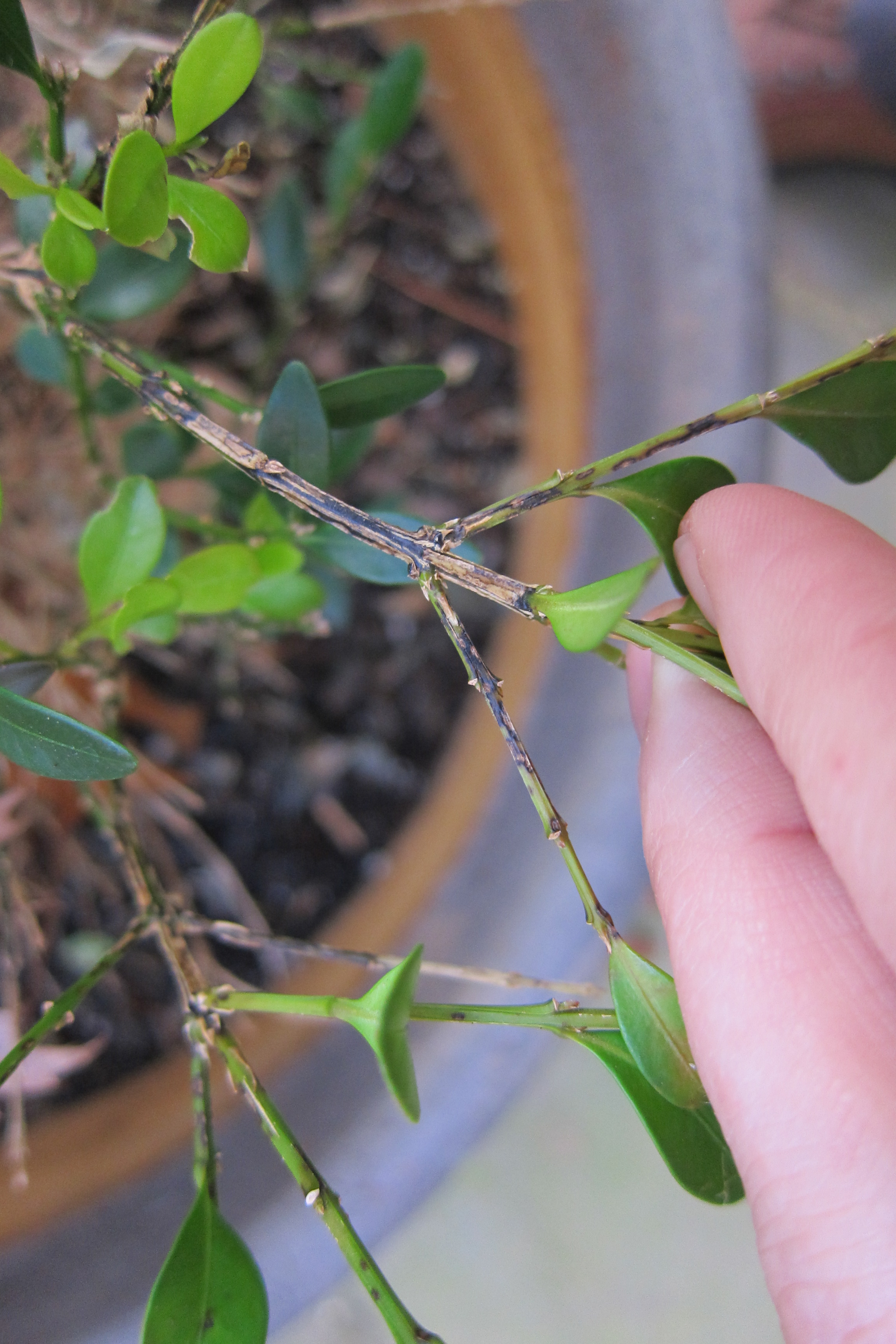
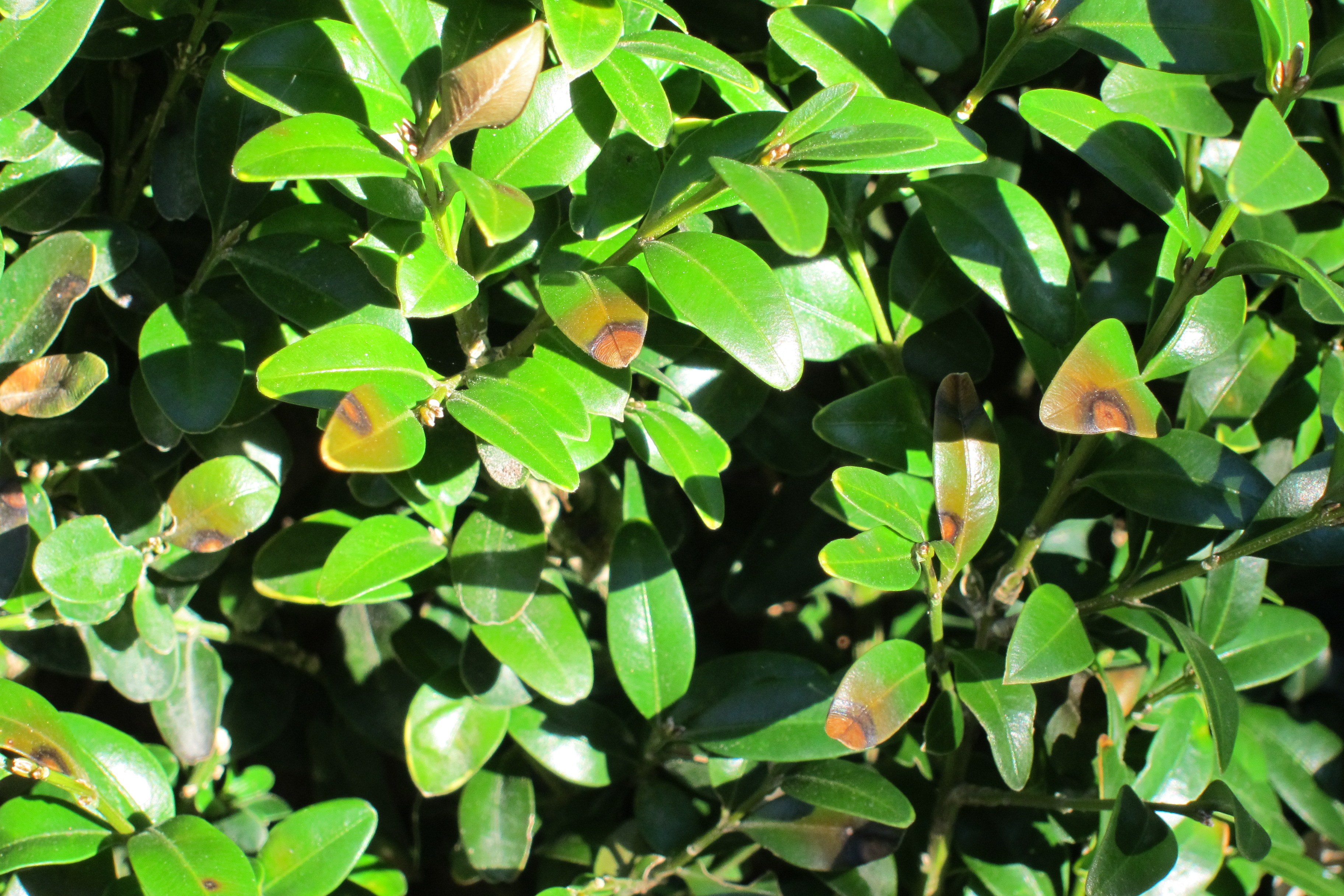
Boxwood blight has been present in Virginia since 2011 and has since spread from its original location in Carroll County to a number of other counties around the state by movement of infected plants. Because much of Virginia’s greenery production industry is located in areas where boxwood blight is known to occur, the potential for spread of the disease on boxwood greenery also exists. Last year we notified agents regarding the potential for spread of the disease via holiday boxwood greenery. Now that potential has become a reality in North Carolina. The North Carolina Department of Agriculture and Consumer Services recently discovered boxwood blight in holiday boxwood greenery sold at several retail locations in North Carolina. Although the fungus that causes boxwood blight is not active at cold temperatures, it produces structures that can survive on plant debris over the winter. The fungus could potentially infect nearby susceptible plants in the landscape when favorable weather conditions return. Therefore, it is very important that boxwood greenery be properly disposed after the holidays by double-bagging and removing to the landfill. Do not compost boxwood greenery and do not leave it in cull piles in the landscape. Inspect boxwood greenery carefully for symptoms of boxwood blight before introducing it to a site containing susceptible boxwood plants and discard symptomatic greenery as described above. Symptoms of boxwood blight include brown leaf spots with dark border, black streaks on green stems, and leaf drop. Be aware, however, that even asymptomatic greenery could potentially harbor the pathogen. If clientele have highly valued boxwood in their landscape, they may want to avoid introducing boxwood greenery altogether.

For more information on the North Carolina situation, refer to the NCSU Plant Disease and Insect Clinic blog at: http://ncsupdicblog.blogspot.com/2014/12/pest-alert-boxwood-blight-on-holiday.html.

For more information on boxwood blight in general, including Best Management Practices for the greenery industry, landscapers, home growers, and retail and wholesale nurseries, visit the Virginia Boxwood Blight Task Force web site at:http://www.ext.vt.edu/topics/agriculture/commercial-horticulture/boxwood-blight/index.html.

Please make sure that property managers of historic sites in your area are informed about this update.

Leaf spots on boxwood caused by the boxwood blight pathogen (photo by A. Bordas)

Leaf spots on boxwood caused by the boxwood blight pathogen (photo by A. Bordas)

Black streaking on boxwood stems caused by the boxwood blight (photo by A. Bordas)

Black streaking on boxwood stems caused by the boxwood blight pathogen (photo by A. Bordas)


Mid-Atlantic & Southeast Farmers Have Tough Decisions Ahead

Mid-Atlantic & southeast growers face tough cropping decisions in the coming weeks & months based on economics by Barney Bernstein with Entira, an Ag consulting business, and Dr. Nick Piggott, economist at NCSU (table below). Even though crop prices for corn and beans have come off the season lows, 2015 may see an even larger soybean crop, with soybean prices dropping into the $8 range. How will growers plan for and manage their risk for 2015 and beyond? Growers producing average soybean yields have significant financial risk if prices drop into the 2015 harvest, while corn production will require around 130 bu/acre to break even.

Factors to consider: An average double crop soybean break-even price is around $10.45/bu at 30 bu/ac; production costs include variable and fixed costs and assume an $85/acre rental rate (split between wheat and soybeans). Farmers who can produce full season bean yields at 40 bu/ac have a break-even price at an optimistic $8.90/bu.

Options and resources are available: Farmers may want to consider double crop or full season sorghum; sorghum offers weed resistance management options and rotational benefits that improve bean yields; and 85 bu/ac are relatively easy to achieve (for example, farmers on Eastern Shore, VA, had 2014 sorghum yields at around 95 bu/ac). Planting multiple crops seems to be by far the best solution for spreading the risk of volatile prices and weather unpredictability.Bernstein & Piggott summary budget

Field corn insecticide seed treatment chart

There are many insecticide seed treatment combinations available on commercial field corn seed. Although there are only 4 main active insecticide ingredients involved (imidacloprid, thiamethoxam, clothianidin, and chlorantraniliprole), there are currently at least 20 different trade names with different combinations and amounts of active ingredient per seed.  The chart provided here (see below) was created as a collaborative effort by corn entomologists from across the southeast.  It shows the combination and rate of the active ingredients of each product and the relative efficacy against the most common soil pests.  Because of the diversity of soil pests of corn in Virginia—depending on location, soil type, crop rotation system and history of pests—product selection should be made to fit each situation.  This chart can be used to select the most effective product for the most common pests of a particular field. For example, if seed corn maggot has been a chronic pest, at least 8 products are ranked as Excellent (E rating on the chart) for controlling that pest—compared with only two products that provide Excellent control of wireworm.  Hopefully this chart will be helpful when selecting the best insecticide seed treatments for next year’s field corn crop.

Field corn insecticide seed treatment chart

Field corn variety insecticide trait and herbicide tolerance chart

Field corn varieties provide a dizzying array of insect toxins—at least 14 different combinations by my count—that have very different degrees of efficacy against several corn pests.  The chart provided here (see below) lists the current commercial varieties, the insect toxin combination they provide, and the relative efficacy of each against the most commonly encountered corn insect pests.  The chart was created as a collaborative effort by corn entomologists from across the southeast, with guidance by two in particular, Kathy Flanders at Auburn University and Dave Buntin at University of Georgia.  For our purposes in Virginia, I would pay the most attention to those  varieties that provide Excellent (E rating on the chart) protection against corn earworm and fall armyworm, and if you are growing continuous corn, especially in the valley and piedmont regions, corn rootworm.  The chart also provides the herbicide tolerance package of each variety, and the associated refuge requirement. Hopefully this chart will help you with your choice of seed in the next season.

Field corn insecticide trait and herbicide tolerance chart


2014 Virginia Soybean Yield Contest

The Virginia Soybean Association in cooperation with Virginia Cooperative Extension would like to announce the 2014 Virginia Soybean Yield Contest. The purpose of the Virginia Soybean Yield Contest is to emphasize and demonstrate the practices necessary to produce maximum economic yields, to recognize those producers who grow high-yielding soybeans, and to gather data on the practices utilized by these outstanding producers. With the help of various seed companies, we reward and promote the achievements of Virginia’s most productive soybean farmers.

There are four Soybean Yield Contest categories: 1) Full-Season, Non-irrigated; 2) Double-Crop, Non-irrigated; and 3) Irrigated (Full-Season or Double-Crop; and 4) Most Efficient Yield (MEY). First, second, and third place winners of the full-season, double-crop, and irrigated contest will be recognized with appropriate trophies or plaques. In addition, cash awards of $200, $100, and $50 will be presented to the first, second, and third place winners in each of these categories. The winner of the MEY contest will receive a plaque declaring him or her the most efficient soybean producer in Virginia for that year.

Printable entry forms and contest details can be obtained from your County Agent or on my website:  (http://www.arec.vaes.vt.edu/tidewater/soybean/).  I look forward to seeing your entries.

Checking on Peanut Maturity in Virginia

In only two weeks since my last peanut maturity advisory, peanut changed from this
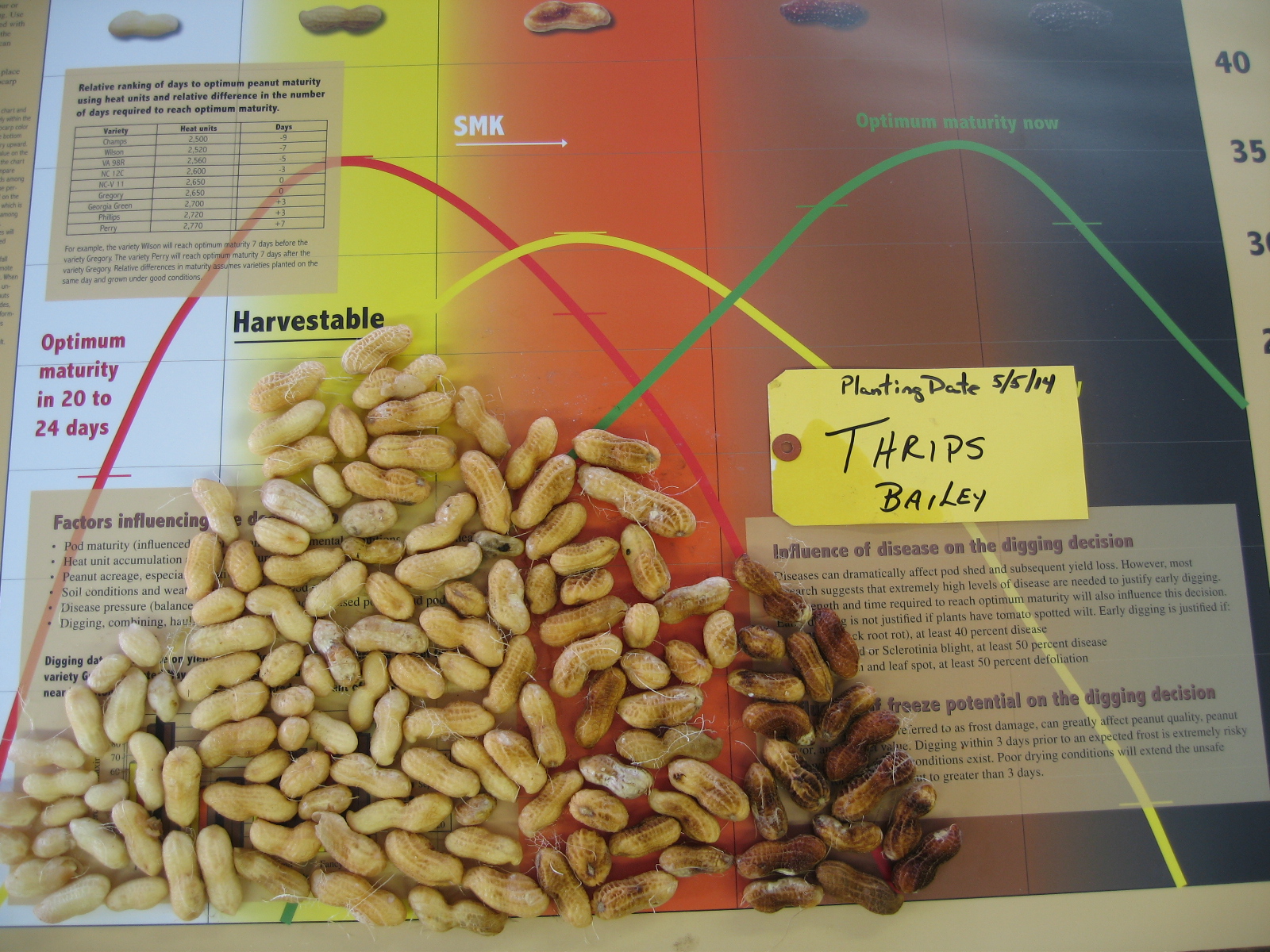
'Bailey' peanut planted on May 5th, and dug on Sep 2nd.

‘Bailey’ peanut planted on May 5th, and dug on September 2nd.

to this
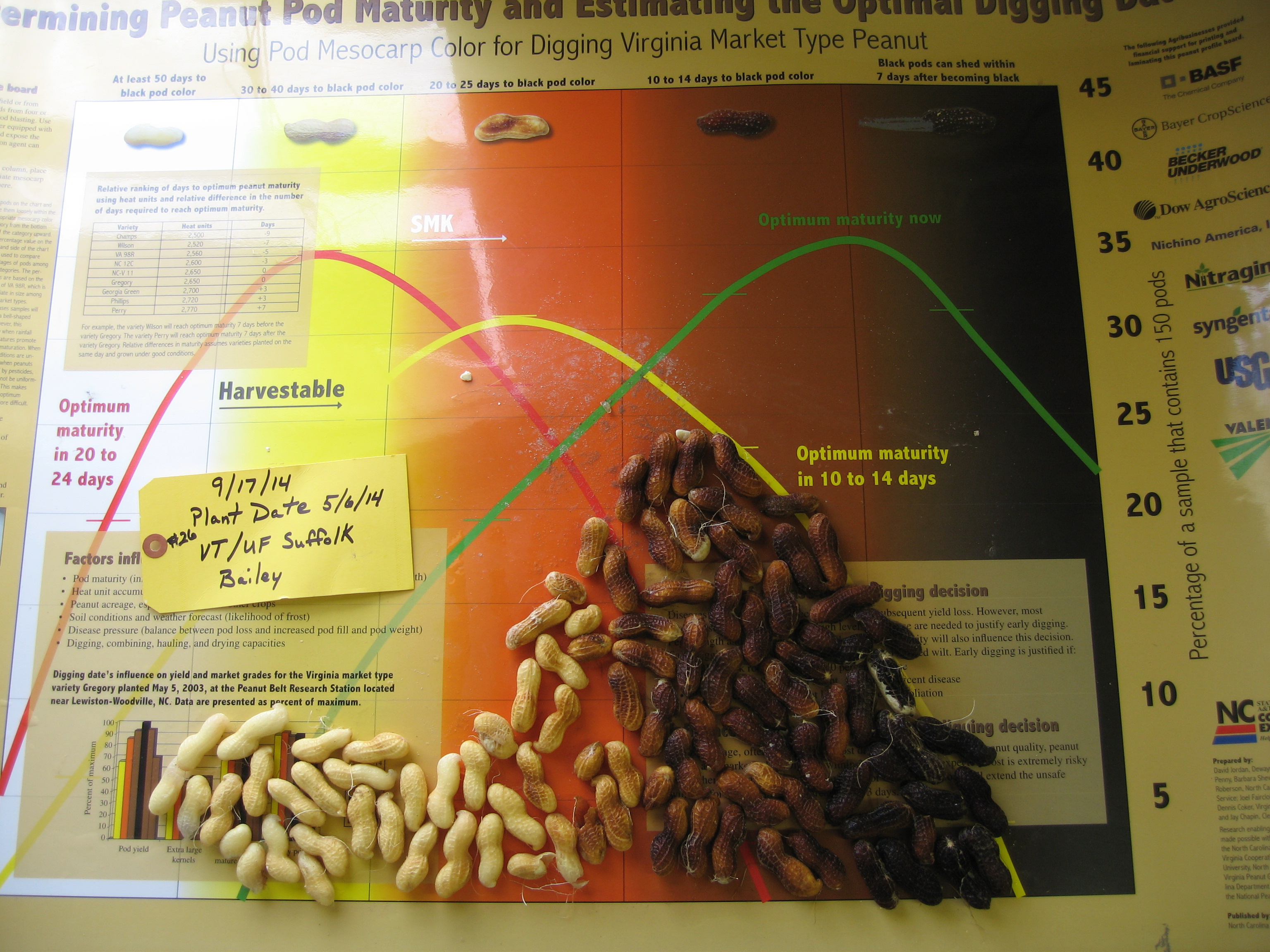
'Bailey' planted on May 6th and dug on September 17th.

‘Bailey’ planted on May 6th and dug on September 17th.

Based on the new picture taken on 9/17/14, it seems that 10 to 14 more days will be sufficient for early May planted peanut to reach maturity in Virginia. This seems to be in agreement with the heat units accumulated from May 1st, 2531 to 2672 °F, in southeastern VA and the number of days from planting (150 days) estimated to suffice for maturity of Bailey and Sugg.

However, peanut planted as late as May 15th seems to have reached similar maturity with the ones planted in the first week of May with far less heat units and days from planting. We conducted this morning a pod blasting in Southampton County, VA, for 27 fields planted from May 4th to May 15th. With the exception of three slower maturing fields, two of which from west Northampton County, NC, all other peanuts seemed to be ready to dig in 7 to 14 days from now. A few fields were ready to dig in the next few days, and actually the farmers growing these fields already started digging a couple days ago. A similar situation was reported by Extension Agent Janet Spencer who conducted a pod blasting in the Isle of Weight County, VA, on 9/17/14.

Have the new peanut cultivars reduced temperature requirements? Or the heat units we have had this year were “good” heat units including a higher frequency of “just right” peanut temperatures and “just right” precipitation amounts and distribution? Or maybe both? Regardless, digging decision is one of the most important decisions in peanut production and basing it on the pod mesocarp color, just like we are showing here, I highly recommend. Tomorrow, Sept 19, another pod blasting clinique will start at 9:00 AM at the Johnson Brothers buying station in Surry, VA. If interested, contact Extension Agent Glenn Slade, 757-294-5215.

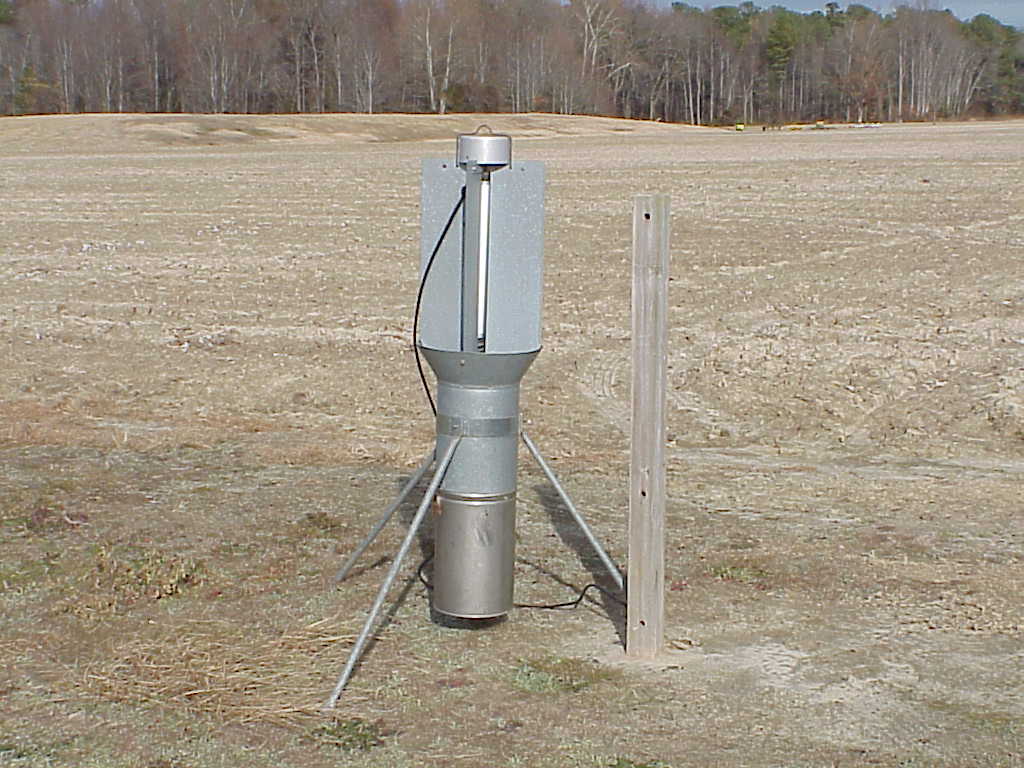
Black light trap in field

Black light trap report for the week ending September 18, 2014

Counts were low this week.  The nightly average corn earworm moth counts were Warsaw-0.4, Petersburg-1.6, Suffolk-2.4, Prince George-Templeton-0.1, and Prince George-Disputanta-0.6.  The Petersburg black light trap caught a mean of 1.6 brown marmorated stink bugs per night, Prince George-Disputanta had 0.1 BMSB, and there were zero caught at Warsaw, Suffolk, and Prince George-Templeton.  Please see the attached tables for trap histories.  Thank you.  BLT_18_Sep_2014