Late blight on leaf

Late blight found on Tomato in Rappahannock County, Virginia

The following information is from Elizabeth Bush with the Virginia Tech Plant Disease Clinic:  Late blight has been confirmed on tomato in Washington, VA by the Virginia Tech Plant Disease Clinic. Potato and tomato growers (especially in the northern part of the Commonwealth) should take precautionary actions and increase scouting. Cool and wet conditions favor development of this disease and fungicide sprays should be in place before the disease is present in a field or garden. For more information on late blight and late blight management refer to the Extension publication available at http://pubs.ext.vt.edu/ANR/ANR-6/ANR-6_pdf.pdf . Late blight was previously identified in Loudoun County, VA on July 22.

Peanut Leaf Injury from Mn and Provost

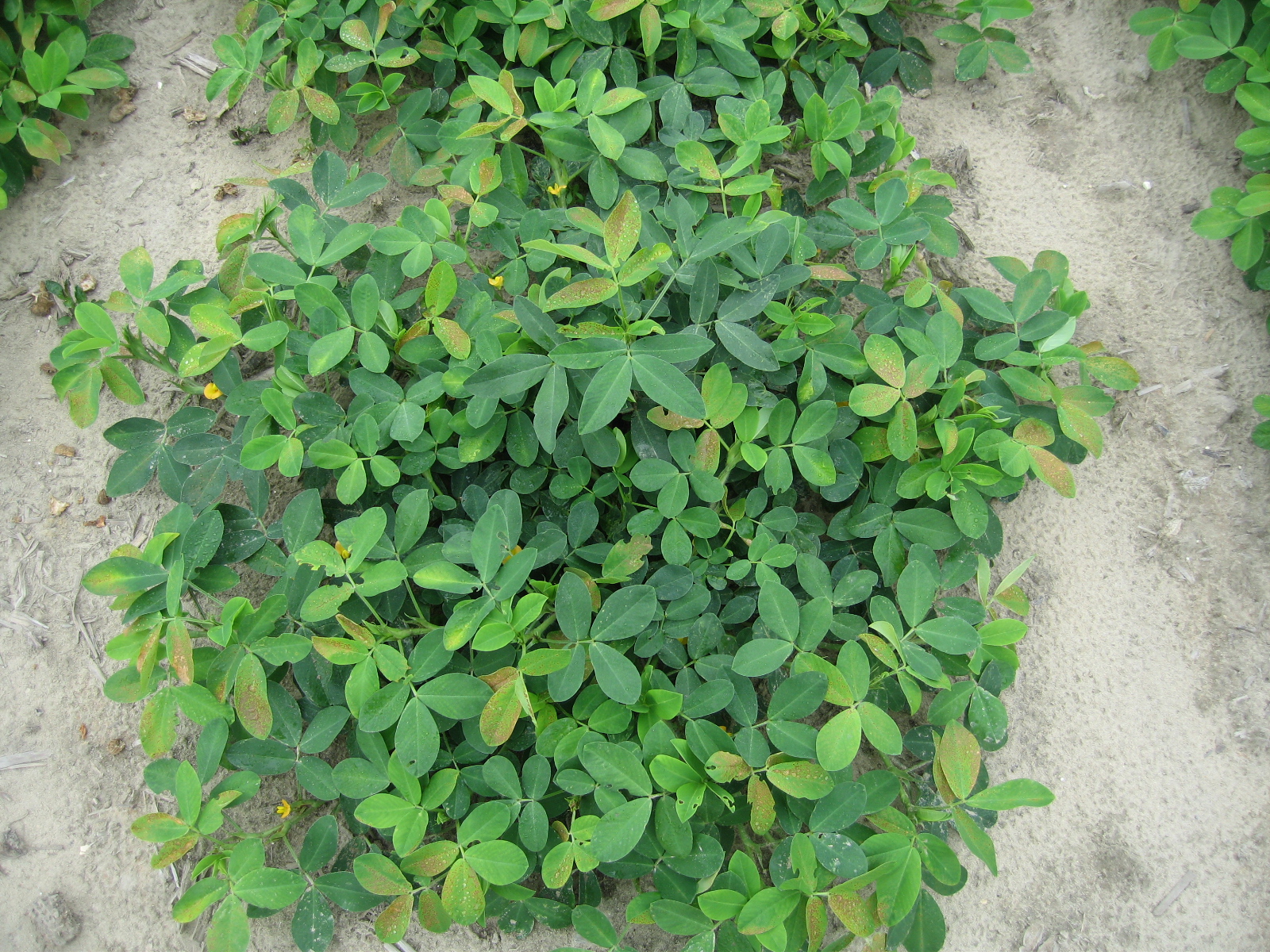
Ten days ago we sprayed the second shot of manganese (Mn) mixed with Provost and Omega for disease control. We have heard that Provost can produce leaf burning if mixed with other products (with boron for example) but those incidents appeared to be unpredictable and inconsistent. This year, mixing Mn with Provost did affect us! The fields that were sprayed later in the day (the hottest part of the day) showed more severe burning than the ones sprayed in the morning. However in none of the fields the burning exceeded 5%; note, however, that the injured leaves were those at the top of the canopy with the best light capture and photosynthetic activity.

Peanuts were sprayed with a mixture of manganese, Provost, and Omega.

Peanuts were sprayed with a mixture of manganese, Provost, and Omega.

How do we know it was the mixture? Because in one field only half received Mn plus Provost plus Omega (leaf burning occurred) and half only received Provost and Omega (no leaf burning was observed). It could have been only Mn, however. Either way, I would caution farmers to double check labels and percentages of Mn before mixing with fungicides, Provost in particular. Also a good practice would be to apply chemicals, micronutrients in particular, early in the morning to avoid the heat.

Black light trap catches for the week ending August 7, 2014

Corn earworm moth catches increased at nearly all stations this week, with means ranging from less than one to 29 moths per night. Brown marmorated stink bug mean captures ranged from zero to 19 per night, with Charles City and Petersburg at the high end. Please click on the link beneath this paragraph that says “BLT_7_Aug_2014” to see the Tables for detailed captures of these two pests. A couple of reports came in shortly after the Tables were posted–the Essex location had 0.6 corn earworm moths per night and no BMSB; the Chesapeake black light trap caught one corn earworm moth over two nights of trapping.  Thanks to the following for their reports this week: Scott Reiter, Mary Beahm, Helene Doughty, Kelvin Wells, Chris Drake, John Allison, Janet Spencer, Mark Kraemer, Dorothy Baker, David Moore, Keith Balderson, Watson Lawrence, and Ames Herbert and his entomology team.

BLT_7_Aug_2014

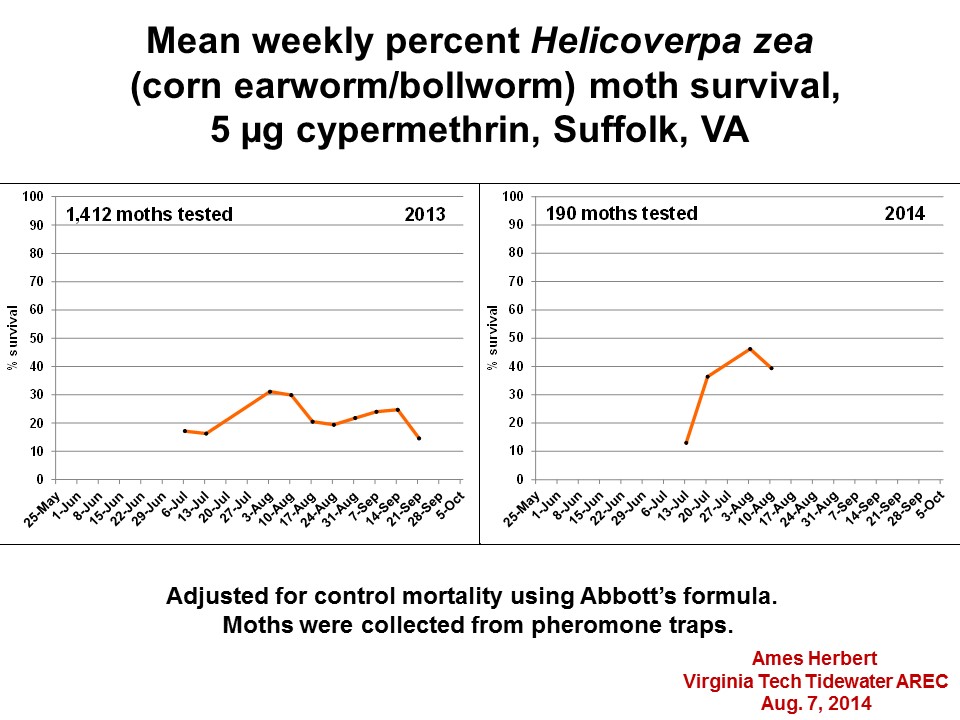
Helicoverpa zea (aka corn earworm, bollworm) resistance monitoring update–Aug. 7, 2014

Our corn earworm/bollworm moth catches went up this week allowing us to conduct adult vial tests on 128 moths.  Vials were treated with the standard 5 microgram rate of cypermethrin (a pyrethroid insecticide), or acetone (the untreated check).  This week, 39.4% of moths survived the test, which is high.  The season-long average is now 35% survival (based on 190 moths evaluated) and is higher than what we saw in 2013 (see graphs, below).  Survivorship at this level indicates that non-pyrethroids may need to be considered when an insecticide is needed for this pest in some regions, so please keep this in mind when scouting and then making management decisions in the upcoming days.

AVT_7_Aug_2014

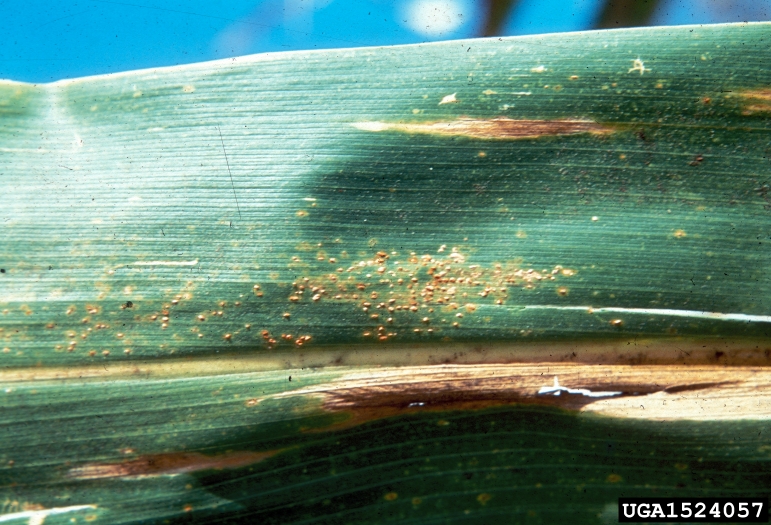
Southern Rust on Corn – Update August 5, 2014

Southern rust on corn

Southern rust was confirmed August 3 on corn samples from Chesapeake and Suffolk. Yield of corn at or near the dent stage is unlikely to be impacted by the disease, but less mature corn in the region may need to be protected with a fungicide application. Strobilurins are good preventative fungicides whereas triazoles are recommended once sporulation is observed in a field due to their curative activity. A combination fungicide is a good option as long as a strobilurin fungicide has not been applied previously. Wet, warm weather favors disease development. Once sporulation occurs, symptoms of rust are relatively obvious. Lesions start out as raised, blister-like pustules then break open to reveal orange spores. Samples of corn plants with symptoms of southern rust can be submitted to the disease clinic at the Virginia Tech Tidewater AREC (contact Dr. Hillary Mehl, hlmehl@vt.edu).

Predator profile: Leatherwings (soldier beetles)

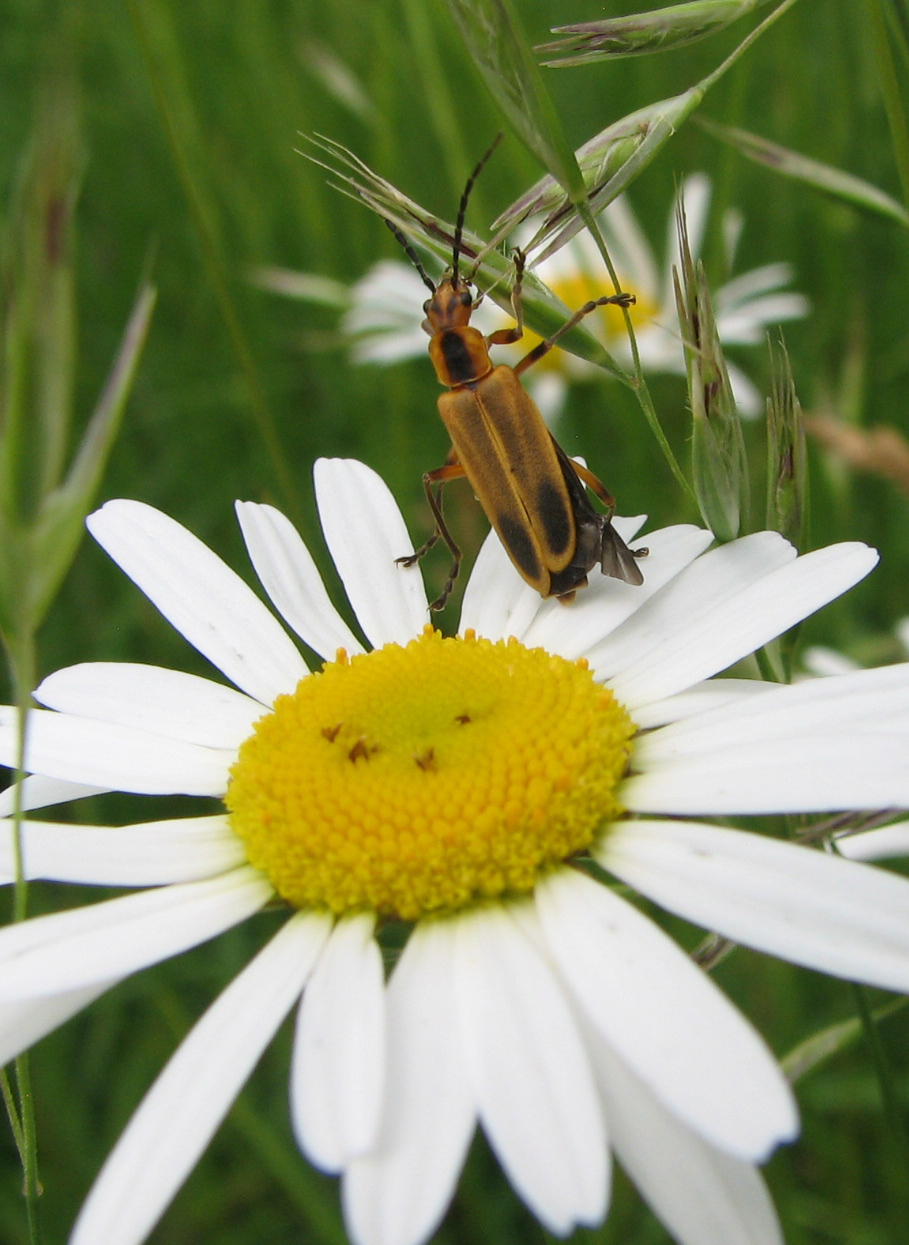
Beetles in the family Cantharidae are referred to as soldier beetles or leatherwings.  Two species in the genus Chauliognathus are commonly found in Virginia agricultural fields. Chauliognathus pennsylvanicus is often referred to as the Pennsylvania leatherwing, or the goldenrod soldier beetle referring to its favorite flowering plant in the fall. A similar species Chauliognathus marginatus, the margined leatherwing, is found in the spring on various flowers.

pennsylvania_leatherwing_Adult

Pennsylvania leatherwing beetle (above).

margined-leatherwing

Margined leatherwing beetle (above)

Description and Life History

Though soldier beetles resemble fireflies, they lack the light-producing organ on their abdomen and their head is not concealed from above. Cantharid beetles in general are elongate with soft and flexible elytra. The two Chauliognathus species range in size from 1/2 to 5/8-inch long, and have yellowish to orange elytra. Pennsylvania leatherwing has two prominent brown-black spots near the tips of the elytra and a black spot in the center of the pronotum. In contrast, the elytra of the margined leatherwing can vary considerably in the amount of dark markings and the dark marking on the pronotum is a band that reaches both the front and the back edge. Another way to differentiate these two species is the time period that the adults are present; Pennsylvania leatherwing adults are active in the fall and margined leatherwing adults are active in the spring. This is also important in regards to conservation biological control as flower resources need to be available in early spring for one species, and in late fall for the other.

Leatherwing beetles have one generation per year. Adults of both species typically feed and mate on flowers. Eggs are deposited in clusters in the soil, and hatch in ~10 days. Tiny neonate larvae are white-colored and display little or no activity until first molt. After about 24 h, they take on C shape. With each successive molt, the larvae darken in color until eventually reaching a black velvety appearance. Activity also increases as the larva develops. Leatherwing larvae are voracious predators consuming a multitude of soft-bodied insects.   A single predatory larva can consume several egg masses of Colorado potato beetle, or aphids, or small lepidopteran larvae in one day.  In the lab, they feed upon many different prey species.

Chaulignathus larva


Grain sorghum growth stage update

Sorghum grows fast with good soil moisture and temperatures in July and August. Hybrids with maturity within 65 to 70 days from planting to flower and planted in late May to early July are blooming now. Get ready to spray Headline (8 oz/acre) for anthracnose control. Waiting with the fungicide until late flowering stage

Sorghum panicles at a late flowering stage. If over 50% of your field is at this stage, you should have sprayed Headline already.

Sorghum panicles at a late flowering stage. If over 50% of your field is at this stage, you should have sprayed Headline already.

may not be as effective as early flower applications.

Sorghum field at beginning flowering stage and when application of Headline for anthracnose control should be made.

Sorghum field at beginning flowering stage and when application of Headline for anthracnose control should be made.

Black light trap catches for the week ending July 31, 2014

Corn earworm moth catches were low this week, with nightly means ranging from zero to two moths.  Brown marmorated stink bug captures were low in all locations except Petersburg (with approximately 20 per night).  Please click on the link below that says “BLT_7_31” to see the Tables for detailed captures of these two pests.  Thanks to the following for their reports this week:  Mary Beahm, Chris Drake, Scott Reiter, Keith Balderson, Mark Kraemer, Janet Spencer, and Ames Herbert and his entomology team.

BLT_7_31

Results of the Corn Earworm Survey in Virginia Field Corn—2014

Annually, we conduct a survey to estimate Helicoverpa zea (corn earworm) infestation levels in field corn in mid- to late July. Corn is considered a nursery crop for corn earworm, allowing the pest to complete a lifecycle and then move on to other crops such as soybean, cotton, and peanut in August. Over 30 years of data show that there is a linear correlation between the infestation level in corn and the amount of soybean acreage that gets treated with insecticide for this pest.

To conduct the survey this year, the number of corn earworms found in 50 ears of corn was recorded in 5 corn fields in each of 29 counties, totaling 7,250 ears and 145 fields sampled. When fields were known to contain Bt or non-Bt corn, this was noted. Otherwise, samples were considered to be random and assumed to be representative of the actual Bt/non-Bt composition in each county. Age of corn earworms, or if they had already exited the ears, was also recorded (data not shown). We greatly appreciate the help of Virginia Cooperative Extension Agriculture and Natural Resource (ANR) Agents, Virginia Tech faculty and staff, and volunteers in this effort. These cooperators are acknowledged in the attached Figure. We also would like to thank the many growers who graciously allowed us to inspect their fields for corn earworm.

Results of the survey are provided below (click on the Figure to enlarge it). Statewide, approximately 20% of ears were infested with corn earworm. For comparison, 18% of ears were infested in 2013, 30% in 2012, 33% in 2011; 40% in 2010; and 36% in 2009. Regional averages for 2014 were 6% infested ears in Northern counties, 4% in the Northern Neck, 18% in Mid-Eastern, 17% in South-Central, 30% in the Southeast, and 17% on the Eastern Shore.

This survey is intended to be a representative sample, not a complete picture. We always recommend scouting individual fields to determine exactly what is happening in terms of corn earworm as well as other pests and crop problems. Also, please check the black light trap reports on the Virginia Ag Pest and Crop Advisory and other reports posted weekly to keep up-to-date on the insect pest situation.
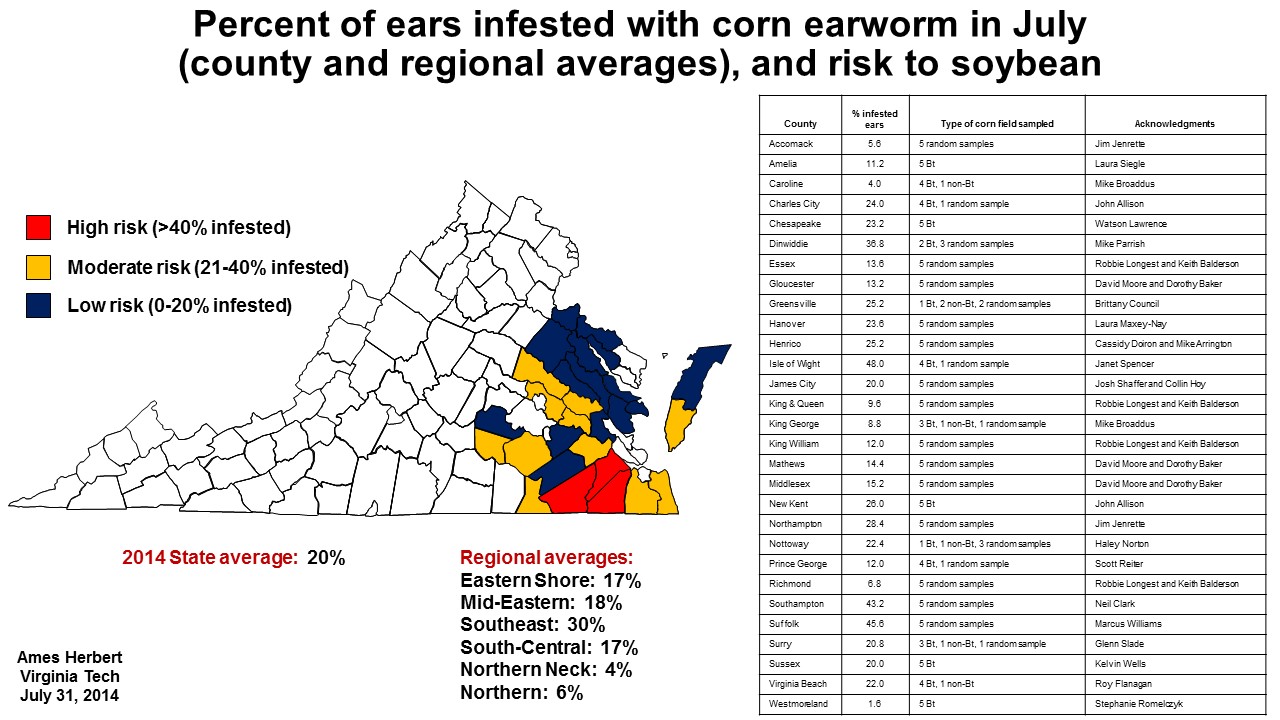
Map of Virginia with levels of corn earworm larvae in field corn.


Brown marmorated stink bug update for soybeans

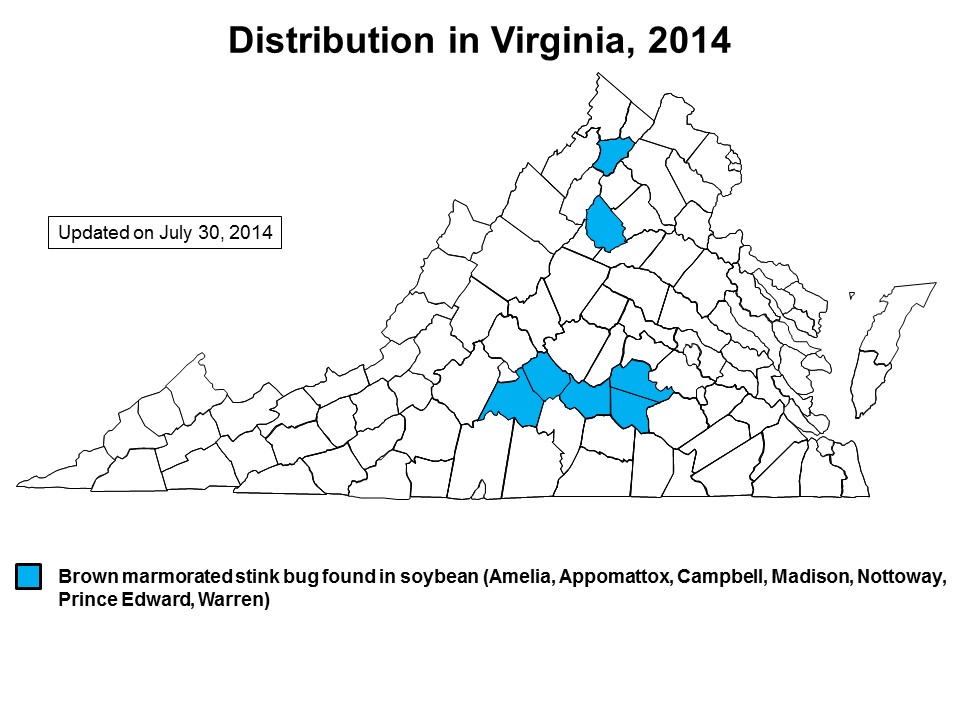
As of this week, brown marmorated stink bug adults, nymphs, and egg masses are beginning to show in a few soybean fields in seven counties (Madison, Warren, Campbell, Appomattox, Prince Edward, Amelia and Nottoway).  Number are still very low but more are expected as they move from border trees into fields.  This early movement is coinciding with the maturity of the soybean crop.  Most of the plants in the infested fields are in late R3-early R4 growth stages.  When plants reach the R5 stage (seed fill), they will become even more attractive to stink bugs that target young seed to feed on.

map of Virginia showing BMSB distribution