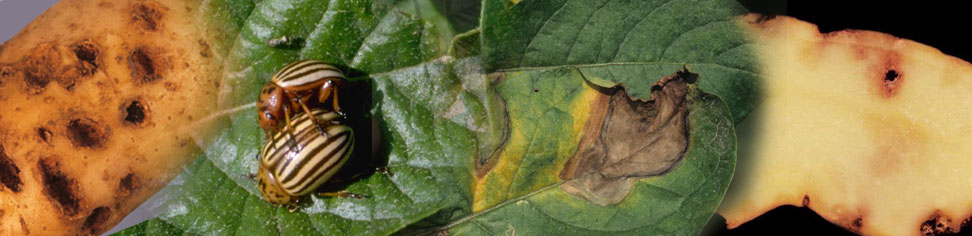
Unfortunately, late blight has been confirmed in Leesburg, VA by the Plant Disease Clinic in Blacksburg. Potato and tomato growers (especially in the northern part of the Commonwealth) should take precautionary actions and increase scouting. For more information on late blight please refer to the extension publication link about this potentially devastating disease. Please let us know if you have any more questions.
http://pubs.ext.vt.edu/ANR/ANR-6/ANR-6_pdf.pdf
Southern Rust on Corn in North Carolina – Update
Southern rust was confirmed on a sample from Camden County, NC on July 21. At this time, southern rust has NOT been reported in Virginia. Yield of corn at or near the dent stage is unlikely to be impacted by the disease, but less mature corn may need to be protected with a fungicide application. Contact your local extension office for recommendations if you suspect southern rust is in your area. Samples of corn plants with symptoms of southern rust should be submitted to your local extension office or the disease clinic at the Virginia Tech Tidewater AREC (contact Dr. Hillary Mehl, hlmehl@vt.edu). Typically the disease has little impact on Virginia corn since it arrives too late in the season to affect yield, but if southern rust is confirmed in Virginia prior to corn reaching the dent stage (R5), fungicide applications may be warranted. Updates will be provided as more information is obtained.
Where are the kudzu bugs–soybean update
The big question today is—where are the kudzu bugs we expected to see in our soybean crop? As of this week, we have not seen any adults or nymphs in the early planted full season crop. In fact, the same situation is being reported for much of the eastern US. Dominic Reisig at NCSU says that even in NC, the only reported infestations are from southernmost counties.
Last summer by this time we were seeing many full season early planted files with infestations of adults that have moved from adjacent overwintering sites. The only bugs we have found so far have been in kudzu patches. So, what’s the difference in years and why the delayed movement of adults? All we can say is that it must be related to the colder than normal temperatures we experienced during the winter. We know that in the Suffolk area there were at least two nights when temperatures dropped below zero (æF), and of course it was even colder north and west of us. Could those cold temperatures have killed some of the overwintering adults reducing the overall population levels?
We do know from our adult overwintering emergence traps that were placed throughout much of the state that adults survived and emerged this April and May in about 12 counties in the southern part of the state. Why they did not move into early planted soybean fields is another unanswered question.
From what I can gather from reading and talking with other entomologists in the southeast, 2014 is shaping up to be similar to 2011 when the first generation of kudzu bugs developed in kudzu (mostly) and other alternate hosts and only the second generation moved into soybean fields. This certainly seems to be what is happening this year. In some ways this scenario, if it plays out, will simplify the field scouting and threshold determination. The ‘original’ kudzu bug threshold developed in the southeast was based on this second generation that moved into reproductive stage (flowering—early pod) soybean fields—and it is based on number of nymphs (see below). We have initiated our 2014 soybean insect pest survey so will be reporting updates as they come in so stay tuned.
Treatment Thresholds for 2nd Generation Kudzu Bugs, Nymphs Present
Sweep Net
” An average of 1 nymph/sweep, 15/15 sweeps
” Take at least ten 15-sweep samples to represent the entire field
” Sampling should not be biased by sampling close to field edges where populations may by congregated
Canopy Observation
” At least 10 observation spots representing the entire field
” Nymphs easily found on main stems, leaf petioles or leaves
Black light trap counts for the week ending July 17, 2014
Low numbers of corn earworm in black light traps this week (July 11-17). Nightly averages were: Southampton=0.5; Petersburg=0.4; Prince George-Templeton=0.3; Prince George-Disputanta=zero; Warsaw=0.4; Isle of Wight=zero; Suffolk=zero. We had some high brown marmorated stink bug catches in Petersburg’s black light trap (average of 6.6 BMSB per night). Other locations had either zero BMSB (Southampton, Prince George, Isle of Wight, and Suffolk) or 0.1 BMSB per night (Warsaw). Thanks to the following for their report: Chris Drake (Southampton), Mark Kraemer (Petersburg), Scott Reiter (Prince George), Mary Beahm (Warsaw), Janet Spencer (Isle of Wight), and Ames Herbert and crew (Suffolk).
Where are the kudzu bugs? — soybean update
The big question today is where are the kudzu bugs we expected to see in our soybean crop? As of this week, we have not seen any adults or nymphs in the early planted full season crop. In fact, the same situation is being reported for much of the eastern US. Dominic Reisig at NCSU says that even in NC, the only reported infestations are from southernmost counties. Last summer by this time we were seeing many full season early planted files with infestations of adults that have moved from adjacent overwintering sites. The only bugs we have found so far have been in kudzu patches. So, what’s the difference in years and why the delayed movement of adults? All we can say is that it must be related to the colder than normal temperatures we experienced during the winter. We know that in the Suffolk area there were at least two nights when temperatures dropped below zero (æF), and of course it was even colder north and west of us. Could those cold temperatures have killed some of the overwintering adults reducing the overall population levels? We do know from our adult overwintering emergence traps that were placed throughout much of the state that adults survived and emerged this April and May in about 12 counties in the southern part of the state. Why they did not move into early planted soybean fields is another unanswered question. From what I can gather from reading and talking with other entomologists in the southeast, 2014 is shaping up to be similar to 2011 when the first generation of kudzu bugs developed in kudzu (mostly) and other alternate hosts and only the second generation moved into soybean fields. This certainly seems to be what is happening this year. In some ways this scenario, if it plays out, will simplify the field scouting and threshold determination. The original kudzu bug threshold developed in the southeast was based on this second generation that moved into reproductive stage (flowering early pod) soybean fields and it is based on number of nymphs (see below). We have initiated our 2014 soybean insect pest survey so will be reporting updates as they come in so stay tuned. Treatment Thresholds for 2nd Generation Kudzu Bugs, Nymphs Present Sweep Net ” An average of 1 nymph/sweep, 15/15 sweeps ” Take at least ten 15-sweep samples to represent the entire field ” Sampling should not be biased by sampling close to field edges where populations may by congregated Canopy Observation ” At least 10 observation spots representing the entire field ” Nymphs easily found on main stems, leaf petioles or leaves.
Black light trap counts for the week ending July 17, 2014
Low numbers of corn earworm in black light traps this week (July 11-17). Nightly averages were: Southampton=0.5; Petersburg=0.4; Prince George-Templeton=0.3; Prince George-Disputanta=zero; Warsaw=0.4; Isle of Wight=zero; Suffolk=zero. We had some high brown marmorated stink bug catches in Petersburg’s black light trap (average of 6.6 BMSB per night). Other locations had either zero BMSB (Southampton, Prince George, Isle of Wight, and Suffolk) or 0.1 BMSB per night (Warsaw). Thanks to the following for their report: Chris Drake (Southampton), Mark Kraemer (Petersburg), Scott Reiter (Prince George), Mary Beahm (Warsaw), Janet Spencer (Isle of Wight), and Ames Herbert and crew (Suffolk).
Southern Rust on Corn in North Carolina
Southern rust, a potentially devastating disease of corn, has been reported from several counties in North Carolina. At this time, southern rust has NOT been reported in Virginia. Samples of corn plants suspected to be infected with southern rust should be submitted to your local extension office or the disease clinic at the Virginia Tech Tidewater AREC (contact Dr. Hillary Mehl, hlmehl@vt.edu). Signs of the disease are pustules filled with powdery masses of orange spores (see attached photo). Typically the disease has little impact on Virginia corn since it arrives too late in the season to affect yield, but if southern rust is confirmed in Virginia prior to corn reaching the dent stage (R5), fungicide applications may be warranted. Updates will be provided as more information is obtained. Additional information: southern-rust-on-corn-jpg

Sclerotinia blight advisory
Sclerotinia blight has been confirmed in a peanut field in Surry County, VA. According to the Sclerotinia advisory, the current risk for Sclerotinia in Virginia is HIGH and scouting for the disease is recommended. Cool temperatures and high humidity favor disease development. Signs and symptoms of Sclerotinia blight include rapid wilting and death of infected branches, bleaching of stems, and white, fluffy fungal growth on stems, leaves, or pegs. Once Sclerotinia is identified in a field, a fungicide spray such as Omega is the best way to limit further development of the disease. For more information see the Peanut-Cotton Infonet (http://webipm.ento.vt.edu/cgi-bin/infonet1.cgi) or contact Dr. Hillary Mehl, Extension Plant Pathologist at the Tidewater AREC (hlmehl@vt.edu).

Southern Rust on Corn in North Carolina
Southern rust, a potentially devastating disease of corn, has been reported from several counties in North Carolina. At this time, southern rust has NOT been reported in Virginia. Samples of corn plants suspected to be infected with southern rust should be submitted to your local extension office or the disease clinic at the Virginia Tech Tidewater AREC (contact Dr. Hillary Mehl). Signs of the disease are pustules filled with powdery masses of orange spores (see attached photo). Typically the disease has little impact on Virginia corn since it arrives too late in the season to affect yield, but if southern rust is confirmed in Virginia prior to corn reaching the dent stage (R5), fungicide applications may be warranted. Updates will be provided as more information is obtained.
Sclerotinia blight advisory
Sclerotinia blight has been confirmed in a peanut field in Surry County, VA. According to the Sclerotinia advisory, the current risk for Sclerotinia in Virginia is HIGH and scouting for the disease is recommended. Cool temperatures and high humidity favor disease development. Signs and symptoms of Sclerotinia blight include rapid wilting and death of infected branches, bleaching of stems, and white, fluffy fungal growth on stems, leaves, or pegs. Once Sclerotinia is identified in a field, a fungicide spray such as Omega is the best way to limit further development of the disease. For more information see the Peanut-Cotton Infonet or contact Dr. Hillary Mehl, Extension Plant Pathologist at the Tidewater AREC.