Update: 4/20/2026. Drought conditions remain moderate to severe across much of Virginia. Although a weather system moved through the state on April 19, most major small grain production areas received little rainfall (<0.1 inch). Combined with the warm temperatures observed last week, these dry conditions are accelerating winter wheat development. Much of the wheat in the Northern Neck, Middle Peninsula, and Eastern Shore has headed or is approaching heading, and some fields have started flowering.
As of April 20, 2026, the risk of Fusarium Head Blight is low across most production regions, although pockets of moderate risk remain. Fields planted no-till into corn residue are at greater risk, especially when susceptible varieties were used. Growers with susceptible wheat planted into no-till corn stubble may still benefit from a timely fungicide application.
Because heat and drought can move wheat through growth stages more quickly than expected, scout fields frequently so fungicides can still be applied at the correct stage, Feekes 10.5.1 (beginning flowering).
–Douglas S. Higgins, Plant Pathologist, Virginia Tech Eastern Shore Agriculture Research and Extension Center
Syngenta Crop Protection recently announced EPA’s approval of their registration of five new insecticide products containing the active ingredient PLINAZOLIN technology (isocycloseram), which is a unique active ingredient that belongs to IRAC Group 30, offering broad-spectrum insect pest management.
Zivalgo™: a foliar-applied insecticide for pome and stone fruit, citrus, potatoes and tree nuts that goes the distance in the race against codling moth, Colorado potato beetle and more with marathon-caliber residual control
Equento®: this insecticide seed treatment for cereals and pulses offers a flexible and compatible option to terminate wireworms and suppress other below-ground pests, ultimately improving plant stand and helping growers’ bottom line
Opello™: this soil-applied insecticide provides revolutionary control of corn rootworm, consistently helping corn yield up to 27 bu/A more than untreated1, while its highly tank-mix compatible formulation allows growers to leave equipment clogs and slowdowns in the past
Vertento®: a foliar-applied insecticide for cotton, onion, peanuts and soybeans that lands the knockout punch on tough-to-manage insect pests like plant bugs/lygus, stink bugs and mites, and offers champion-level residual control
Incipio™: a foliar-applied insecticide for vegetables that’s tough on pests like diamondback moth and thrips but easy on growers, helping protect their time and peace of mind with long-lasting and reliable control
My lab has field-tested these insecticides against many pest groups on vegetables, potatoes, and other crops over the past several years. Plinazolin insecticide offers a wide pest spectrum including some hard-to manage pests such as: thrips, mites, lepidopteran larvae like diamondback moth and beet armyworm, Colorado potato beetle, alfalfa weevil etc. Because its mode of action is much different than other insecticides, it offers an excellent rotational tool for insecticide resistance management.
Posted on behalf of: Dr. Carrie Ortel, Soybean Agronomist
Each year, the Virginia Tech Soybean Agronomy Program conducts the Official Variety Trials (OVT), evaluating a wide range of commercially available soybean varieties to provide farmers with unbiased, research-based information for variety selection. Traditionally, these results are compiled into a VCE factsheet and shared during winter extension meetings in January and February.
This year, growing interest in earlier access to results encouraged our team to launch a new interactive Soybean Variety Selection Tool, allowing producers to explore yield data as soon as it becomes available. The familiar VCE factsheet—including seed grading information—will still be published in early 2026, but this new tool offers a more timely and dynamic way to view performance data throughout the harvest season.
Filter the data Use the buttons on the left side of the page to filter results based on:
System (full-season or double-crop)
Location
Group (field-determined relative maturity grouping)
Brand
Variety
Herbicide package
Relative maturity group
Yield (bu/ac)
Relative yield (percentage of maximum yield at that site and group)
Sort columns Click any column header to sort the table and explore trends.
Access company tech sheets Want more information? Click any variety name to open the associated company tech sheet. You will have a redirect notice appear, the new web link should begin with https://arec.vaes.vt.edu, followed by variety information, indicating you’re continuing to a safe VT site with the PDF available.
View archived results To explore last year’s dataset, change the “Planting Year” filter to 2024.
Share your feedback Use the “Let us know what you think!” button to submit anonymous comments and suggestions.
Learn more about the tool Click the “?” icon for a detailed overview of how everything works.
Why This Tool Matters
Our goal is to deliver timely, unbiased, and easy-to-interpret variety trial results to support producers in making confident variety selection decisions. While the 2025 yield data is now live, remember that results from a single year should be considered preliminary. That’s why archived data from previous years remains accessible—you’ll get a clearer picture by comparing performance over time.
We encourage growers to select multiple top-performing varieties across several maturity groups, ensuring coverage of the herbicide and disease resistance traits needed for success on your farm.
Thank You
We extend our sincere appreciation to everyone who made this tool and the 2025 OVT season possible. Special thanks to Chris Mitchell, VT CALS Web Manager, and Suzanne Pruitt, Tidewater AREC Communicator, for their guidance and support in bringing the Soybean Variety Selection Tool to life.
We are also grateful to our colleagues across the Virginia Tech Agricultural Research and Extension Centers for hosting trial plots: Dr. Joseph Oakes and his team at the EasternVirginia AREC; Dr. Arash Rashed, Ned Jones, and Laura DeBusk at the Southern Piedmont AREC; Dr. Mark Reiter and Andrew Fletcher at the Eastern Shore AREC; and Jenny Sheetz at the Northern Piedmont Center.
Finally, we appreciate the participating seed companies for contributing their top varieties to the soybean OVT and supporting research that benefits growers across Virginia.
Questions or Suggestions?
We’d love to hear from you. Contact: Carrie Ortel — carrieo@vt.edu
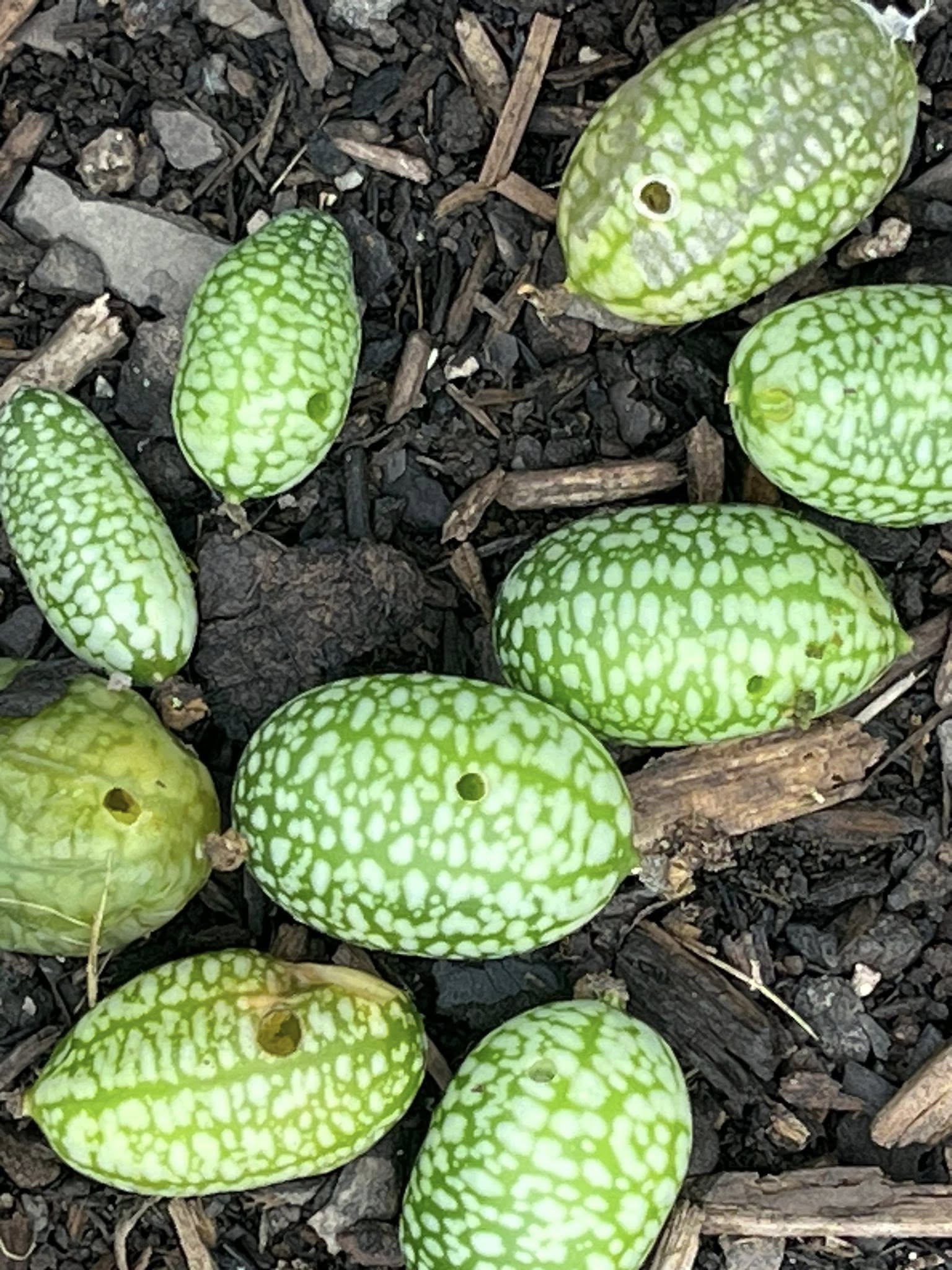
While presenting at a community garden meeting with growers and gardeners in Boydton, VA this morning (Sept 10), one of them talked about a pest that was creating holes in her sour gherkin cucumbers. I checked it out and it was pickleworm (see photos). Location was Clarksville, VA. This is not good news for our large pumpkin industry in Virginia. This means that at least some of these tropical moths have mead their way from the southern U.S. on storm fronts and are depositing eggs on blossoms of cucurbit host plants like cucumbers, squash, and pumpkins.
Pickleworm holes in gherkin cucumbers – Clarksville, VA September 10, 2025. Pickleworm larva crawling out of infested cucumber.
Larvae bore into fruit where they can cause the fruit to rot in addition to reducing marketability of the fruit. Growers should inspect their fruit and blossoms regularly until harvest. If pickleworm is found, there are many effective insecticides to control it, but the most affordable would probably be a pyrethroid.
Like every year, I get a lot of questions on late leaf spot fungicides the closer we get to digging. Since it’s near the end of the season, regardless if you’ve been on a rigorous, effective leaf spot program you’re going to see some leaf spot. I’ve heard some growers are having severe leaf spot and some significant defoliation. Below I’ll cover some points regarding late leaf spot management as we approach digging.
Leaf spot has a greater affect on yield the earlier it occurs. If the onset of disease begins near harvest we often don’t observe much loss. I’d be more concerned about yield loss in fields where leaf spot was significantly spreading in early to mid-August compared to just seeing it get worse since labor day weekend. However, if you see up to 40% or more defoliation, a fungicide application at that point isn’t going to help and you may consider digging early to help preserve yield.
The cooler it gets leaf spot takes longer to spread. Cooler weather coupled with the extremely dry weather we’re experiencing really slows disease development. The big increases in leaf spot you’re seeing now are the result of infections that took place 2-3 weeks ago or more. That would mean the fungicide applications you made (or not) early to mid-August are impacting what you’re seeing now more than sprays you applied within the past 2 weeks. Applying a fungicide now won’t have a major impact on leaf spot or yield.
Just because I just said spraying leaf spot now won’t have a big effect on yield doesn’t mean spraying for leaf spot is a terrible idea right now. A lot of that depends on how close you are to digging based on peanut maturity. If you’re over 2 weeks away from digging I can see where a fungicide application may help leaves stay on longer and prevent yield loss compared to peanuts that are within 2-weeks of digging. Everyone’s maturity situation is different, and it can vary from field to field. The situation is very different between dryland and irrigated peanuts. In talking to Jacob Forehand in Virginia and David Jordan in NC this morning, according to pod blasting results, peanuts are not maturing very quickly due to cool, dry conditions and peanuts may be mature a little later than “normal”. Plus, although the forecast isn’t calling for much rain, if it becomes warmer and we get some unexpected rain that can change things so far as maturity and diseases are concerned. Lots to consider…
If you’re going to use a fungicide this late, make sure it’s a fungicide that’s going to be effective (kinda intuitive I know). I hear about a lot of people making fungicide recommendations that are questionable. If you ask me about a fungicide to use right now I’m going to tell you to use Provost Silver or chlorothalonil (Bravo, Echo, Equus etc) with or without micronized sulfur. Why those? They are the only fungicides that I am confident in providing some control. The efficacy and curative activity of Provost Silver is well established, chlorothalonil works as well as it did when it was first used back in the 70’s because it has multiple modes of action and carries practically no risk of resistance development, and micronized sulfur has been shown by several researchers in several states to enhance the efficacy of leaf spot applications when mixed with an effective fungicide. Each product has some downsides which may be a cause for pause.
We use FRAC Group 3 fungicides in almost every application we make on peanuts, and the actives in Provost Silver are both groups 3’s. Provost Silver is probably the most used FRAC Group 3 fungicide. The more we use the same MOA (mode of action) over and over again we put more pressure on them for resistance development. Couple that with spraying when higher inoculum levels are present during the late season adds more to the resistance risk.
Chlorothalonil has been shown to increase the risk of spider mite development, and to a lesser degree it can enhance the development of Sclerotinia blight. As dry as it is I can see growers being resistant to use chlorothalonil because of spider mites. But since sulfur has some activity against spider mites, I’ve been suggesting tank-mixing it with chlorothalonil to provide some control of spider mites. Spider mites are favored by hot, dry conditions. We have the “dry” but don’t have the “hot” right now and looking forward. I’m not saying there’s no risk of spider mite infestations right now, but conditions are less favorable for them to occur.
The main issue with sulfur are problems with mixing and it’s potential to leave residues in spraying equipment that can cause clogging. I recommend trying different formulations of micronized sulfur. The one’s I’m familiar with are Microthiol Disperss® (dry), Kolla® (liquid), and Suffa® (liquid). I keep using the word “micronized” for a reason. That is that all the positive efficacy data I talked about earlier was with micronized formulations only. Non-micronized sulfur does not show the same positive effects on leaf spot control.
Corn earworm larvae have been found well in excess of economic thresholds in several counties throughout Virginia the past two weeks. In Prince George, we sampled a field with 50+ larvae per 15 sweeps (see below photo). There are a few key things to remember for managing corn earworm in soybeans.
It pays to scout. Use the economic threshold. For corn earworm in soybeans, we have what’s called a “dynamic threshold”. The benefit of using a dynamic threshold is that it shifts with commodity prices, production practices, and the cost of control and you can be certain that you will get economic return on a spray under current conditions. You can find the calculator here. At an estimated soybean price of $10/bu, and $15 cost of control using a sweep net to sample 15 inch soybean rows you get an economic threhsold of 2.2 larvae per 15 sweeps.
We have expanded our corn earworm moth monitoring in 2025. While these traps do not indicate the need to spray alone, they can guide your scouting efforts and help make decisions. The monitoring tool is updated in real time and can be found here.
Select the right insecticide Pyrethroids alone will have limited efficacy for corn earworm, particularly for large larvae. Our most recent efficacy data can be found in the figure below. These numbers are total number of corn earworm larvae per 15 sweeps at 2 days post application. If targeting stink bugs as well as corn earworm a product containing both a pyrethroid and a diamide (I.e. Besiege or Elevest) would be a good option. If you are also reaching defoliation thresholds (15% during reproductive stages) and have mostly soybean loopers, Besiege has offered limited control for soybean loopers in recent years. Intrepid Edge or Steward are good options to manage both corn earworm and soybean loopers.
As always, please contact me if you have any questions or concerns. Tim Bryant (btim2@vt.edu).
Pheromone trap data from our cooperators across Virginia are in this Table. Virginia Cooperative Extension Agents Hélène Doughty (Northampton County) and Scott Reiter (Prince George County) reported many corn earworm larvae in soybean fields this week. Scott’s black light trap averaged 9.3 moths per night. With his help, our entomology program put in an insecticide efficacy experiment in Prince George soybean on August 20. The economic threshold calculator for corn earworm larvae in soybean can be found here. Our cypermethrin adult vial tests show 46% dead or down moths after 24 hours exposure time to this pyrethroid insecticide (n = 594 moths tested this season).
Updated corn earworm moth catches from our pheromone trap network are in this Table. Prince George County’s black light had 11 total moths over the past 8 nights, but high numbers were caught in that county’s pheromone trap (averaging 42.5 per night over the past 8 nights).
Today in a project supported by USDA-NIFA Crop Protection and Pest Management’s Extension Implementation Program, our entomology crew sampled cotton in Suffolk, VA with no genetic protection against bollworm and found 14% boll injury due to this pest in the insecticide-untreated plot. There was no boll injury due to bollworm in the insecticide-untreated WideStrike or Bollgard 3 plots.
Recently, soybean aphids have been confirmed at higher populations than typically expected in August. While many folks are scouting for worms and stinkbugs, we also recommend looking for aphids in your soybean fields as well. The key variables to consider regarding managing soybean aphids are the number of aphids per plant and the soybean growth stage. Information from our Pest Management Guide on Soybean Aphids in summary including info on thresholds and sampling are as follows (VCE Field Crops PMG, Publication 456-016):
Number of aphids per soybean plant
The current economic threshold for aphids is an average of 250 aphids per plant, on two consecutive field visits spaced about 5-7 days apart. This is because aphid populations can “crash” quickly due to heavy pressure by natural enemies like lady beetles, parasitic wasps, and fungal diseases. When scouting, choose a “Z” or “W” shaped pattern to cover the entire field and sample at least 20 to 30 plants per field by examining the entire plant, including stems and upper and lower leaf surfaces. Use the aphid/plant average for determining the need for treatment.
The soybean growth stage
The threshold of 250 aphids per plant applies to soybeans through the R5 growth stage (3 mm long seed in the pod at one of the four uppermost nodes on the main stem), after which time plants can tolerate 1,000+ aphids with no threat to yield. If an insecticide is applied for aphids, pyrethroids (e.g. bifenthrin, Warrior II, Mustang Max, etc.) can be effective for management, but choosing a more selective insecticide can preserve natural enemy populations and limit future flare ups of aphids or other pests.
The August 2025 corn earworm moth pheromone trap data (to date) can be found in Table 3. Some of the higher catches occurred in Brunswick, Prince George, and Rockbridge, VA. Last month’s data can be found in Table 2. Scott Reiter’s black light trap in Disputanta captured a total of 30 moths this week (6 nights).
We’ve evaluated 470 moths in our cypermethrin vial tests, with 48% dead/down after a 24-hour exposure to this pyrethroid insecticide at the 5 microgram/vial rate.