The average number of corn earworm (=bollworm) moths captured per night was 9 in Greensville, 2 in Prince George/Disputanta, and 14 in Suffolk. Thanks to Sara Rutherford, Scott Reiter, and the Tidewater AREC entomology crew for their reports. Here is the Table.
Ear rots and mycotoxins in corn.
The Situation
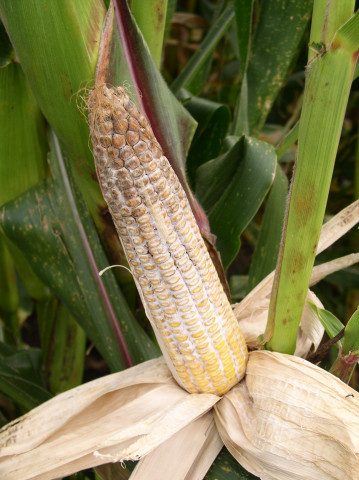
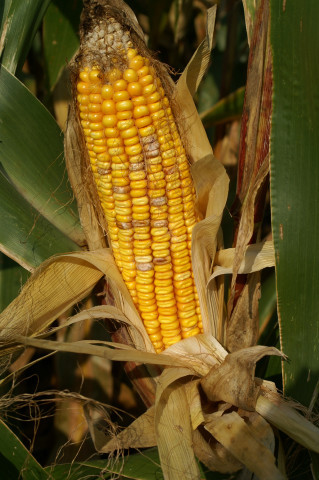
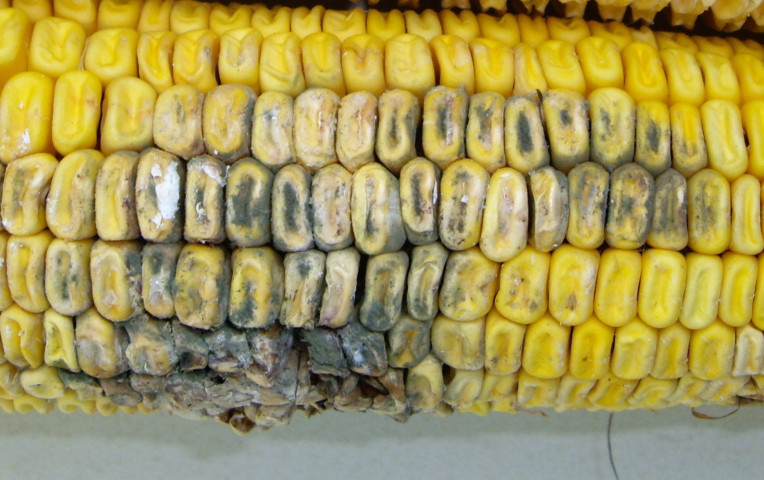
I have heard from several growers and county agents that they have been seeing a lot of moldy ears lately. Unfortunately, the drought in June followed by wet conditions in July and early August set the stage for ear rot fungi to infest corn this year. Ear rot diseases are Aspergillus ear rot, Diplodia ear rot, Fusarium ear rot, Gibberella ear rot, Penicillium ear rot and Trichoderma ear rot. Pictures and symptoms and signs of each are below.
Aspergillus ear rot

Image by A. Robertson
Diplodia ear rot

Image by G. Munkvold
Fusarium ear rot

Image by A. Robertson
Starburst kernel pattern from Fusarium ear rot

Image by Pioneer Seeds
Gibberella ear rot

Image by A. Robertson
Penicillium ear rot

Image by A. Robertson
Trichoderma ear rot

Image by G. Munkvold
Damage Caused by Ear Rots
The most obvious losses due to ear rots are to yield and quality. Probably the biggest concern with ear rots is that some of them produce mycotoxins that harm humans and livestock. Mycotoxin producers are Aspergillus ear rot (aflatoxin), Fusarium ear rot (fumonisin), Gibberella ear rot (deoxynivalenol or DON) and to a lesser degree Penicillium ear rot (PR toxin and Ochratoxin A). Grain cannot be sold for food or feed if aflatoxin levels are 20 ppb (parts per billion), fumonisin levels cannot be higher than 30-50 ppb and DON no higher than 5 ppb.
Assessing Damage
Growers should hand pick 100 ears of corn from a representative area of a field and shuck them. Pick out 10 ears showing the worst ear rot damage. Place these ears side-by-side to assess the average amount of kernel damage. If more than 25% of the kernels on these 10 ears are damaged, you have a problem. If less than 25% of kernels on the 10 worst ears are damaged, check the field again after a rainfall event and plan on harvesting early. Harvesting at more than 20% moisture and drying to less than 15% moisture will significantly reduce harvest losses when compared to waiting for the corn to dry on its own in the field. The extent of the problem can be determined by shelling all 100 ears, mixing the grain thoroughly, and sending a sample (usually 5.0 lbs) to a reputable mycotoxin testing facility. Don’t mix grain from a field affected by ear rots with grain from a field that has not been affected.
What to do if You Have 10% or More Affected Ears
- Harvest early at higher moisture and dry to below 15% moisture
- Adjust combine to discard light or damaged kernels
- Clean harvest equipment between affected fields and clean fields
- Segregate poor quality grain from good grain
- Store affected long-term grain at less than 13% moisture and 30°F or below
- Don’t store affected grain for more than 1 year
Corn earworm/bollworm update for August 22, 2024
Corn earworm (= bollworm) moth catches in southeast Virginia black light traps declined further this week. The average number captured per night was 16 in Greensville, 12 in North Dinwiddie, 2 in Prince George/Disputanta, and 6 in Suffolk. Here is the Table. Reports of soybean fields at larval threshold are coming in.
Fall armyworm outbreaks around Virginia
By: Tom Kuhar, Alejandro Del Pozo, and Katlyn Catron.
Summer storms moving up from the South often bring pests with them. Fall armyworm (FAW) is definitely one of them, and true to form, this tropical moth pest has shown up around Virginia, causing problems in various crops as well as turfgrass. We noticed FAW attacking whorl-stage sweet corn in Blacksburg three weeks ago, and recently have heard reports of problems in Richmond and Appomattox. Other colleagues have documented the presence of FAW in Williamsburg and the Hampton Roads. Fall armyworm is a tropical moth native to warm climate areas of the western hemisphere. It cannot successfully overwinter in Virginia, but frequently makes its way to our state by flying at high altitudes where populations get carried northward on wind fronts. Turfgrass, pasture grass, late planted sweet corn and sorghum, and fall small grains plantings can be particularly at risk to damage from this pest.


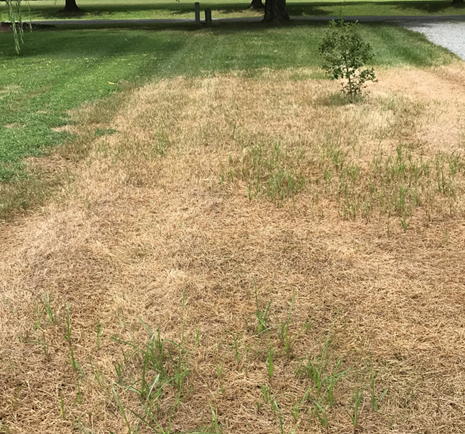
Crops at risk. This pest seems to have a very wide host range, with over 80 plants recorded, but clearly prefers grasses. In addition, field crops also can be attacked, including alfalfa, barley, Bermudagrass, buckwheat, cotton, clover, corn, oat, millet, peanut, rice, ryegrass, sorghum, soybean, sugarcane, timothy, tobacco, and wheat. When the larvae are very numerous, they defoliate the preferred plants, acquire an “armyworm” habit and disperse in large numbers, consuming nearly all vegetation in their path. Just like a battle front, FAW damage appears in a characteristic progressive line across grass plantings (Fig. 1).
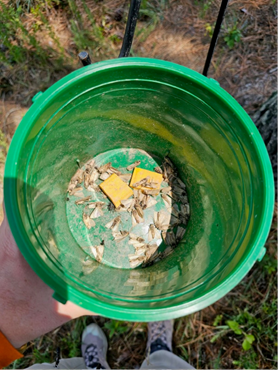
Monitoring. Because of the unpredictability of pest pressure from year to year and throughout the season, the use of pheromone traps to monitor local presence and build-up of FAW levels of these moth pests is strongly recommended. Pheromones are natural compounds that are emitted by female FAW moths to attract male moths (Fig. 2) for mating. Synthetic compounds that mimic natural FAW pheromones, often referred to as lures, are placed in traps to attract and trap male moths to inform farmers if FAW is present in their fields and if there is a need for increased scouting. Funnel or bucket (unitrap, universal trap [see Fig. 3]) is the preferred trap for FAW moths. We are monitoring FAW in different locations around Virginia and have caught moths at all locations (Fig. 4).


In-field scouting for turfgrass. If you are unsured that you might have an active FAW infestation, you could use the soap flush method, to drench a designated area and disturb the caterpillars that are present. Below are suggested steps to conduct a step-by-step soap flush drench.
What do I need to scout for FAW?
– 03 gallons of water per lawn
– Liquid dish soap (our suggestion is to use a lemon-scent soap)
– Measuring utensils
How do I start?
– Mix 3 tablespoons of the dish soap in one gallon of water
– Then pour one gallon of the soap solution over 2 squared-foot area of the lawn
What is next?
– Spend at least 5 minutes observing the areas of the lawn where you pour the soap water
– Be patient, it takes some time for these caterpillars to move up from the thatch, since the dish is an irritant for them
– There will be several insects and other arthropods crawling out from this area
– Remember to look for caterpillars with the “Y” suture on the front of their heads to confirm the presence of fall armyworms
– Repeat this drench technique in a total of three different spots in one lawn
Control. Most fall armyworms that established in Virginia will die naturally from diseases, parasitoids, and predation, and virtually none will make it through the winter., Nonetheless, masses of larvae can cause significant feeding damage to turfgrass in just a day or two, and thus quick mitigation is sometimes needed to stop their attack. This invariably involves insecticide applications. A wide range of products are available for control of FAW, but resistance to certain insecticides has been reported in some populations and control of large larvae is sometimes difficult with any insecticide. Pyrethroids appear to still be working well on FAW as well as most of the newer lepidopteran-targeting insecticides like diamides (i.e., Acelpryn in turfgrass, Coragen and Vantacor in agricultural crops) and spinosyns (Radiant, Entrust, Blackhawk in ag crops, Matchpoint in turfgrass etc.).
Agronomic Crop Disease Update
A few disease issues have popped up within the past week on peanuts and soybeans. Some are pretty routine and some are not…
Peanuts
As you may expect, the wet, humid weather has been favorable for peanut diseases like leaf spot, southern stem rot (white mold) and Sclerotinia blight, but especially leaf spot. Sclerotinia is moving slowly due to the warmer weather over past two weeks, but with highs in the 70s today and possibly going forward I expect it to move faster. I have observed Sclerotinia blight in my trial plots. This late in the game I prefer Omega 500 for Sclerotinia blight over Miravis + Elatus. Miravis may not perform against leaf spot if there’s any out there already and Elatus is not a good stand-alone product for Sclerotinia. Remember, if you use Omega 500 you must use a leaf spot material with it. With leaf spot, just don’t extend your spray interval beyond 14 days. The leaf spot advisory has shown leaf spot risk to be steadily high and the last effective spray date jumps 2 days every day. If leaf spot is already showing up you may want to use a micronized sulfur product to temporarily arrest leaf spot along with a fungicide that gives residual control. The hot weather we experienced up until now has led to southern stem rot (white mold) showing up in some fields. If this is the case the best products for that are Excalia (3.0 fl oz), Elatus (7.0 – 9.0 oz) or Convoy at 32 fl oz.
Soybeans
Warm humid weather have led to outbreaks of FLS (frogeye leaf spot) and target spot in some fields. Frogeye will show up first in soybeans that have poor resistance to FLS, and some soybean varieties are more susceptible to target spot like AG49XF3. Both diseases can be very similar in appearance but FLS shows up more in the upper canopy and target spot starts in the lower canopy. I have seen pictures of soybeans defoliated from the bottom up by target spot recently. If you sprayed ahead of disease symptoms you shouldn’t have many problems, but you may see target spot start showing up. If you see disease is already there, use products that have an effective Group 3 fungicide that have curative disease activity. Examples would be Delaro Complete, Lucento, Revylok and Topguard or Topguard EQ.
If you have questions or concerns contact me via e-mail at dblangston@vt.edu or use my cell phone at (757) 870-8498.
Corn earworm/bollworm update for August 15, 2024
Corn earworm (= bollworm) moth catches in southeast Virginia black light traps declined this week. The average number captured per night was 28 in North Dinwiddie, 22 in Prince George/Disputanta, and 22 in Suffolk. Here is the Table.
Here is the corn earworm larvae threshold calculator for soybean. Additional information for corn earworm sampling, decision making, and insecticide options can be found beginning on page “4-56” of the Virginia Cooperative Extension 2024 Field Crops Pest Management Guide’s Insect Control in Field Crops Chapter.
For cotton, bollworm thresholds for Virginia and insecticide options can be found beginning on page “4-80” of the above publication.
Corn earworm/bollworm update for August 8, 2024
Corn earworm (= bollworm) moth catches were exceptionally high this week, continuing to climb in Dinwiddie, Prince George, and Suffolk, VA black light traps. The average number captured per night was 38 in Greensville, 79 in North Dinwiddie, 72 in Prince George/Disputanta, and 124 in Suffolk. Thanks to Sara Rutherford, Scott Reiter, and the Tidewater AREC entomology crew for their reports. Here is the Table.
Invitation to the Virginia Cotton Growers Association Annual Field Day on August 16, 2024
Location: Virginia Tech Tidewater AREC Research Farm (1045 Hare Road, Suffolk, VA). This event is free and open to the public. Registration begins at 7:30 am with tours starting at 8:00 am. Lunch will be provided, followed by a Peanut Agronomy Tour in the afternoon. Here is the Tour Program.
If you are a person with a disability and desire any assistive devices, services, or other accommodations to participate in this activity, please contact Matthew Chappell, Tidewater AREC Director at (757) 807-6537/TDD 800-828-1120 during business hours of 8:00 a.m. to 4:30 p.m. to discuss accommodations five days prior to the event.
Corn earworm/bollworm update for August 1, 2024
Corn earworm (= bollworm) moth catches increased greatly this week in southeastern Virginia black light traps. The average number captured per night was 50 in Greensville, 42 in North Dinwiddie, 39 in Prince George/Disputanta, and 67 in Suffolk. Thanks to Sara Rutherford, Scott Reiter, and the Tidewater AREC entomology crew for their reports. Here is the Table.
We have evaluated over 250 moths in our 2024 vial tests, with 57% surviving the 24-hour exposure to the pyrethroid insecticide, cypermethrin, at 5 micrograms per vial.
Corn earworm and fall armyworm attacking sweet corn throughout Virginia
By: Tom Kuhar and Brian Currin, Department of Entomology, Virginia Tech.
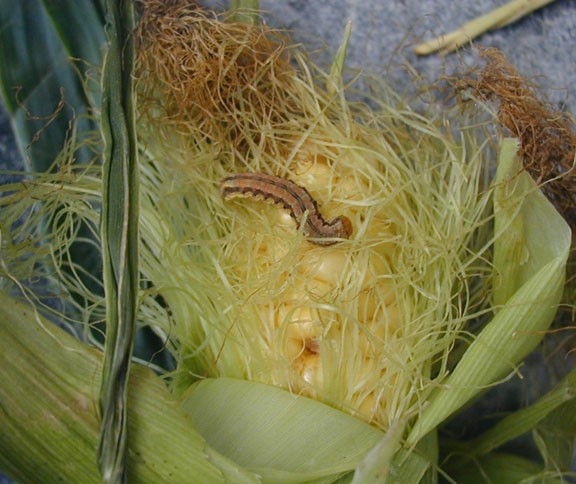
Early sweet has had its challenges this year in Virginia for sure. First the weather. A drought in June was hard on a lot of crops, but definitely corn if you weren’t able to irrigate. Following that up, a series of rainfall events almost every day in some locations for some stretches in July made it hard to spray insecticides on sweet corn in a timely manner. In addition to challenging weather, pest pressure has been unusually high. We are not even out of July yet and corn earworm moth numbers have been higher than usual in central and western Virginia this month in 2024. Moth catch in pheromone traps totaled 192 and 286 moths per trap last week in Montgomery County (western part of the state) and Halifax County (south central Virginia), respectively. That’s pretty high for July. Harvested sweet corn last week from Whitethorne, VA was heavily infested with corn earworms (Fig. 1) and later corn in the whorl stage had higher than usual infestations of fall armyworm (Fig. 2). This pest species usually comes later in the season. This year some early summer storms brought FAW moths from the south to Virginia.

Many sweet corn growers rely on insecticide spray programs to protect their ears from worm infestations. Some corn earworm populations have shown reduced susceptibility to pyrethroid insecticides such as lambda-cyhalothrin, bifenthrin, Hero, Baythroid, Asana XL, etc. Currently the top performing insecticide products with regards to corn earworm control in sweet corn include: Coragen, Coragen Evo, and Vantacor (all contain the same diamide active ingredient). These insecticides are also relatively safe on nontarget organisms like vertebrates, bees, and natural enemies. Beseige and Elevest also include the same diamide active ingredient paired with a pyrethroid. They are very effective, but less safe on beneficial organisms. The spinosyn products Radiant and Blackhawk are also fairly effective as is the old carbamate standby, Lannate LV. This older insecticide has performed well in recent efficacy trials in sweet corn. These are pretty much it when it comes to effective insecticides for sweet corn. All of these insecticides should be used in a rotation with other products. Recent insecticide trials have shown that rotating the aforementioned products with pyrethroids every other spray provides decent control. This may not be the case in areas that are showing high levels of insecticide resistance.

Table 1 shows an action threshold for spray intervals based on trap catches of moths. Our moth catch has been high in late July suggesting a short interval between sprays is probably needed.
| Table 1. Action thresholds and insecticide spray intervals during silking based on pheromone trap catch of CEW moths using the Scentry nylon mesh trap and Hercon Heliocoverpa zea lure. | |||
| Average number of CEW moths captured per trap | Recommended control action or days between sprays | ||
| per day | per 5 days | per week | |
| less than 0.2 | less than 1 | less than 1.4 | spray at green silk then reassess |
| 0.2 – 0.5 | 1 – 2.5 | 1.4 – 3.5 | 6 |
| 0.5 – 1 | 2.5 – 5 | 3.5 – 7 | 5 |
| 1 – 13 | 5 – 65 | 7 – 91 | 4 |
| >13 | >65 | >91 | 3 |