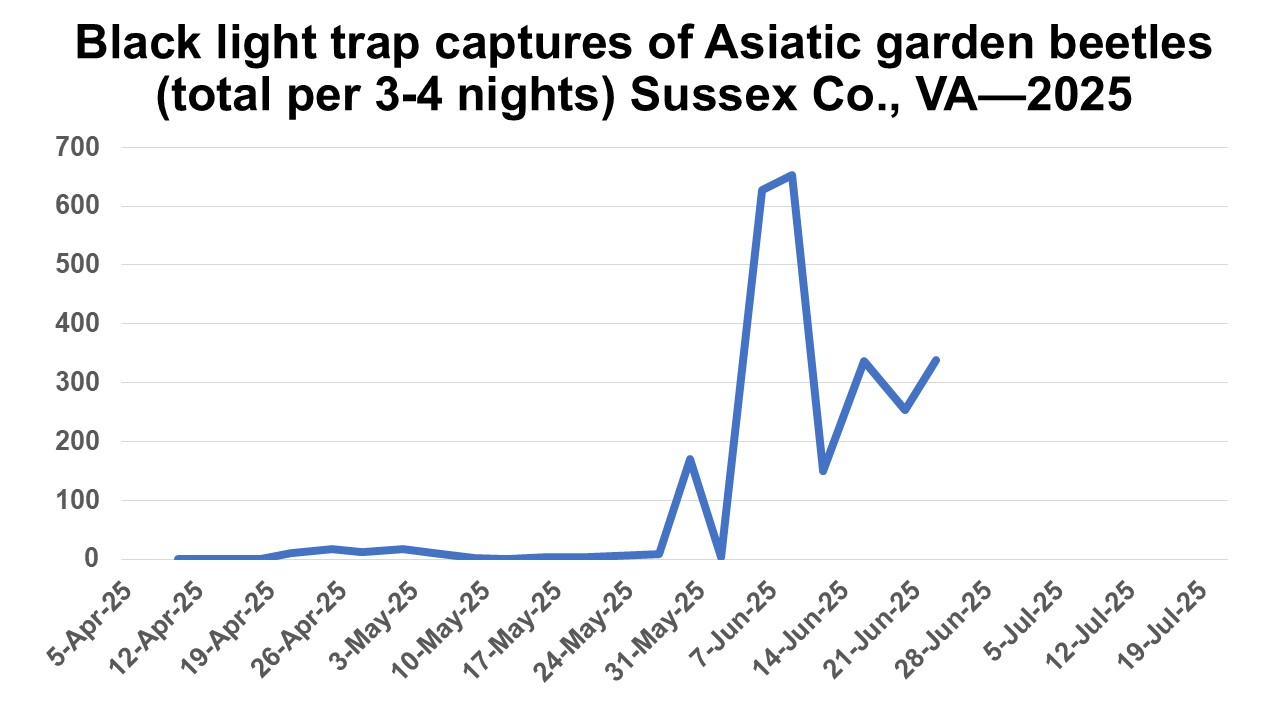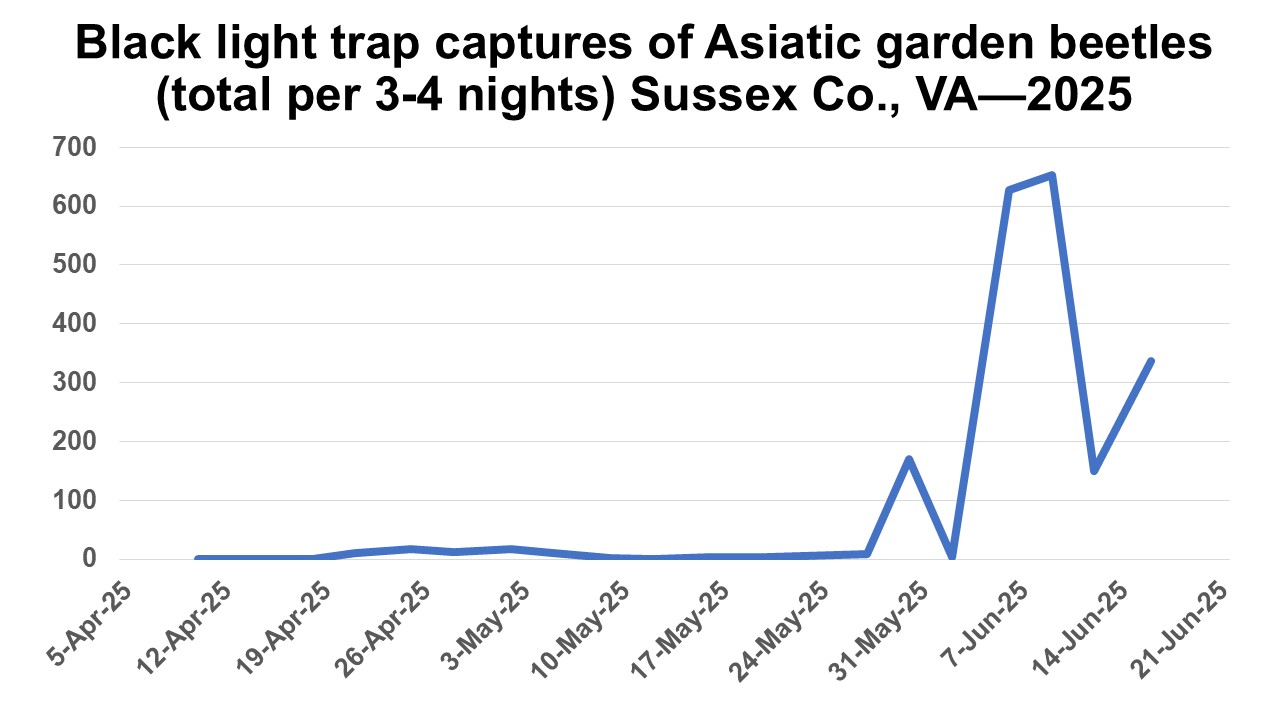
Asiatic garden beetle (AGB) captures in our Sussex, VA black light trap spiked the first week of June, totaling 1,281 adults over a 7-day span. Some severe AGB foliar injury to seedling cotton was reported near Wakefield (image below). We dug up cotton plants and marestail in AGB hotspots, finding adults under each, but we do not have evidence that they feed on cotton roots. For more information, please see our Virginia Cooperative Extension publication, “Asiatic Garden Beetle in Cotton”
With funding support by the Virginia Soybean Board, the Tidewater AREC entomology program (led by Dr. Tim Bryant), along with collaborating Virginia Cooperative Extension Agents and Interns, has expanded our Helicoverpa zea (corn earworm/bollworm) pheromone trap monitoring network. Because corn earworm populations vary across the state, knowledge of local moth flights can better inform growers when to scout fields, use insect thresholds, and make the best management decisions for their crops. Here is the Table Numbers in the table represent variable numbers of days between trap checks (most are 3 or 4 nights).
In Dr. Tom Kuhar’s Advisory from May 28, 2025, he discusses high catches of corn earworm moths in Halifax and Northampton Counties, and in Delaware. We saw high catch numbers from Stafford and Caroline Counties this week. We’ll continue to keep you up to date on corn earworm flights across Virginia and expect many more counties to begin issuing reports.
On Monday, May 26 the Tidewater AREC entomology team collected tobacco thrips from cotton throughout southeastern Virginia. These populations were sent to the University of Tennessee where they were tested in the lab for susceptibility to acephate, spinetoram (Hemi SC or Radiant), and dicrotophos (Bidrin). Across all the sites, the results were very consistent with;
75-79% mortality with acephate 100% mortality with spinetoram 47-50% mortality with dicrotophos
We would classify this as tobacco thrips having reduced susceptibility to acephate in southeastern Virginia. Acephate resistance was also previously confirmed in northeastern North Carolina, just across the state line. This year we have found a high proportion of flower thrips, which are harder to kill with acephate, and now have confirmed that acephate has reduced efficacy for tobacco thrips. If you still plan to make a foliar thrips application, or are making a second application after a previous acephate application, Hemi SC (spinetoram) should be considered for more effective control. See this previous blog post for more details on the importance of timing your foliar application for maximum economic return.
We’d like to thank Sebe Brown at the University of Tennesee and his team for running the lab tests and the Virginia Cotton Board for sponsoring this research.
Authors: Taylore Sydnor (Ph.D. Student), Alejandro Del-Pozo (Assistant Professor) & Thomas Kuhar (Professor) – Department of Entomology, Virginia Tech
Diamondback moth
Diamondback moth (DBM), Plutella xylostella, is an important pest of brassica crops worldwide including Virginia (Fig. 1). Management of this pest is challenging due to its ability to quickly develop resistance to insecticides. Therefore, integrated pest management (IPM) tactics are strongly desired. Mating disruption has been developed for DBM as an alternative to insecticides. Mating disruption involves releasing high rates of the mating pheromone into fields confusing and/or desensitizing male moths so that they cannot find female moths and mate and produce damaging larvae on the crops. The strategy has worked extremely well for tree fruit moth pests, and is currently being researched by our lab in Virginia for DBM.
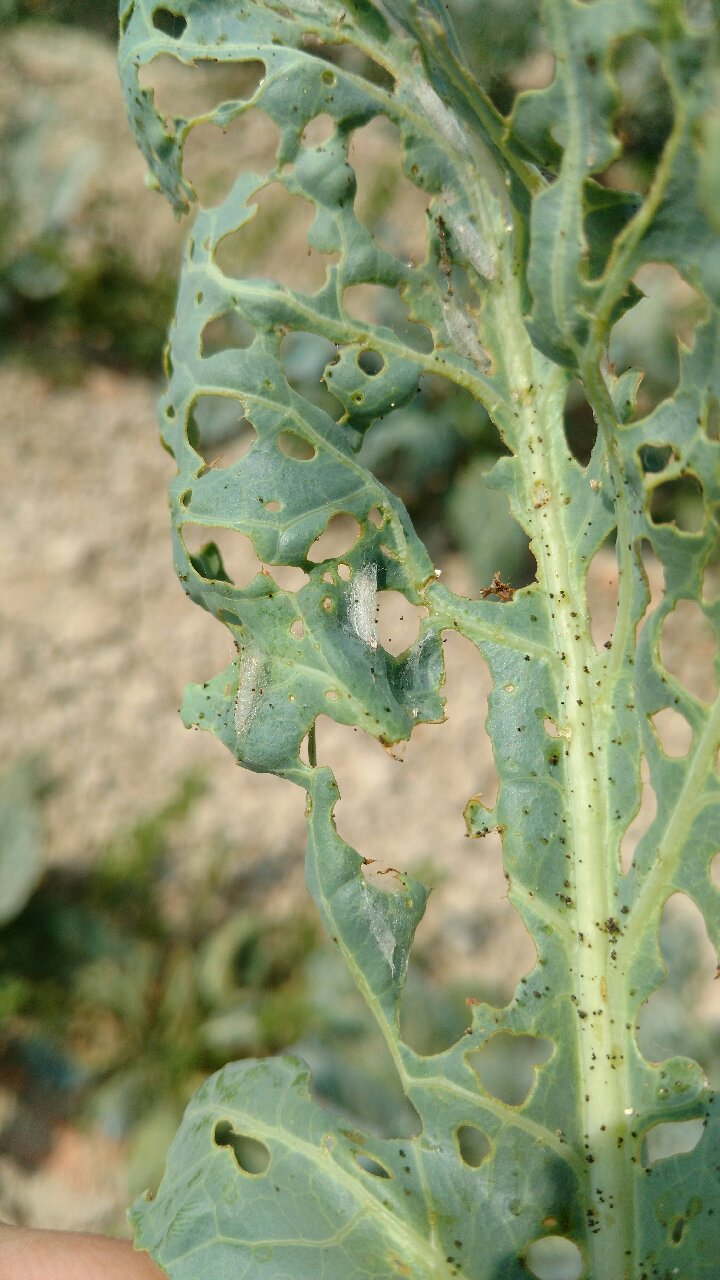
Fig. 1. Diamondback moth larva and leaf feeding damage.
Mating Disruption Trials
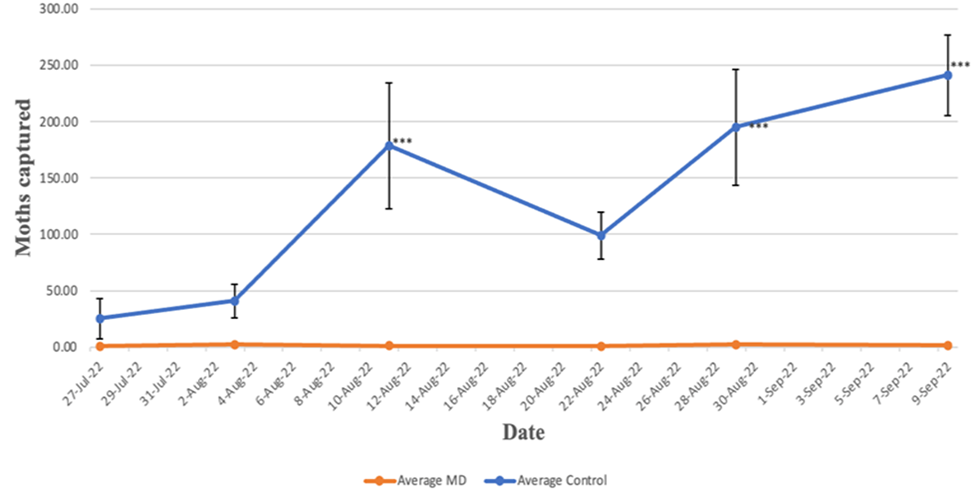
In the past three years we have tested several mating disruption dispensers and other products in commercial cabbage and broccoli fields in Hillsville and Mechanicsville, Virginia. Similar research has been conducted in North Carolina and South Carolina by our entomology colleagues. Virtually all of our trials have resulted in sentinel trap shut down of DBM moth catch in the middles of commercial brassica fields that have had mating disruption pheromones released (via dispensers) as compared with non-mating disruption (control) fields that had significant moth catch in the fields (Fig. 2). When male moths cannot find females, then there will be little to no DBM larval infestations on the crops. The Trécé Incorporated dispensers (Fig. 3) used in the aforementioned research are not commercially available yet.
Fig. 2. Weekly catch of diamondback moths (mean ± SE) in baited sticky traps placed in the centers cabbage fields treated with mating disruption dispensers (n= 6) vs. controlFig. 3. Trécé Incorporated MESO pheromone dispenser in a cabbage field. Photo credit: Taylore Sydnor.
Although we have tested various dispensers, tablets, and sprayable pheromones, with each demonstrating success for reducing DBM, the only commercial DBM mating disruption product currently available to growers is a sprayable pheromone, Checkmate® DBM-F (Fig. 4). The sprayable product has been around for a while, but not heavily used by commercial growers probably because of the plethora of effective lepidopteran insecticides that have hit the market in the past 25 years. However, with DBM populations developing resistance to virtually all of the insecticide classes, mating disruption is now a more attractive option for managing this difficult pest.
Fig. 4. CheckMate DBM-F mating disruption product from Suterra.
In 2024, we tested Checkmate® DBM-F in commercial cabbage in Hillsville, VA (4 treated fields paired with 4 control fields), then later in the fall in 2024 in broccoli in Mechanicsville, VA (1 treated field and 1 control field).
Fields were sampled from July to August. Growers were encouraged to maintain their spray regimens to maintain homogeneity between field plots. All treatment fields in both locations were treated with Checkmate at a rate of 2 fl oz/acre approximately every 30 days. Three pheromone-baited delta sticky traps were placed equidistant in each field plot to monitor the DBM moth activity and were checked weekly. In Hillsville, we found that Checkmate® DBM-F was not significant in reducing DBM populations when compared to the control fields. However, during this trial there was a lot of rain, 5.34” over a two-week span, that likely reduced the efficacy of the sprayable pheromone to last in the field. In fairness, the company does recommend re-applying the product after rain events. See the following blog from Suterra that addresses the different rates and frequencies: https://www.suterra.com/blog/checkmate-dbm-f-flexible-spray-timings-for-diamondback-moth-control
This was not possible given the amount of rain that occurred during that 2-week stretch. We felt a more fair assessment of the product occurred with our test in Mechanicsville, where we found that DBM adult captures were significantly shut down in fields treated with Checkmate® DBM-F when compared to control plots (Fig. 5). Overall, we conclude that Checkmate® DBM-F has the potential to be effective in reducing DBM pest populations when applied at the proper conditions. Growers need to be mindful of rainfall after application.
Fig. 5. Weekly catch of diamondback moths (mean ± SE) in baited sticky traps placed in the center of broccoli fields treated with CheckMate DBM-F vs. control.
Over the past three years, we have tested several types of mating disruption dispensers and products for DBM, and have consistently achieved sentinel trap shut-down (= effective control) of the pest in cabbage and broccoli fields in Virginia. We encourage growers to try this innovative strategy for controlling this very difficult pest. Please feel free to contact us if you are interested in trying mating disruption for DBM in Virginia.
It has been a cool and wet start to the cotton season in southeast Virginia, and growth is slow. With a slow start to the season some folks are considering a second foliar application for thrips management. There are a couple key things to consider…
The first thing to consider for effective thrips management is timing
The most consistent return on investment comes from a foliar application early in the first true leaf stage. An application at the second leaf stage sometimes pays off, which is more likely to be the case with our current growing conditions. If cotton reaches the three or four-leaf stage, foliar applications made for thrips rarely pay off.
The next consideration is what insecticide to chose.
One of the most commonly used products to control thrips with a foliar spray is acephate. There are two thing to consider when using acephate; 1) western flower thrips are not as susceptible to acephate as tobacco thrips, and 2) acephate resistance has been documented in tobacco thrips in northeastern North Carolina, just across the state line from us in southeastern Virginia.
Populations of western flower thrips have been high so far in southeastern Virginia.
In several trials at the Tidewater AREC in Suffolk, we found around 80% western flower thrips in a foliar insecticide trial. Additionally, collections made from grower fields throughout Suffolk and Southampton counties on May 23 averaged 73% western flower thrips. While most fields did have a majority of western flower thrips, it is important to note that it varies between fields even across a relatively small area, and some sampled fields had a larger proportion of tobacco thrips. A table of thrips collections from May 23 can be found below. Each row represents a sample of five cotton plants in a field in Suffolk or Southhampton county.
Field
Tobacco thrips
Western flower thrips
% Western flower thrips
#1
2
6
75%
#2
2
13
86%
#3
1
4
80%
#4
4
23
85%
#5
11
3
21%
#6
1
9
90%
#7
1
8
88%
#8
4
4
50%
In the foliar insecticide test at the TAREC, acephate (at 3 oz/ac) did not provide better control than not treating with these high populations of flower thrips. Hemi SC (spinetoram), provided good thrips control at both the 2.5 and 3 oz rates. Hemi SC is the same active ingredient found in Radiant and is available for use in Virginia and the Carolinas this year for thrips suppression. It is important to mix Hemi SC with a non-ionic surfactant or with an herbicide which already contains a surfactant, to get good thrips control.
If you are using acephate, you should carefully monitor the performance of the application in your field. If you are not satisfied with the performance of an acephate application, the cotton growth stage and the growing conditions at that time should be assessed before considering a second application. If a second application is made, Hemi SC should be considered for more effective control and to rotate the insecticide mode of action. Bidrin should not be used for a second application after acephate, as these two insecticides are the same mode of action.
Both acephate and spinetoram can be washed away by rain up to 8 hours after application (or possibly longer), but acephate is slightly less susceptible to being washed away when comparing the two. However, some protection from a foliar application is better than none under current conditions, which are expected to extend through this weekend.
As a reminder, if you are planting Thryvon cotton, it provides excellent thrips control and does not need a foliar application. If you have any thrips questions contact Tim Bryant (757-621-8804, btim2@vt.edu), field crop entomologist at the TAREC in Suffolk, VA.
Corn earworm is one of the most important pests of agricultural crops in Virginia feeding on corn, cotton, beans, tomatoes, and other crops. Often cold winters lead to high mortality of pupa in the soil and most CEW moths coming from more southern locations. Typically, we don’t see much moth activity and pest pressure until mid-July. But this spring we have seen some unusually high corn earworm moth activity at pheromone traps for this early in the year. Sweet corn grower Mr. Bill Tiver from Halifax Co. (near the North Carolina border) reported >30 moths in one night at his trap on May 26, 2025. Helene Doughty caught 50 moths at a trap in Northampton County this week. Delaware traps also are catching high numbers for late May based on recent correspondence from David Owens. This probably is the result of high overwintering survival of CEW pupa in Virginia or North Carolina soils and pupation already occurring. This could mean the start of a bad year for corn earworm, but so much of this depends on CEW moth flights rolling in from the South on prevailing winds during the summer. We shall see, but it would behoove you to monitor for CEW and keep tabs on this pest if you grow susceptible crops like sweet corn, soybeans, tomatoes, and others.
Corn earworm moths caught in Halifax Co. Virginia May 26, 2025. Photo: Bill Tiver.Corn earworm larva in sweet corn at harvest. From Blacksburg, VA, August 2024.
Douglas S. Higgins, Assistant Professor and Extension Specialist, Virginia Tech Eastern Shore Agriculture Research and Extension Center
In Virginia, wheat is currently at varying growth stages across the state. Many fields are at the boot stage (Feekes 9) or beginning to head (Feekes 10.1 to 10.3), while in some areas and in early-maturing varieties heads are fully emerged (Feekes 10.5).
For those choosing to make a fungicide application, the optimal timing for managing scab is at early flowering (Feekes 10.5.1) and up to seven days afterward (see figure below). Reminder: Do not use products that contain strobilurins (FRAC 11) to manage scab.
Warm, humid, and wet conditions leading up to and during flowering favor infection by the scab-pathogen. As of April 25, 2025, conditions in Virginia are not favorable for disease development in flowering wheat. However, for fields expected to flower in the coming days or weeks, monitor your local weather closely and consult the Fusarium Risk Tool (https://www.wheatscab.psu.edu/) for updates on disease-conducive conditions.
Allium Leafminer (ALM) (Phytomyza gymnostoma), first detected in the U.S. in 2015, has spread through the Northeast, affecting onions, garlic, leeks, chives, and shallots. Detections have been made in VA over the past few years. To date the pest has been detected in the following localities: Frederick, Montgomery, Carroll, Nelson, Northampton, Botetourt, and Bedford counties, plus the City of Lynchburg. If you see oviposition injury, please report it through this form so we can make an accurate map of the pest distribution in VA.
Allium leafminer adult fly. Photo by Grace Stern
Growers should inspect crops for neat rows of small white spots on leaves, indicating feeding and oviposition. Initial infestations often occur on the tips of leaves, with adults visible near leaf tips in cooler conditions. To manage ALM, use floating row covers and apply insecticides as needed. Entrust, works well for organic growers. An integrated pest management (IPM) plan, including monitoring and timely intervention, is essential to reduce ALM’s impact and ensure a successful harvest. For more information, contact your local extension office or visit relevant resources.
Alllium leafminer oviposition marks. Photo by Grace Stern
First, I would like to introduce myself. I am Tim Bryant, the new assistant professor of entomology and extension specialist at the Tidewater AREC, in Suffolk, VA. I did my master’s degree here at the TAREC under Dr. Sally Taylor, and I am excited and grateful for the opportunity to come back and work with the farming community in Virginia. I am also looking forward to continuing to provide updates on this platform as regularly as we have updates to provide. Now, on to a quick update from my first few weeks on the job…
Soybean aphids have been reported in Mecklenburg and Prince George counties (First reports 8/28). Aphids can reproduce asexually, and are capable of rapid population growth under the right conditions, so close monitoring is important. Our threshold for managing soybean aphids is 250 per plant at R4 (full pod) or prior, and 1000+ at R5 (beginning seed) and beyond. The below image shows 300 aphids on a single leaflet as a point of reference (Photo credit: Roger Schmidt, University of Wisconsin-Madison, Bugwood.org). There is likely to be multiple developmental stages of aphids present at one time, and early stages are very small.
There are a couple key considerations for managing aphids; 1) they are highly susceptible to population crashes from natural enemies or weather events, and 2) broad-spectrum insecticide applications (i.e. pyrethroids) may kill aphids, but also the afore-mentioned beneficial insects. Eliminating beneficials can potentially flare up spider mites or other pests later on. If you think you may have an aphid problem, scout several areas of the field to estimate the number of aphids per plant and pay close attention to the number of beneficial insects present. Where we scouted for aphids, there were also large numbers of lady beetle adults and larvae, which are excellent aphid predators. If you reach the aphid threshold, sample again in 5-7 days to ensure the population has not crashed. Narrower spectrum insecticides (e.g. sivanto) may preserve some beneficial insects if an application for aphids is made. See our pest management guide (beginning on page “4-62”) for more details on labeled products, application rates, etc.
The below image shows a lady beetle larvae, which were found in abundance along with the aphids we are reporting on here, feeding on an aphid (Photo credit: Winston Beck, Iowa State University, Bugwood.org).
Corn earworm (=bollworm) moth captures in local black light traps increased this week. The average number per night was 12 in Greensville County, 14 in Prince George/Disputanta, and 70 in Suffolk. Here is the Table. Scouting soybean in these locations indicated that larval numbers are low. Here is the customizable Corn Earworm Larval Threshold Calculator for Soybean. Thanks to Sara Rutherford, Scott Reiter, and the Tidewater AREC entomology crew for their reports.
Stink bugs tend to increase in soybean this time of year. This week in Greensville County we were finding a mixture of brown marmorated, green, and brown stink bugs. The threshold in soybean for grain is 5 stink bugs per 15 sweeps (all stink bug species combined) until the leaves begin to senesce and fall–at which point the threshold numbers are doubled to 10.
Insect pest pressure and beneficials will vary by field. Please be sure to scout your fields and check the Virginia Cooperative Extension thresholds.