Tag Archives: Urgent News

Managing Fusarium Head Blight Risk as Drought Accelerates Wheat Development in Virginia

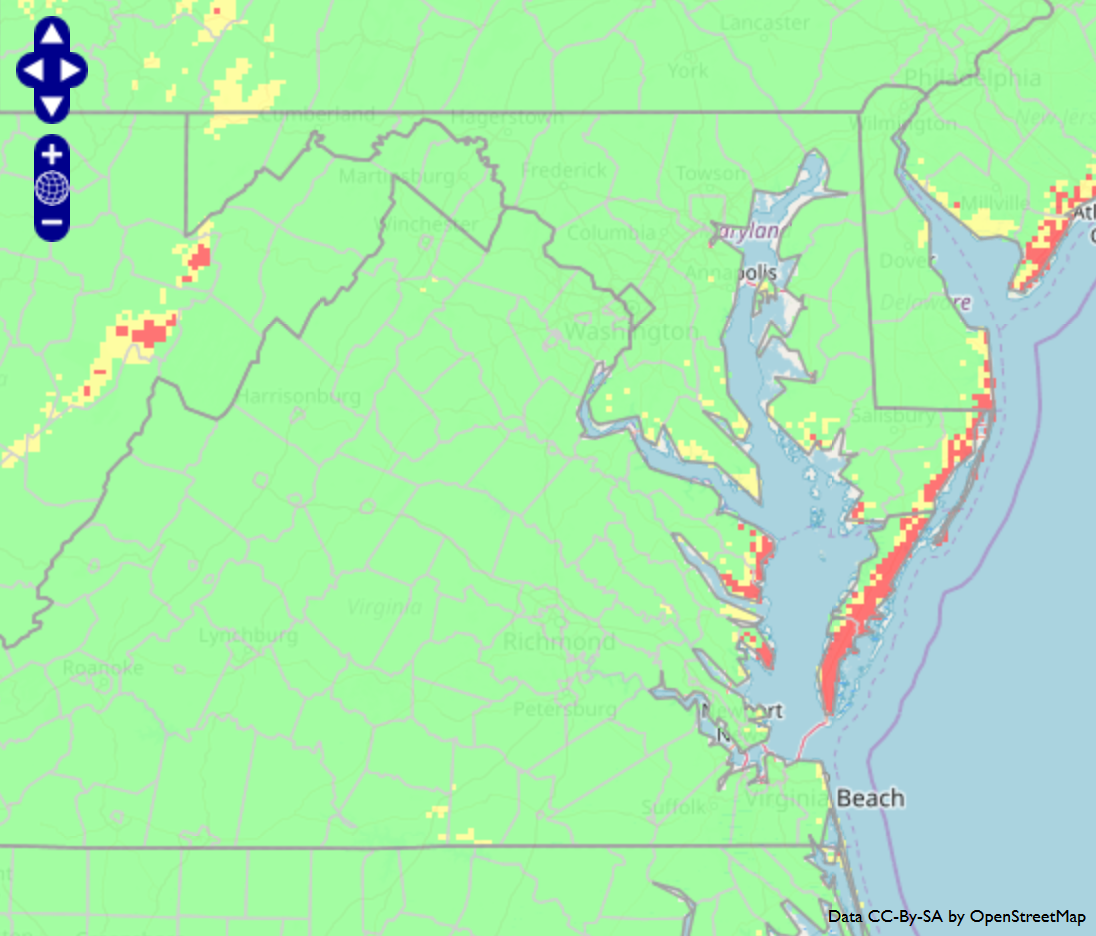
Update: 4/20/2026. Drought conditions remain moderate to severe across much of Virginia. Although a weather system moved through the state on April 19, most major small grain production areas received little rainfall (<0.1 inch). Combined with the warm temperatures observed last week, these dry conditions are accelerating winter wheat development. Much of the wheat in the Northern Neck, Middle Peninsula, and Eastern Shore has headed or is approaching heading, and some fields have started flowering.

As of April 20, 2026, the risk of Fusarium Head Blight is low across most production regions, although pockets of moderate risk remain. Fields planted no-till into corn residue are at greater risk, especially when susceptible varieties were used. Growers with susceptible wheat planted into no-till corn stubble may still benefit from a timely fungicide application.

Because heat and drought can move wheat through growth stages more quickly than expected, scout fields frequently so fungicides can still be applied at the correct stage, Feekes 10.5.1 (beginning flowering).

–Douglas S. Higgins, Plant Pathologist, Virginia Tech Eastern Shore Agriculture Research and Extension Center
Wheat Growth Stages and Scab Management Update – April 25, 2025

Douglas S. Higgins, Assistant Professor and Extension Specialist, Virginia Tech Eastern Shore Agriculture Research and Extension Center

In Virginia, wheat is currently at varying growth stages across the state. Many fields are at the boot stage (Feekes 9) or beginning to head (Feekes 10.1 to 10.3), while in some areas and in early-maturing varieties heads are fully emerged (Feekes 10.5).

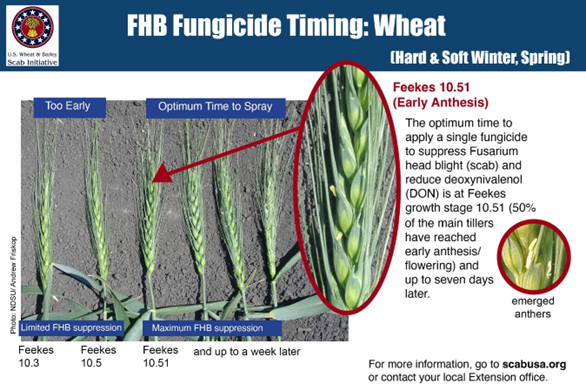
For those choosing to make a fungicide application, the optimal timing for managing scab is at early flowering (Feekes 10.5.1) and up to seven days afterward (see figure below). Reminder: Do not use products that contain strobilurins (FRAC 11) to manage scab.  

Warm, humid, and wet conditions leading up to and during flowering favor infection by the scab-pathogen. As of April 25, 2025, conditions in Virginia are not favorable for disease development in flowering wheat. However, for fields expected to flower in the coming days or weeks, monitor your local weather closely and consult the Fusarium Risk Tool (https://www.wheatscab.psu.edu/) for updates on disease-conducive conditions.


Soybean Fungicide Advisory – August 3, 2019

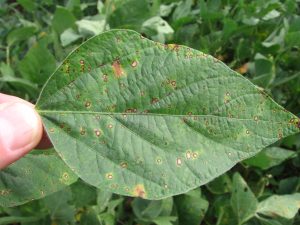
For soybean that is at or near the beginning pod (R3) stage, it is time to consider whether or not a fungicide application is needed to control foliar diseases and protect yield. The Virginia soybean fungicide advisory indicates that disease risk is variable across the state. Fields with moderate risk should be scouted since foliar diseases will not be an issue in every field every year.  Keep in mind that other risk factors also contribute to disease severity and yield loss to fungal diseases. High risk fields include those where susceptible soybean varieties are planted, there is a recent history of soybean foliar diseases, and/or rotations out of soybean are short or soybean is planted continuously over several years. If based on the soybean fungicide advisory or other factors you decide to apply a fungicide, applications are generally the most effective when applied between R3 and R4 stages (no later than R5). The most recent Soybean Fungicide Efficacy Table can be downloaded from the Crop Protection Network website. Instructions on how to use the Virginia soybean fungicide advisory can be found in the July 19 blog post. A summary of disease risk and spray recommendations for different locations in Virginia can be found below.

Region of VirginiaLocation of weather stationSoybean disease riskRecommendation
Eastern ShorePainterHighSpray
SoutheasternSuffolkLow to moderateDon’t spray
SoutheasternVirginia BeachModerateScout
Northern NeckWarsawModerate to highScout
CentralBlackstone LowDon’t spray
NorthernMiddleburgModerate to highScout
NorthernShenandoahModerate to highScout
NorthernWinchesterLow to moderateDon’t spray
WesternCritzHighSpray
WesternBlacksburgModerateScout
WesternGlade SpringHighSpray

For detailed daily advisories, select the location closest to your field and download the corresponding file here:

If you have any questions, feel free to contact Dr. Hillary Mehl (hlmehl@vt.edu).

Wheat Disease Update – May 1, 2019

There is increased risk of Fusarium head blight (FHB) in some parts of Virginia, especially near the Northern Neck and Eastern Shore of Virginia. Wheat in much of the state is flowering, and if a field is in a high risk area a fungicide application is recommended. Recommended fungicides for control of FHB and DON contamination include Caramba, Prosaro, Proline, and Miravis Ace. Do not apply a strobilurin-containing fungicide after the flag leaf stage since this has the potential to increase DON concentrations in the grain. To maximize their effectiveness, fungicides for FHB and DON control should be applied at early flowering or up to one week later. Fungicides that control FHB and DON will also control foliar diseases including powdery mildew, leaf rust, stripe rust, and leaf blotch.

Wheat varieties vary in susceptibility to FHB and DON, and this should be considered when making decisions of whether or not to apply a fungicide at flowering for FHB control. The FHB Risk Tool (http://www.wheatscab.psu.edu/) allows you to select the susceptibility of your wheat variety to determine risk. You can find information on FHB susceptibility of your wheat variety from your seed dealer or in the Virginia Cooperative Extension Small Grains publication. The FHB Risk algorithm adjusts the relative risk based on the variety susceptibility as illustrated below. For assistance with small grains disease identification or for additional management recommendations contact Dr. Hillary Mehl, Extension Plant Pathologist (hlmehl@vt.edu).

FHB risk for susceptible (S) wheat, May 1, 2019.

FHB risk for moderately resistant (MR) wheat, May 1, 2019.

Wheat Disease Update – May 15, 2018

Three-day forecast for Fusarium head blight (FHB) risk on susceptible wheat varieties.

FHB risk is increasing in Virginia and will continue to increase over the next several days. Risk is highest on the Eastern Shore, but susceptible varieties such as Shirley that are flowering over the next week will be at moderate to high risk in many portions of the state. Growers should monitor the FHB risk tool (www.wheatscab.psu.edu) as their wheat crop begins to flower. Consider applying a fungicide if risk is moderate to high, especially on susceptible or moderately susceptible varieties. Wheat that has completed flowering is no longer at risk. Fungicides should be applied at early flowering or up to one week later. Do not apply a strobilurin-containing fungicide since this can increase DON contamination. Recommended fungicides include Prosaro, Caramba, and Proline.

Steve Rideout, Extension Plant Pathologist at the Eastern Shore AREC, confirmed stripe rust on research plots of Shirley on Monday. FHB risk continues to be high on the Eastern Shore, so growers in this part of the state with varieties that are susceptible to stripe rust should consider an application of Prosaro, Caramba, or Proline since these will control both FHB and rust.

Stripe rust on wheat.

For assistance with disease identification or management recommendations, contact Dr. Hillary L. Mehl, Extension Plant Pathologist (hlmehl@vt.edu).


Potato Late Blight in North Carolina

The following advisory is posted on behalf of Dr. Steve Rideout:

Late blight was found on potato in Camden and Pasquotank counties in North Carolina over the weekend. We will be processing the samples to determine more information on race/fungicide sensitivity. In the meantime, growers are encouraged to scout their tomato and potato fields for the disease.  Preventative fungicide applications are recommended, particularly near the outbreak area in NC.

If you have questions please let us know.  You can access current recommended materials for late blight in the commercial and homeowner vegetable production guides.  Also, you can visit the following web page for more information on this disease:

https://www.pubs.ext.vt.edu/content/dam/pubs_ext_vt_edu/ANR/ANR-6/ANR-6_pdf.pdf

This is a serious threat to potato and tomato production in the Commonwealth.  Please let us know if we can help.

Wheat Disease Update – May 2, 2017

Following last week’s rain, the risk for Fusarium head blight (FHB or scab) infections has increased, and the risk is very high even for moderately resistant varieties in certain portions of the state (see FHB Risk Map). Much of the wheat crop is beyond the early flowering stage, but for fields where wheat is currently flowering a fungicide may be needed to protect the crop from FHB infection and DON contamination. Recommended fungicides include Caramba, Prosaro, and Proline. Fungicides are most effective when applied at the start of flowering and up to a week later. The greatest coverage of the heads can be achieved by applying fungicides in 5 gal/A by air and 15 gal/A by ground with a 300-350 um droplet size and nozzles angled forward at least 30 degrees.

FHB risk on May 2, 2017 for moderately resistant wheat varieties. Susceptible wheat varieties that are currently flowering are at high risk for FHB infection throughout Virginia.